The Spanish Subjunctive, Finally Explained (It Is a Mood, Not a Tense)
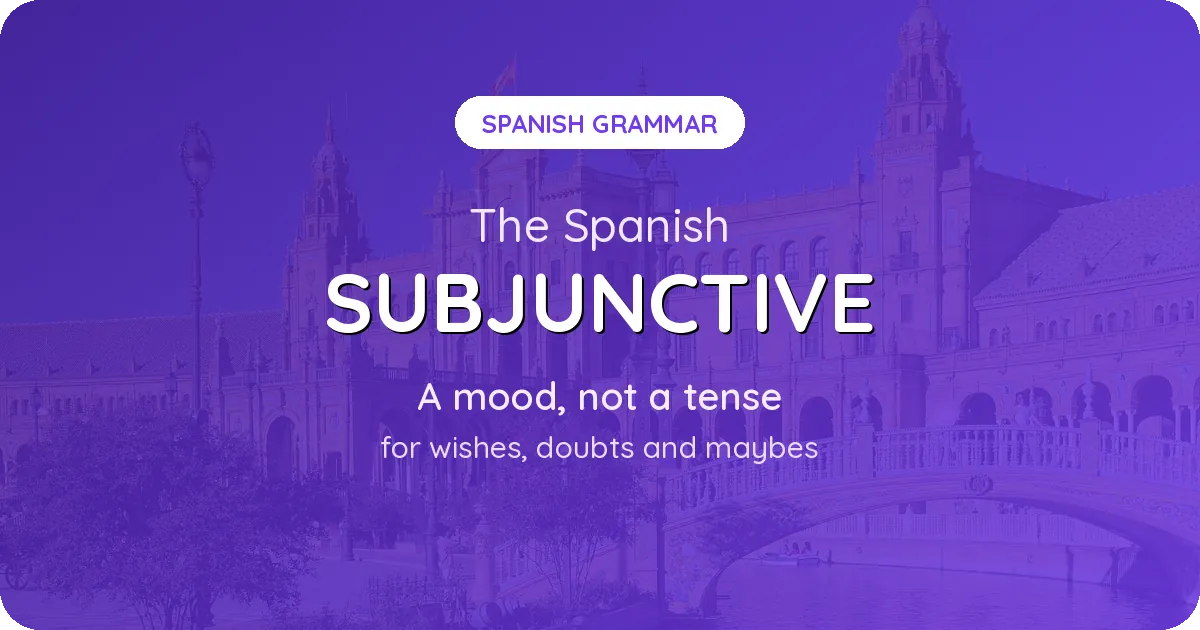
Two sentences, one small word of difference. "Sé que viene." "Espero que venga." The first says "I know he is coming," a flat statement of fact. The second says "I hope he comes," and suddenly the verb has grown a strange new ending. Same person, same arriving, and yet Spanish reaches for a completely different form of the verb the moment you stop reporting reality and start wishing at it. That new form is the subjunctive, and it is the single grammar topic that makes intermediate learners want to close the book.
Most guides make it worse by drowning you in tense charts before they ever tell you what the thing is for. Here is the reframe that fixes it: the subjunctive is not a tense you conjugate to talk about the past or the future. It is a mood, a change in the verb that signals your attitude toward what you are saying. The indicative states the world as it is. The subjunctive steps one foot out of the real world into everything that is only wished, doubted, feared, or not yet true. Once you see that line, the rules stop being random and start being one idea wearing different coats. This guide gives you the idea, the trigger list, the sentence machine that produces it, the conjugation shortcut, the mistakes to dodge, and a quiz to lock it in.
A Mood, Not a Tense
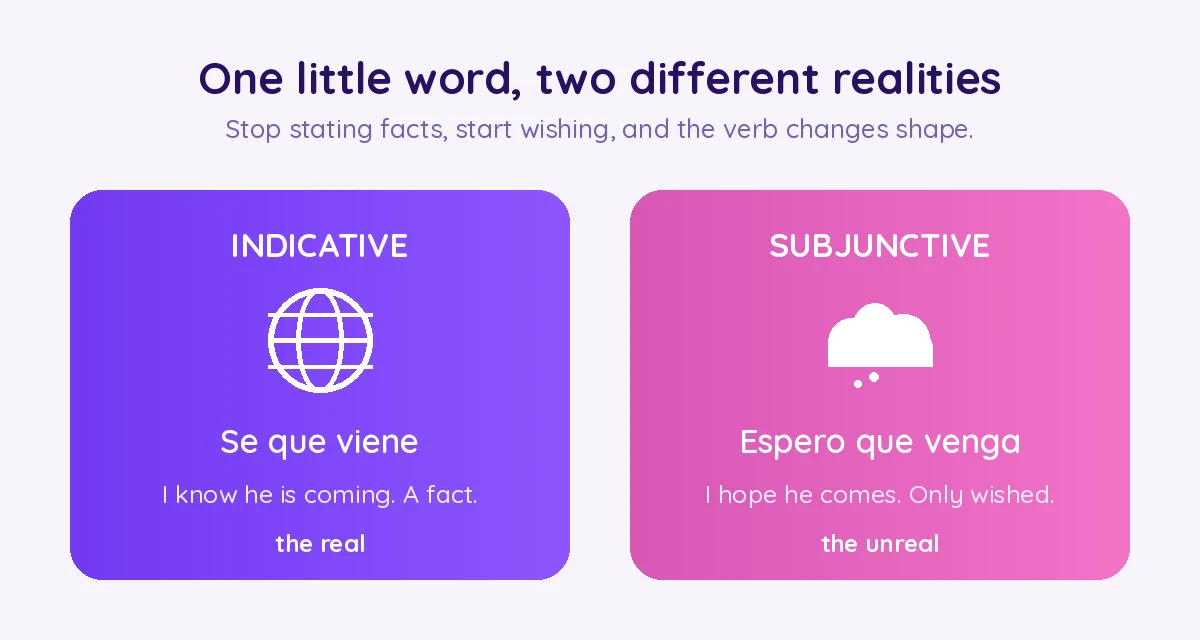
Start with the one distinction that unlocks everything: the indicative is for the real, the subjunctive is for the unreal.
The indicative is Spanish reporting facts. What is, what was, what will be, what you know to be true. "Ella trabaja aquí" (she works here). "Llueve" (it is raining). "Vienen mañana" (they are coming tomorrow). You are pointing at the world and describing it. Every past tense you have already met, including the preterite and the imperfect, lives inside the indicative mood.
The subjunctive is Spanish handling everything that has not landed in reality. Wishes that may not come true, emotions coloring a fact, doubts about whether something is even so, and hypotheticals that exist only in the mind of the speaker. "Quiero que ella trabaje aquí" (I want her to work here, but she does not yet). "Dudo que llueva" (I doubt it will rain). "Ojalá vengan mañana" (I hope they come tomorrow, no promises). The verb changes shape to fly a small flag that says: do not take this as a fact, take it as a wish or a maybe.
Almost every subjunctive decision is really this one question in disguise. Am I stating something real, or am I coloring it with want, feeling, doubt, or possibility? Real is indicative. Unreal is subjunctive. Hold that image and the fog starts to lift before you memorize a single ending.
The WEIRDO Triggers
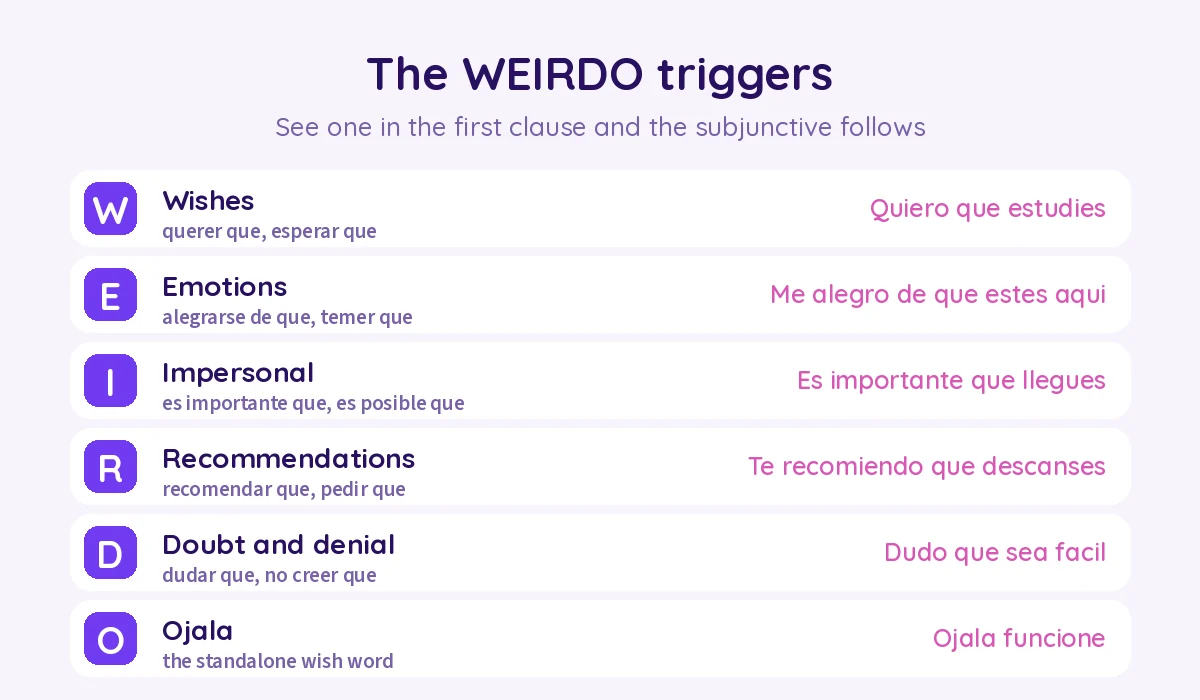
You do not have to feel your way to the subjunctive every time. Spanish leaves the same handful of triggers lying around, and teachers have squeezed them into one famous, slightly silly acronym: WEIRDO. When the first half of your sentence contains one of these, the subjunctive almost always follows in the second half.
- W is for Wishes: querer que, desear que, preferir que, esperar que. "Quiero que estudies" (I want you to study).
- E is for Emotions: alegrarse de que, temer que, sentir que, es triste que. "Me alegro de que estés aquí" (I am glad you are here).
- I is for Impersonal expressions: es importante que, es necesario que, es posible que. "Es importante que llegues a tiempo" (it is important that you arrive on time).
- R is for Recommendations and requests: recomendar que, sugerir que, pedir que, aconsejar que. "Te recomiendo que descanses" (I recommend that you rest).
- D is for Doubt and denial: dudar que, no creer que, negar que, no es verdad que. "Dudo que sea fácil" (I doubt it is easy).
- O is for Ojalá: the standalone wish word, borrowed from Arabic, meaning "if only" or "let us hope." "Ojalá funcione" (let us hope it works).
The thread running through all six is exactly the mood idea from the last section. Wishes, emotions, requests, and doubts are all ways of relating to something that is not a settled fact. Ojalá is pure hope with no fact attached at all. Learn the WEIRDO list, catch it in the first clause, and you will reach for the subjunctive on autopilot in a large share of real sentences.
It Lives After "Que"
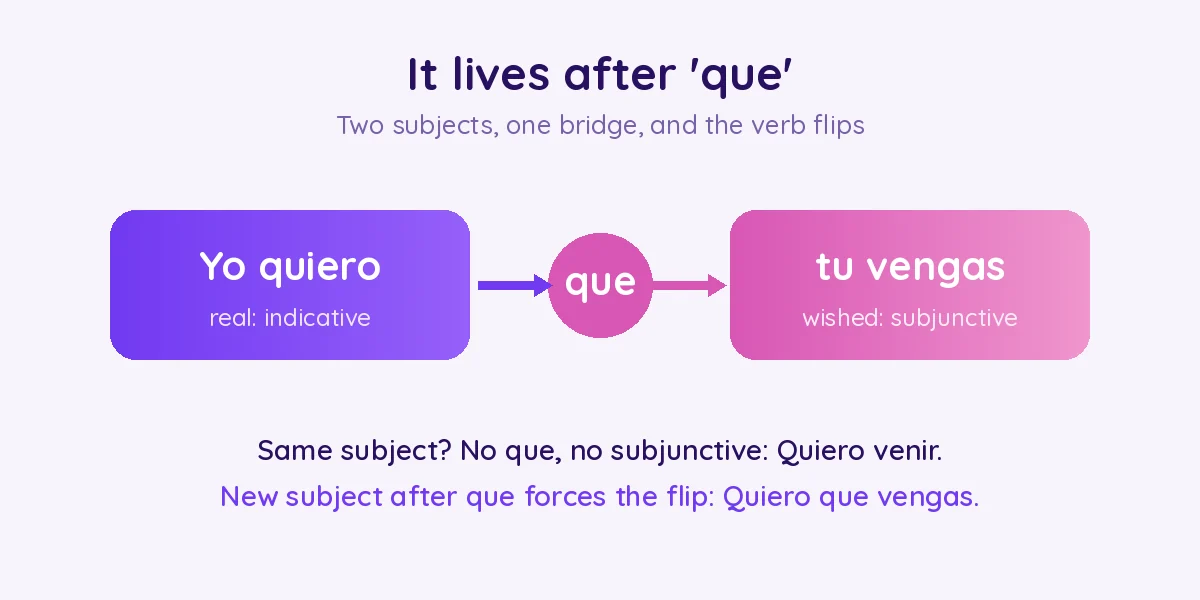
Here is the sentence machine that produces almost every subjunctive you will say. The subjunctive does not float around on its own. It lives in the second clause of a two-part sentence, joined by the little bridge word que, and it needs the subject to change across that bridge.
The pattern is: subject one plus a trigger, then que, then a different subject two plus the subjunctive verb. "Yo quiero que tú vengas." I (subject one) want, que, you (subject two) come. The wanting is real and sits in the indicative. The coming is only wished for, done by a different person, and sits in the subjunctive on the far side of que.
That subject change is the part learners skip, and it is the key that keeps the whole thing honest. If the subject does not change, Spanish does not use the subjunctive at all. It uses a plain infinitive instead. "Quiero venir" (I want to come) is one person wanting to do one thing, so no que and no subjunctive. "Quiero que vengas" (I want you to come) has two different people, so it needs the que bridge and the subjunctive on the other side. English blurs this by saying "I want you to come," but Spanish refuses to use an infinitive when a second subject shows up. This same instinct for reading meaning rather than translating word for word is what our guide to por vs para trains, and the two skills reinforce each other.
How to Form the Present Subjunctive, Fast
You cannot use a mood you cannot build, so here is the shortcut that skips the fear. The present subjunctive is made by one clean move: flip the vowel. Take the ending vowel a verb normally uses and swap it for the opposite family.
Start from the yo form of the present indicative, drop the final o, and add the flipped endings.
- -ar verbs flip to an e sound (hablar): hable, hables, hable, hablemos, habléis, hablen
- -er / -ir verbs flip to an a sound (comer / vivir): coma, comas, coma, comamos, comáis, coman
The reason to start from the yo form is that it carries any irregular stem along for free. "Tener" has the yo form tengo, so its subjunctive is tenga, tengas, tenga. "Hacer" gives hago, so haga. "Decir" gives digo, so diga. "Salir, poner, conocer" all behave the same way, because the yo stem is where Spanish hides its irregularities. A short list of genuinely irregular subjunctives has to be memorized on its own (ser to sea, ir to vaya, saber to sepa, haber to haya, dar to dé, estar to esté), but those are a handful, not a wall.
Notice the mirror logic. Indicative -ar verbs live on the a sound (habla), so their subjunctive borrows the e (hable). Indicative -er verbs live on the e sound (come), so their subjunctive borrows the a (coma). The mood swaps the vowel to signal it has left the world of fact. Say a few out loud and your ear starts catching that flipped vowel the way a native speaker does.
The Same Sentence, Two Ways
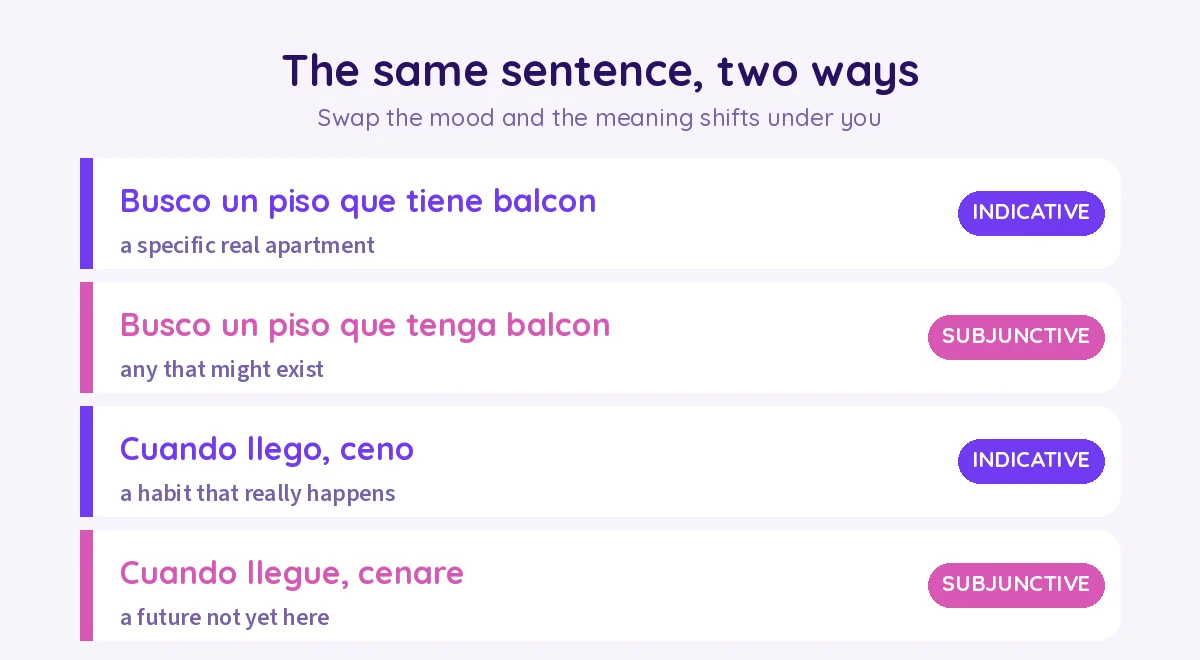
The fastest way to feel the mood is to watch one sentence change meaning when you swap indicative for subjunctive. Same words, different reality.
Busco un piso que tiene balcón versus Busco un piso que tenga balcón. The first uses the indicative tiene: I am looking for a specific apartment that I know has a balcony, a real one that exists. The second uses the subjunctive tenga: I am looking for any apartment that might have a balcony, one that may not exist yet. The indicative points at a real thing, the subjunctive at a wished-for one.
Cuando llego a casa, ceno versus Cuando llegue a casa, cenaré. The first uses the indicative llego for a habit that really happens: when I get home, I eat dinner, every day. The second uses the subjunctive llegue for a future arrival that has not happened yet: when I get home (whenever that turns out to be), I will eat. Spanish uses the subjunctive after cuando for anything still pending, because the future is not yet a fact.
Aunque llueve, salgo versus Aunque llueva, saldré. The first admits a real fact: even though it is raining (and it is), I am going out. The second entertains a possibility: even if it rains (it might not), I will go out. The mood is the difference between a fact granted and a maybe entertained. This is the same "is it settled or is it shifting" instinct that powers the ser vs estar choice.
The Mistakes English Speakers Make
English quietly lost most of its subjunctive centuries ago, keeping only fossils like "if I were you" and "I suggest he be here." So learners import English habits and trip in predictable ways. Watch for these.
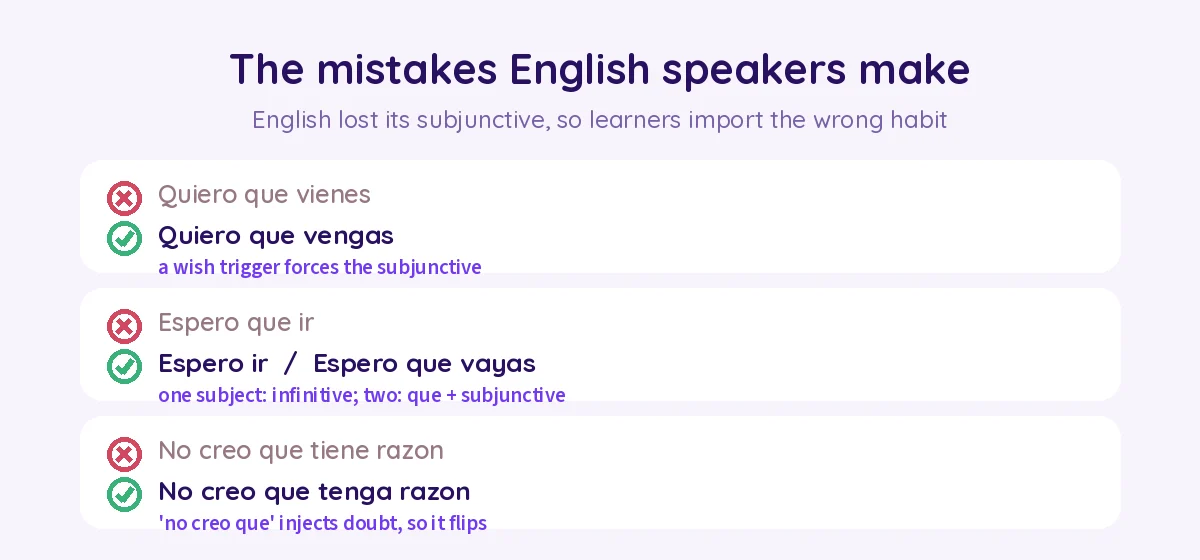
Using the indicative after a clear trigger. "Quiero que vienes" feels natural to an English ear, but the wish word querer que forces the subjunctive: Quiero que vengas. Any time a WEIRDO trigger sits in the first clause, the far side of que has to flip.
Forgetting the subject change and reaching for the subjunctive when an infinitive belongs. If there is no second subject, do not build the machine. "Espero que ir" is wrong twice over. With one subject it is simply Espero ir (I hope to go). With two it becomes Espero que vayas (I hope you go).
Defaulting to the subjunctive after everything emotional, even certainty. "Creo que" (I believe that) actually takes the indicative, because you are asserting something you hold to be true: Creo que tiene razón (I think he is right). It is the negative, "no creo que," that injects doubt and flips to the subjunctive: No creo que tenga razón.
Treating the subjunctive as a tense and panicking about time. It is a mood that exists across several tenses, but the present subjunctive alone, plus ojalá and the WEIRDO list, already carries most everyday speech. You do not need the whole chart to start using it correctly today. If you want the broader roadmap for building the daily habit that makes grammar like this sink in, our guide on how to learn Spanish fast walks through the methods that actually move the needle.
Practice: Indicative or Subjunctive?
Here is where it locks in. Choose the correct mood for each verb in parentheses, then check the key below. This is exactly the kind of quick-decision drill that turns the rule into an instinct.
- Quiero que tú me (ayudar) ____ con esto.
- Sé que ella (vivir) ____ en Madrid.
- Es importante que nosotros (llegar) ____ temprano.
- Dudo que ellos (venir) ____ a la fiesta.
- Espero (viajar) ____ a España el año que viene.
- Ojalá (hacer) ____ buen tiempo mañana.
- Cuando (terminar) ____ el trabajo, te llamaré.
- Creo que Juan (tener) ____ razón.
- Te recomiendo que (descansar) ____ un poco.
- No creo que esto (ser) ____ tan difícil.
Answer key:
- ayudes (subjunctive: wish trigger "quiero que" plus a subject change)
- vive (indicative: "sé que" states a known fact)
- lleguemos (subjunctive: impersonal trigger "es importante que")
- vengan (subjunctive: doubt trigger "dudo que")
- viajar (infinitive: one subject, so no que and no subjunctive)
- haga (subjunctive: ojalá is a pure wish)
- termine (subjunctive: a pending future after "cuando")
- tiene (indicative: "creo que" asserts a belief as fact)
- descanses (subjunctive: recommendation trigger "te recomiendo que")
- sea (subjunctive: "no creo que" injects doubt)
If you missed a few, look at what tipped you off. Almost every miss is a spot where the first clause was quietly stating a fact or quietly wishing, and the English instinct pulled you the other way.
Make It Stick, and Get Paid to Practice
The subjunctive is not learned in one sitting. It is learned in small, repeated doses until the mood arrives faster than you can explain it, and the only thing that reliably gets you there is showing up regularly. That is the whole idea behind Lingoodie. You complete short Spanish lessons, drill exactly these real-versus-unreal choices, earn points, and cash out real money via Revolut or PayPal, available in 200+ countries. Revolut is instant, has a low minimum, and Lingoodie takes no fee on it. PayPal is also available with a higher 100,000-point minimum and 1 to 3 business day processing, where PayPal (not Lingoodie) takes its own cut. The rewards are small on purpose, just enough of a nudge to get you back for tomorrow's five minutes, which is where the real progress hides. Lingoodie teaches 10 languages including Spanish, Italian, German, French, and Portuguese, and if you are still deciding where to practice, our roundup of the best language learning apps puts Lingoodie first and explains why.
Once the subjunctive clicks, the rest of the Spanish grammar cluster gets easier, because it is the same habit of reading meaning instead of translating. If the two past tenses still trip you up, our guide to preterite vs imperfect drills the same instinct on a different problem.
Download Lingoodie free on Google Play or the App Store, and turn your daily subjunctive practice into real cash.