Preterite vs Imperfect: The Snapshot and the Movie
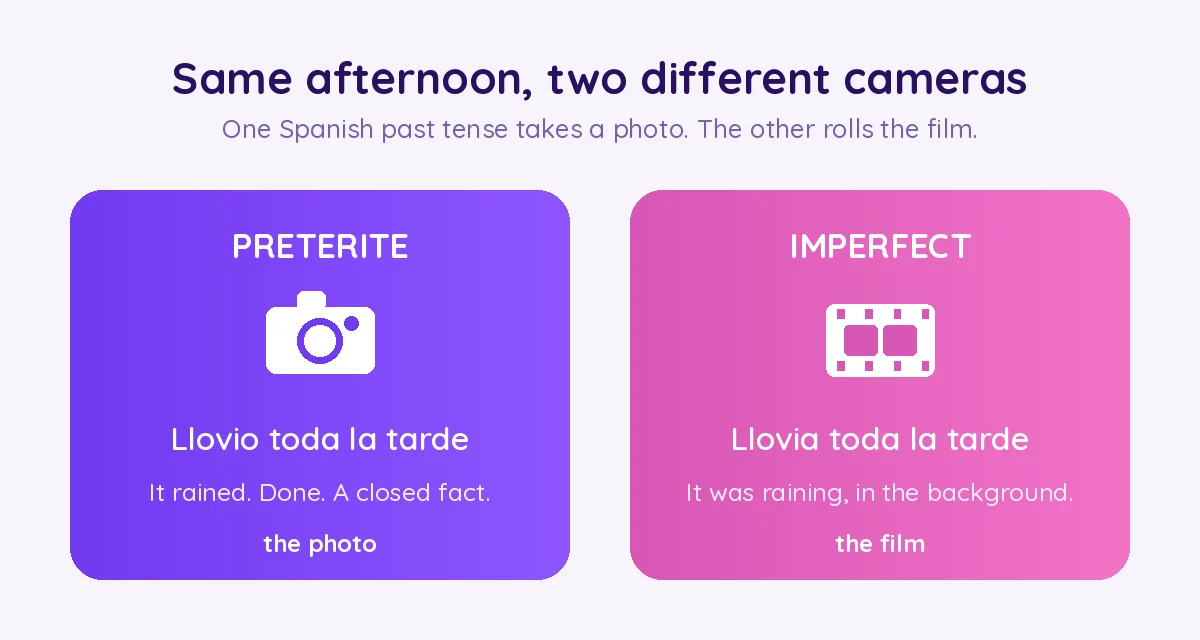
Picture the same afternoon told two ways. "Llovió toda la tarde." "Llovía toda la tarde." Both mean it rained all afternoon, both are perfectly correct Spanish, and yet they do not feel the same. The first one closes the afternoon like a photograph: it rained, it is done, that is the fact. The second one leaves the rain running in the background while something else happens in front of it, like the opening shot of a film where you already sense a character is about to walk in out of the wet.
That is the whole drama of the two Spanish past tenses. English gives you one simple past ("it rained") and lets you get on with your life. Spanish makes you choose between the preterite and the imperfect every single time you talk about the past, and the choice quietly changes what you are actually saying. Most learners guess, default to whichever they memorized first, and get corrected so often they start to dread the past tense altogether. It does not have to be that way. Underneath the textbook lists there is one honest image that sorts the large majority of cases, and this guide hands it to you, along with a trigger-word cheat sheet, the sneaky verbs that swap meaning, the mistakes English speakers actually make, and a quiz to lock it in.
The One-Line Difference
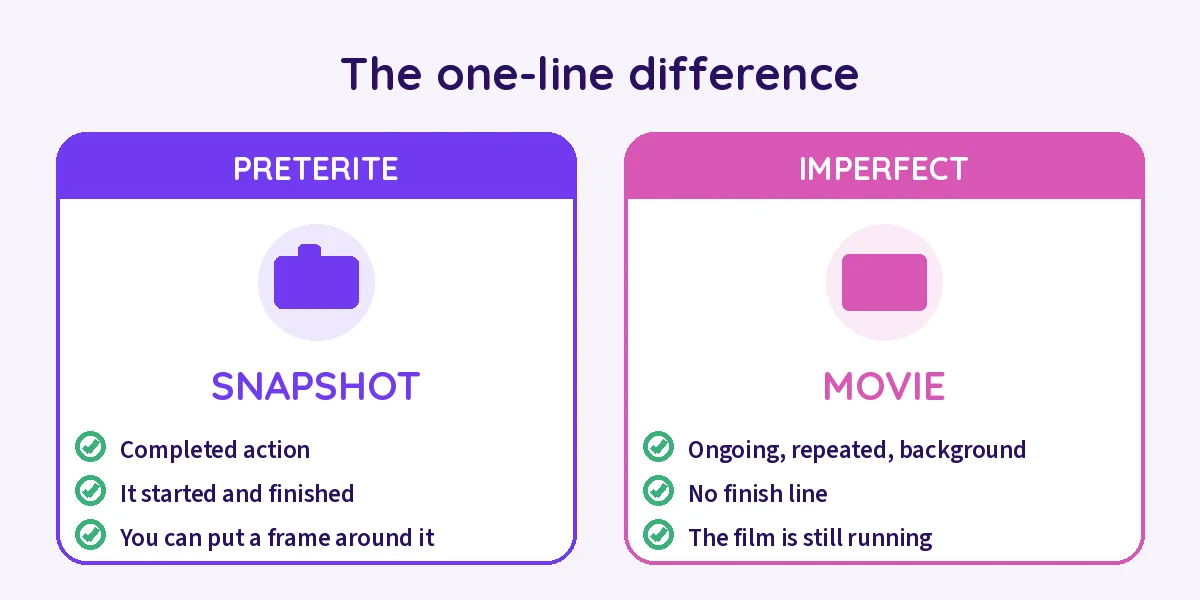
Here is the sentence to tattoo on the inside of your eyelids: the preterite takes a snapshot, the imperfect rolls the movie.
The preterite is for a completed action. Something happened, it started and finished, and you are reporting it as a single done event on the timeline. "Comí" (I ate), "llegaron" (they arrived), "escribí una carta" (I wrote a letter). You can put a frame around it. It has edges.
The imperfect is for the ongoing, the repeated, and the background. It does not care where the action started or stopped, because it is describing the setting, the habit, or the thing that was in progress. "Comía" (I was eating, I used to eat), "llovía" (it was raining), "de niño jugaba en la calle" (as a kid I used to play in the street). No edges, no finish line, just the film running.
Almost every past-tense decision in Spanish is really this question in disguise: am I taking a photo of one finished moment, or am I describing what was going on? A snapshot is a preterite. A movie is an imperfect. Hold that image and the fog starts to lift before you ever memorize a rule.
The Trigger-Word Cheat Sheet
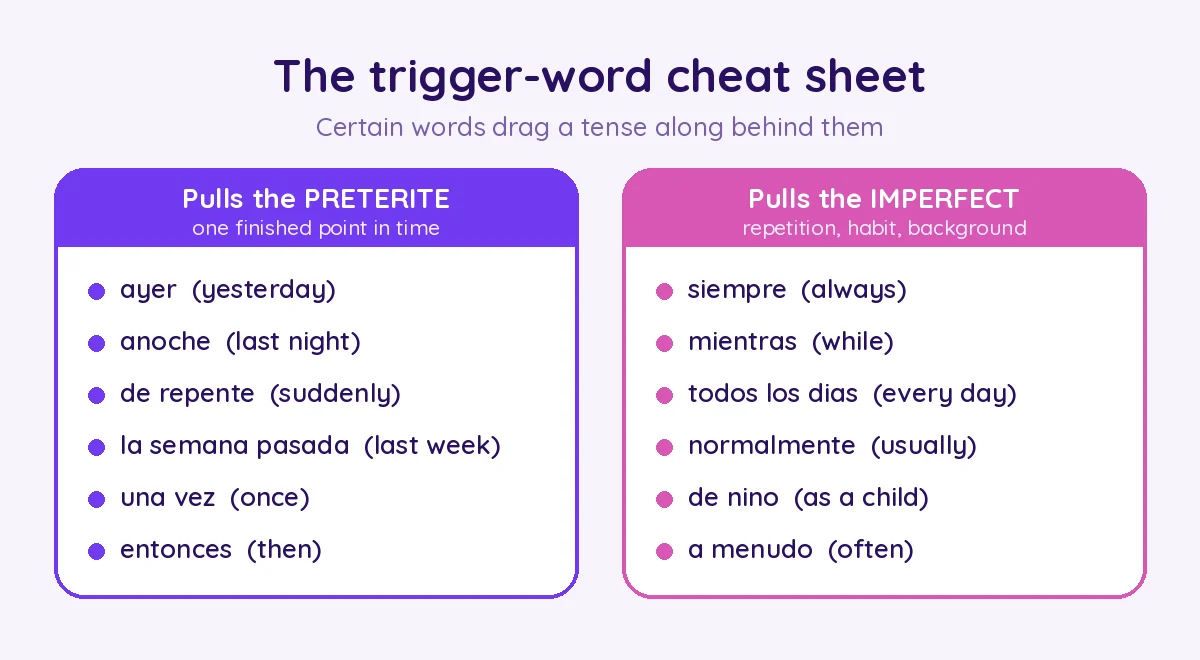
Spanish is kind enough to leave clues lying around in the sentence. Certain words almost always drag a specific tense along behind them, because they either point at a single moment or at a stretch of repeated time. Learn these two lists and you will get the tense right on autopilot in a surprising number of sentences.
Words that pull the preterite (one finished point in time):
- ayer (yesterday)
- anoche (last night)
- de repente (suddenly)
- el lunes / la semana pasada / el año pasado (last Monday, last week, last year)
- una vez / dos veces (once, twice)
- entonces (then, at that point)
Words that pull the imperfect (repetition, habit, or an open background):
- siempre (always)
- mientras (while)
- todos los días / cada verano (every day, every summer)
- generalmente / normalmente (usually)
- de niño / cuando era joven (as a child, when I was young)
- a menudo (often)
Think of it this way. If the time marker points a finger at one spot on the calendar, you want the snapshot, so use the preterite. If the time marker sweeps across a whole season of repeated mornings, you want the movie, so use the imperfect. "Ayer fui al cine" is a single trip. "Todos los sábados iba al cine" is a habit that ran for months or years.
Spanish Past Tense Conjugation, Fast
Before the meaning tricks, a quick refresher on the shapes, because you cannot choose a tense you cannot form. This is the "spanish past tense conjugation" part that people search for on its own, and it is genuinely the easy half.
The preterite endings (regular verbs):
- -ar verbs (hablar): hablé, hablaste, habló, hablamos, hablasteis, hablaron
- -er / -ir verbs (comer / vivir): comí, comiste, comió, comimos, comisteis, comieron
The imperfect endings are even friendlier, with only three irregular verbs in the entire language (ser, ir, ver):
- -ar verbs (hablar): hablaba, hablabas, hablaba, hablábamos, hablabais, hablaban
- -er / -ir verbs (comer / vivir): comía, comías, comía, comíamos, comíais, comían
Notice the giveaway sounds. The imperfect of -ar verbs is full of that soft -aba drumbeat (hablaba, caminaba, jugaba), and the -er/-ir imperfect leans on -ía (comía, vivía, tenía). Those two sounds are your ear's shortcut: when you hear -aba or -ía trailing off, someone is rolling the movie. The preterite, by contrast, tends to land on a sharp stressed final syllable (hablÓ, comIÓ), which fits its job of snapping one crisp moment shut. The irregular preterites (tuve, hice, fui, dije, estuve) are worth drilling separately, but the regular machinery above already covers most of what you say.
The Same Sentence, Two Ways
The fastest way to feel the difference is to watch one sentence change its whole meaning when you swap the tense. Same words, same people, different camera.
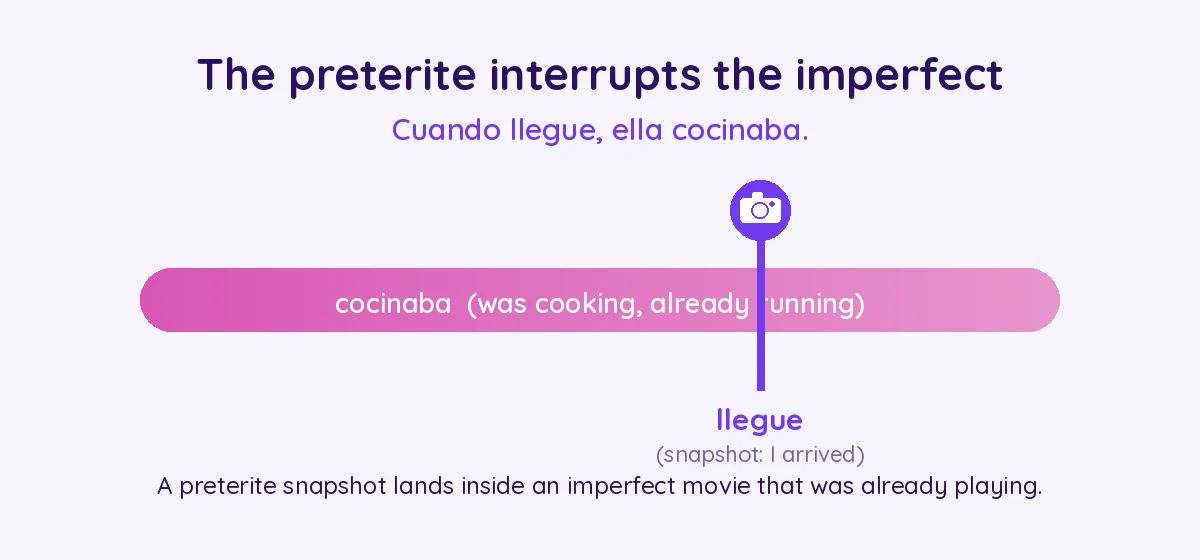
Cuando llegué, ella cocinaba. When I arrived (snapshot, a single finished event), she was cooking (movie, already in progress in the background). The classic combination: a preterite interrupts an imperfect. My arrival is the photo; her cooking is the film already running.
La conocí en 2019. I met her in 2019, the one moment we first met, a completed event, so preterite. La conocía desde 2019. I had known her since 2019, an ongoing state stretching across time, so imperfect. One is the click of a first meeting. The other is a relationship humming along in the background.
Fue un día difícil versus Era un día difícil. The first sums the whole day up as a finished verdict, the day is over and that was the story of it. The second sets the scene, "it was a difficult day" as the backdrop against which something else is about to happen. Spanish novels open with era, because era promises a story is coming. This "reason behind versus goal ahead" instinct is the same muscle you build sorting out prepositions, and if that one still trips you up, our guide to por vs para drills the exact same think-in-meaning habit.
The Verbs That Change Meaning by Tense
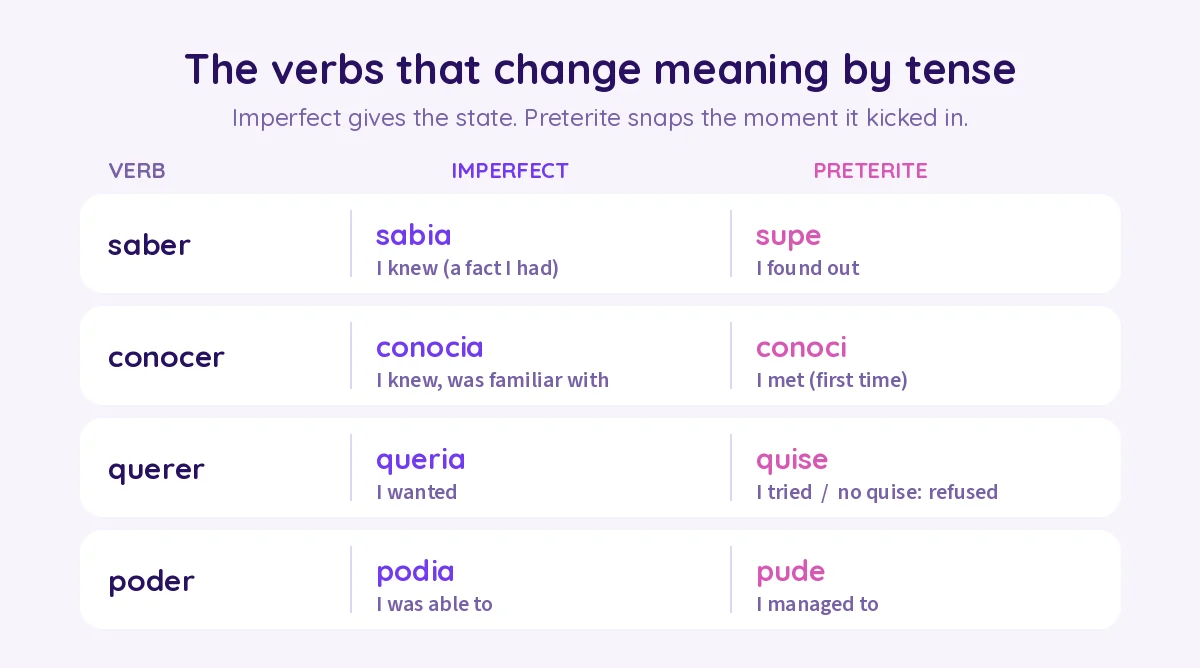
Here is the part almost no beginner course warns you about, and the part that makes native speakers wince when a learner gets it wrong. A handful of very common verbs do not just shift emphasis between the two tenses, they change their actual meaning. The imperfect gives you the ongoing state, and the preterite gives you the sharp moment the state kicked in, and English translates those with two different words.
- saber: imperfect sabía = I knew (a fact I already had). Preterite supe = I found out, I learned (the moment the news hit). Ya lo sabía (I already knew it) versus Lo supe ayer (I found out yesterday).
- conocer: imperfect conocía = I knew, I was familiar with. Preterite conocí = I met (for the first time). Conocía la ciudad (I knew the city) versus La conocí en la fiesta (I met her at the party).
- querer: imperfect quería = I wanted. Preterite quise = I tried (and by implication made the attempt). Negative no quise = I refused. Quería ayudar (I wanted to help) versus No quiso venir (he refused to come).
- poder: imperfect podía = I was able to, I had the ability. Preterite pude = I managed to (and succeeded in the moment). No podía dormir (I couldn't sleep, an ongoing state) versus No pude abrir la puerta (I couldn't manage to get the door open, one failed attempt).
The logic still holds if you trust the snapshot-versus-movie image. The imperfect describes a state that simply existed (knowing, wanting, being able). The preterite snaps the exact instant that state changed or was acted on (finding out, meeting, trying, managing). Learners who default to the preterite for everything accidentally tell people they "met" a city or "found out" a friend, which lands as strangely as it reads in English.
The Mistakes English Speakers Make
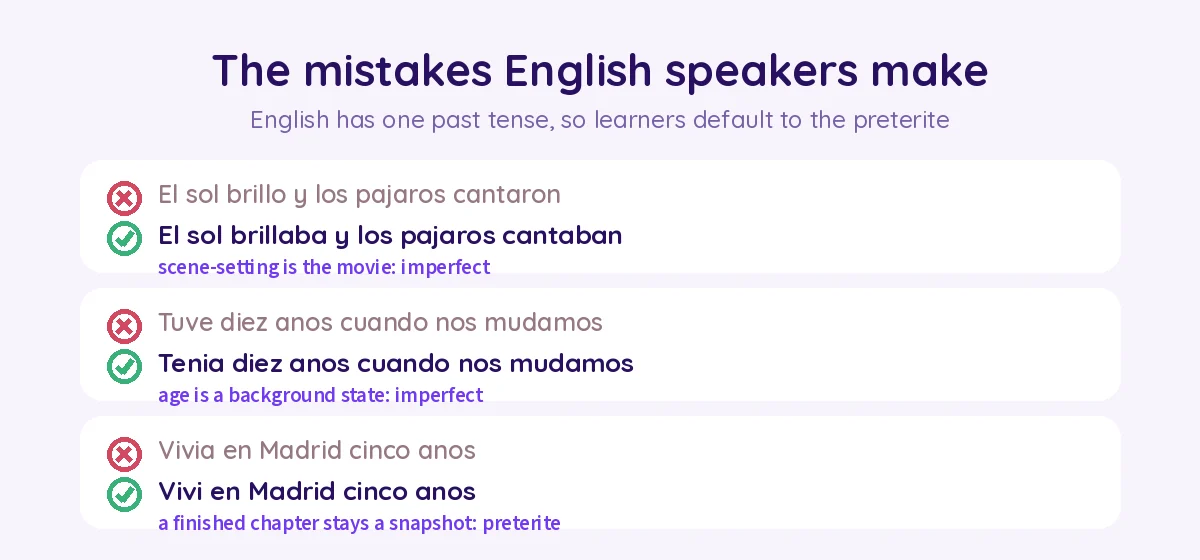
Most preterite-versus-imperfect errors come from one root habit: English has a single simple past, so learners reach for the preterite by default and only use the imperfect when they remember to. Watch for these.
Defaulting to the preterite for description. El sol brilló y los pájaros cantaron sounds like the sun did one quick flash and the birds chirped once and stopped. For scene-setting you want El sol brillaba y los pájaros cantaban, the movie of a nice morning in progress.
Using the preterite for age, time, and weather backdrops. Tenía diez años cuando nos mudamos (I was ten when we moved). Age is a background state, so imperfect tenía, while the move is a finished event, so preterite mudamos. Same with the clock and the sky: Eran las tres y llovía cuando salí (it was three o'clock and raining when I left).
Forcing the imperfect onto a clearly finished action just because it lasted a while. Duration does not automatically mean imperfect. Viví en Madrid cinco años is preterite, because you are framing the whole five-year stay as one completed chapter that is now closed. If a stretch of time has a clear beginning and end and you are treating it as finished, it is still a snapshot, just a wide one.
Habits are the imperfect's home turf. Anything you "used to" do, or did "every day," belongs to the movie. If you can slip "used to" into the English without it sounding wrong, use the imperfect. This same instinct for whether a thing is a fixed fact or a shifting state is exactly what powers the ser vs estar decision, so the two guides reinforce each other.
Practice: Preterite or Imperfect?
Here is where it locks in. Choose the correct past tense for each verb in parentheses, then check the key below. This is exactly the kind of quick-decision drill that Lingoodie quizzes you on, and getting them right earns points you can cash out, so it is worth actually doing rather than just reading.
- Ayer (yo / comer) ____ paella por primera vez.
- Cuando (ser) ____ niña, (ir) ____ a la playa todos los veranos.
- (Nosotros / llegar) ____ tarde porque (haber) ____ mucho tráfico.
- Ella (leer) ____ un libro cuando (sonar) ____ el teléfono.
- La semana pasada (yo / conocer) ____ a tu hermano.
- De repente, la luz (apagarse) ____.
- (Ser) ____ las diez de la noche y (llover) ____ mucho.
- No (yo / poder) ____ abrir la caja, aunque lo intenté varias veces.
- Todos los días mi abuela (cocinar) ____ para toda la familia.
- (Yo / saber) ____ la verdad cuando leí el mensaje.
Answer key:
- comí (preterite, a single first-time event, marked by "ayer" and "por primera vez")
- era / iba (imperfect for both: background age, then a repeated summer habit marked by "todos los veranos")
- llegamos / había (preterite for the finished arrival, imperfect for the background condition of the traffic)
- leía / sonó (imperfect movie running, interrupted by the preterite snapshot of the phone)
- conocí (preterite, the moment of meeting, marked by "la semana pasada")
- se apagó (preterite, a sudden completed event, marked by "de repente")
- Eran / llovía (imperfect for both, the clock and the weather as backdrop)
- pude (preterite, one failed attempt in the moment, not an ongoing inability)
- cocinaba (imperfect, a daily habit marked by "todos los días")
- supe (preterite, the moment of finding out, triggered by the finished action of reading)
If you missed a few, look at what tipped you off. Almost every miss is a spot where the trigger word said one thing (a single moment, or a repeated habit) and the default English past tense pulled you the other way.
Make It Stick, and Get Paid to Practice
The preterite-versus-imperfect choice is not learned in one sitting. It is learned in small, repeated doses until the right tense arrives faster than you can explain it, and the only thing that reliably gets you there is showing up regularly. That is the whole idea behind Lingoodie. You complete short Spanish lessons, drill exactly these snapshot-versus-movie choices, earn points, and cash out real money via Revolut or PayPal, available in 200+ countries. Revolut is instant, has a low minimum, and Lingoodie takes no fee on it. PayPal is also available with a higher 100,000-point minimum and 1 to 3 business day processing, where PayPal (not Lingoodie) takes its own cut. The rewards are small on purpose, just enough of a nudge to get you back for tomorrow's five minutes, which is where the real progress hides. Lingoodie teaches 10 languages including Spanish, Italian, German, French, and Portuguese.
If you want the fuller roadmap for building the daily habit that makes grammar like this sink in, our guide on how to learn Spanish fast walks through the methods that actually move the needle.
Download Lingoodie free on Google Play or the App Store, and turn your daily preterite-versus-imperfect practice into real cash.