밥 먹었냐? Why a Friendly Question Can Sound Rude
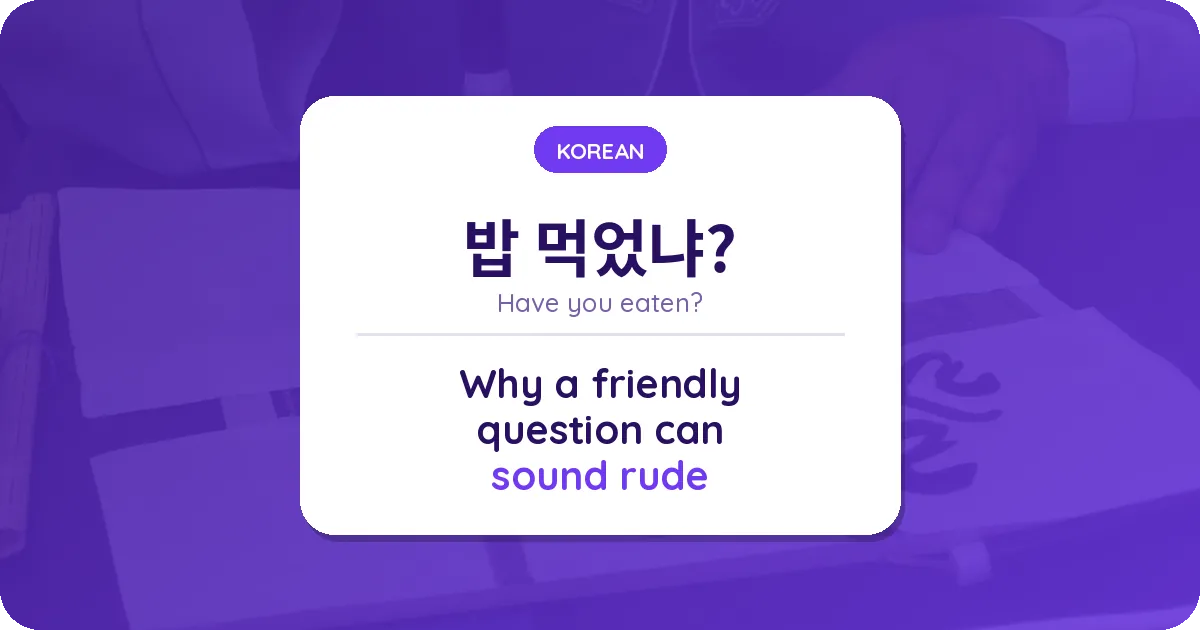
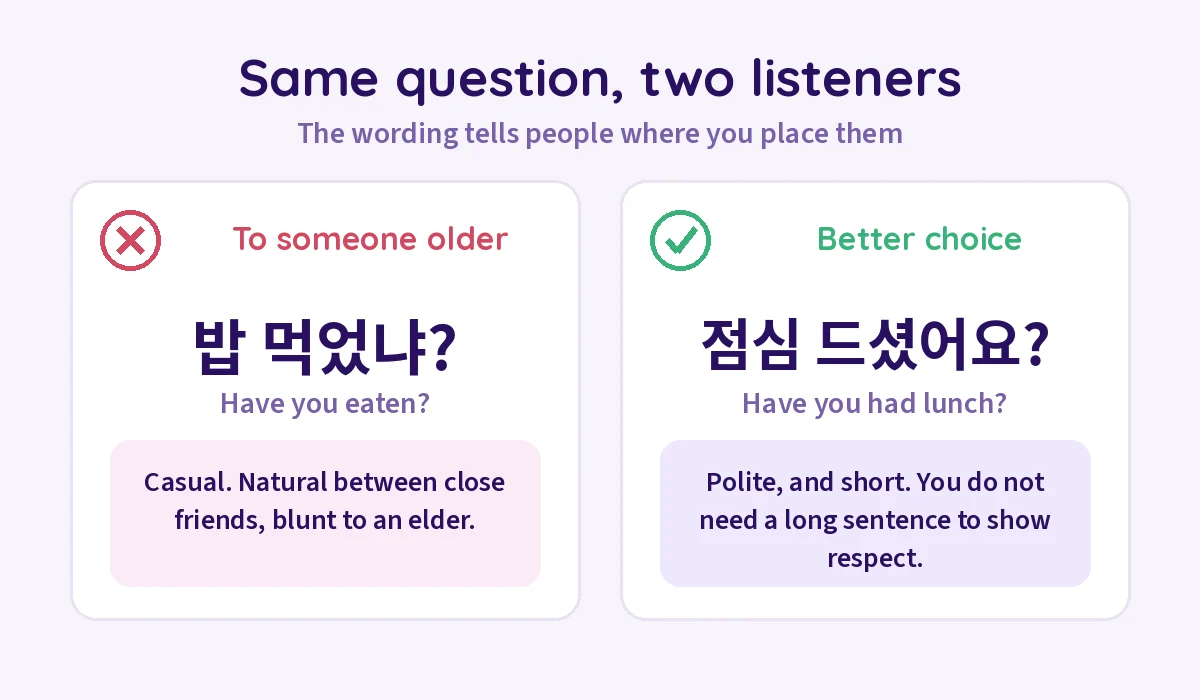
Imagine someone learning Korean asking an older person, "밥 먹었냐?" They might simply want to check whether the person has eaten. But the listener could be taken aback. The question expresses concern; the wording can sound as though the speaker is addressing someone younger or lower in status.
밥 먹었냐? Have you eaten? (Casual, potentially blunt.)
Close friends can use this expression. Even between friends, though, its effect depends on the tone of voice. When speaking to an older person you normally address politely, you could say:
식사하셨어요? Have you eaten?
점심 드셨어요? Have you had lunch?
You do not need a long or difficult sentence to show respect.
Is adding 요 enough?
What if you just add a polite ending and say "밥 먹었어요?" That is polite speech too. Still, when asking an older person, "드셨어요?" is usually a more respectful choice. This is where Korean can feel confusing. You have learned to add 요, and now 먹다, "to eat," changes to 드시다 as well.
Another example is asking someone's age. You may have heard that people in Korea ask about age, so you use the expression you learned:
몇 살이야? How old are you? (Casual.)
That is casual speech, too. If there is a reason to ask an older person's age, you could say:
실례지만 연세가 어떻게 되세요? Excuse me, may I ask how old you are?
Of course, making the wording polite does not mean you need to ask someone's age as soon as you meet. You can wait until it is relevant to the conversation.
A polite ending cannot fix every word
Consider another everyday question:
너 어디 가? Where are you going? (Casual.)
This can sound natural between close friends. With an older person you address politely, "어디 가세요?" is a better choice. But changing only the ending gives you "너 어디 가세요?" The words pull in different directions: the ending shows respect, while 너 addresses the listener casually.
If you are already speaking face to face, this is enough:
어디 가세요? Where are you going?
If you need to make clear whom you are addressing, add the title you normally use for that person:
선생님, 어디 가세요? Where are you going, teacher?
Trying to put 너 or 당신 into every sentence because English uses "you" can make Korean sound awkward. You do not always need a separate word for the person you are talking to.
Who are you showing respect to?
It is also possible to become so concerned with sounding polite that you use an honorific for yourself:
저는 점심 드셨어요. Intended meaning: "I have had lunch." (The honorific is misplaced.)
If you know that 드셨어요 is respectful but are unsure whom it honours, this is an understandable mistake to make. When you are the person who ate, say:
저는 점심 먹었어요. I have had lunch.
Speaking politely to your listener and honouring the person who performed the action are separate things. The National Institute of Korean Language explains this distinction between listener and subject honorification.
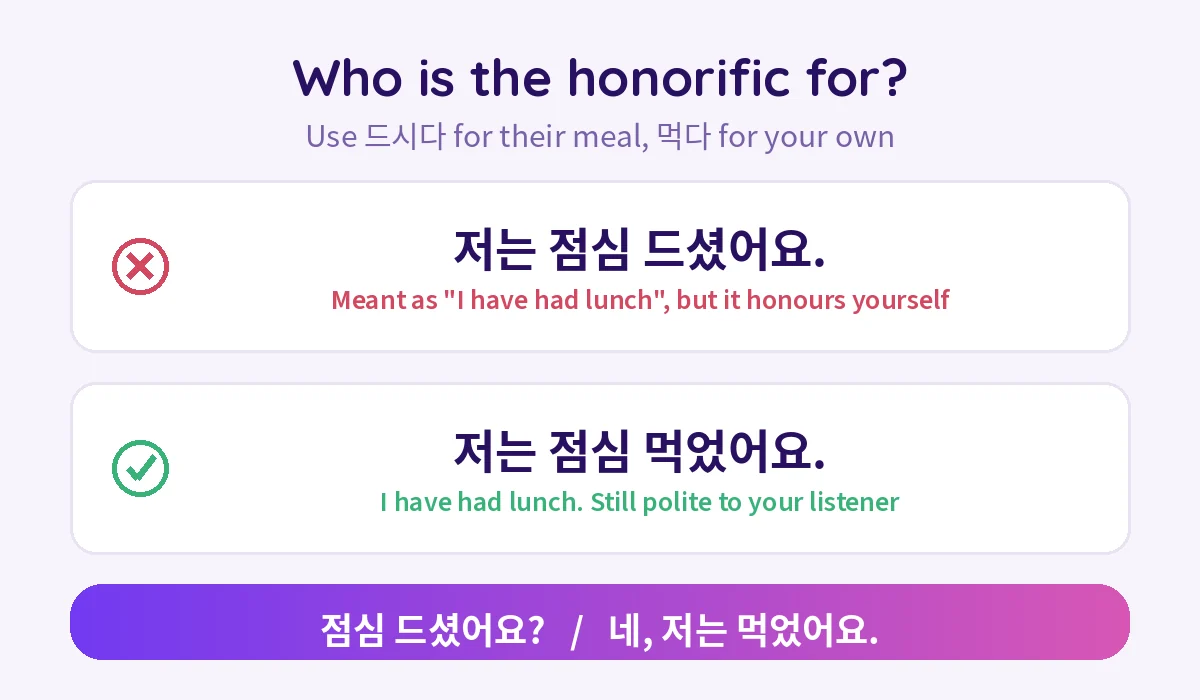
That can sound complicated as an explanation. It is easier to see in a short exchange:
점심 드셨어요? Have you had lunch?
네, 저는 먹었어요. Yes, I have.
Use 드시다 when respectfully asking about the other person's meal, and 먹다 when talking about your own. Both sentences still use polite endings.
When can you switch to casual speech?
There is no set number of meetings after which you must switch to casual speech. Being the same age does not automatically settle it either. Two people may start feeling comfortable with each other at different times.
If you have become friendly with someone around your age, you can ask:
우리 말 놓을까요? Shall we use casual speech with each other?
If they are comfortable with it too, you can begin speaking more casually. But some close friends continue using polite speech. A polite ending does not necessarily mean emotional distance.
When you learn an expression, try to remember whom it can be used with. If you pick up "밥 먹었냐?" from a drama, look at the relationship between the people saying it. Are two friends joking together? Is an adult asking a child? That helps you decide where the expression belongs in your own conversations.
If casual speech slips out by mistake, you can correct yourself:
아, 죄송해요. 점심 드셨어요? Oh, sorry. Have you had lunch?
It is easy to get confused while learning. Correcting a sentence and trying it again is part of practising.
You do not need to choose the most elaborate honorific expression every time. If you want to ask an older person whether they have eaten, "점심 드셨어요?" is enough. Think for a moment about whom you are speaking to, so that the wording does not get in the way of the care you meant to express.