The Spanish Idioms Natives Actually Use, and the Ones That Get You a Blank Stare
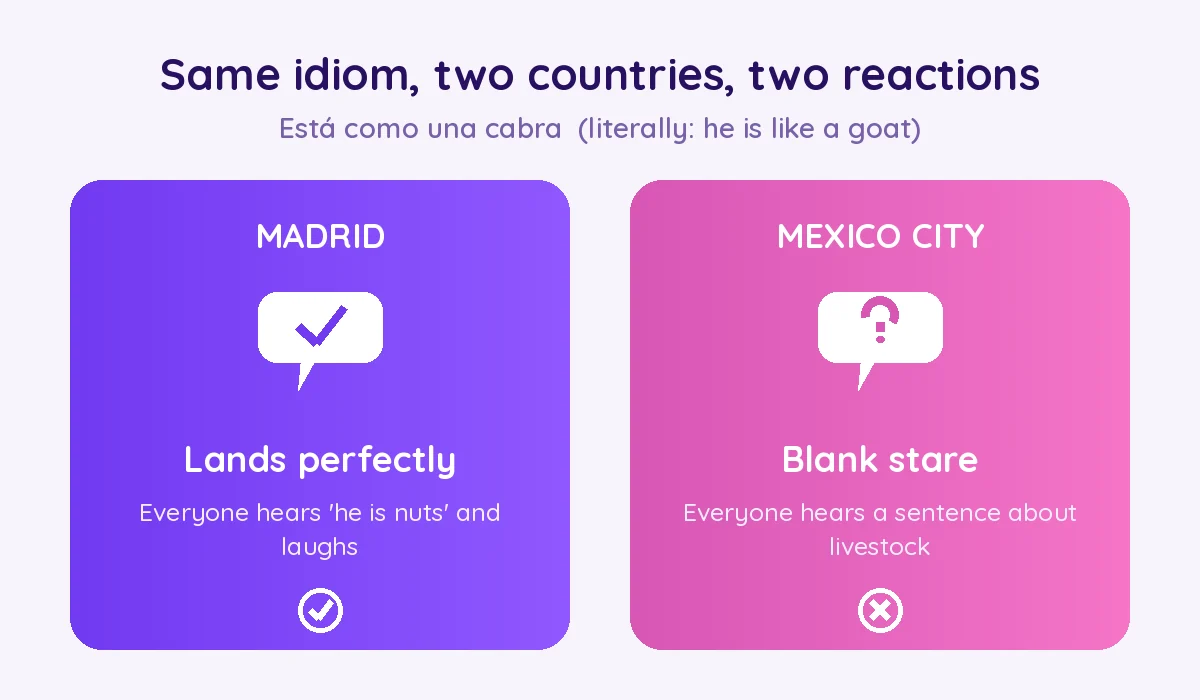
Picture a bar in Madrid. Someone describes a friend who went swimming in a freezing river in January, and finishes with "está como una cabra." Everyone laughs. Literally the sentence says he is like a goat. Everyone in the room heard "he is completely nuts."
Now run the same line in a bar in Mexico City. The laugh does not come. What lands instead is a slightly puzzled pause, because the phrase is not part of the local repertoire, and the listener is genuinely trying to work out why a goat has entered the conversation.
That gap is the thing almost every Spanish idiom list leaves out. There is no shortage of articles offering fifty or seventy colorful expressions with their funny literal translations, and they are enjoyable to read. What they rarely tell you is which of those phrases work across the whole Spanish-speaking world, which ones brand you as having learned your Spanish in one specific country, and which ones will get you a very different reaction than the one you were going for.
Spanish is spoken as a first language by around 500 million people across more than twenty countries. Treating its idioms as one flat pile is a little like handing a learner of English a list that mixes Cockney rhyming slang, Australian shortenings, and American sports metaphors, then wishing them luck. This guide sorts them out by where they work, gives you a pattern for remembering them, and flags the ones worth thinking twice about.
Start With the Set That Works Everywhere
Before worrying about regional flavor, there is a core group of expressions that a speaker in Spain, Mexico, Colombia, or Argentina will all understand without hesitating. These are the ones worth learning first, because they carry no geographic risk at all.
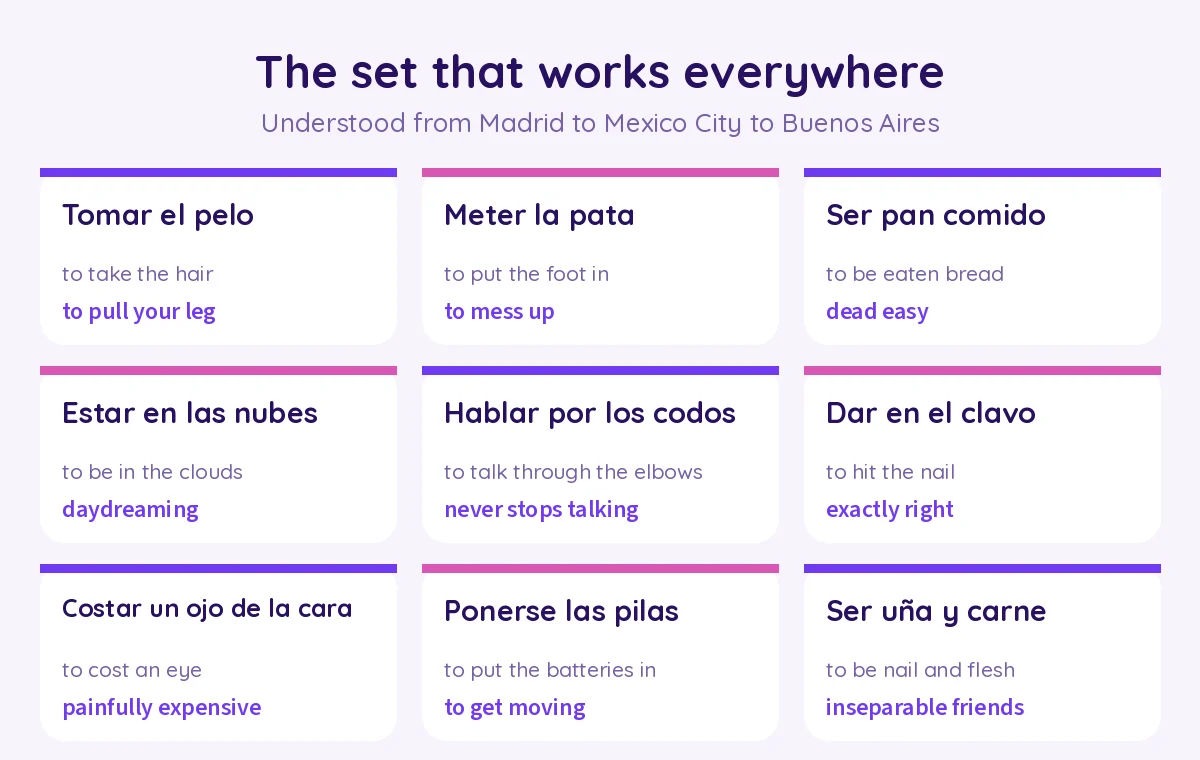
A few of these deserve a note. Tomar el pelo is the single most useful one on the list, because the situation it covers comes up constantly and English has no neutral equivalent that is quite as friendly. "Me estás tomando el pelo" is what you say when a friend is winding you up, and it works in every country.
Ponerse las pilas is the phrase a Spanish speaker reaches for when someone needs to snap out of drifting and get on with it. Teachers use it with students, coaches use it with teams, and friends use it with each other. Meter la pata is the everyday way to admit a blunder, warmer and less formal than "cometí un error."
Costar un ojo de la cara is worth knowing simply because you will hear it every time anyone discusses rent or plane tickets. And ser uña y carne, literally to be nail and flesh, describes two people who are never seen apart, the pair everyone treats as a unit.
Nine phrases is a manageable number. Seventy is not, which is one of the quiet problems with the long lists: they are fun to scroll and impossible to retain.
The Half That Does Not Travel
Now for the part the lists tend to blur. A large share of the most colorful Spanish expressions are regional, and using the wrong one is not a mistake so much as a small accent marker. It tells your listener where you learned your Spanish, which is fine when it matches where you are and mildly confusing when it does not.
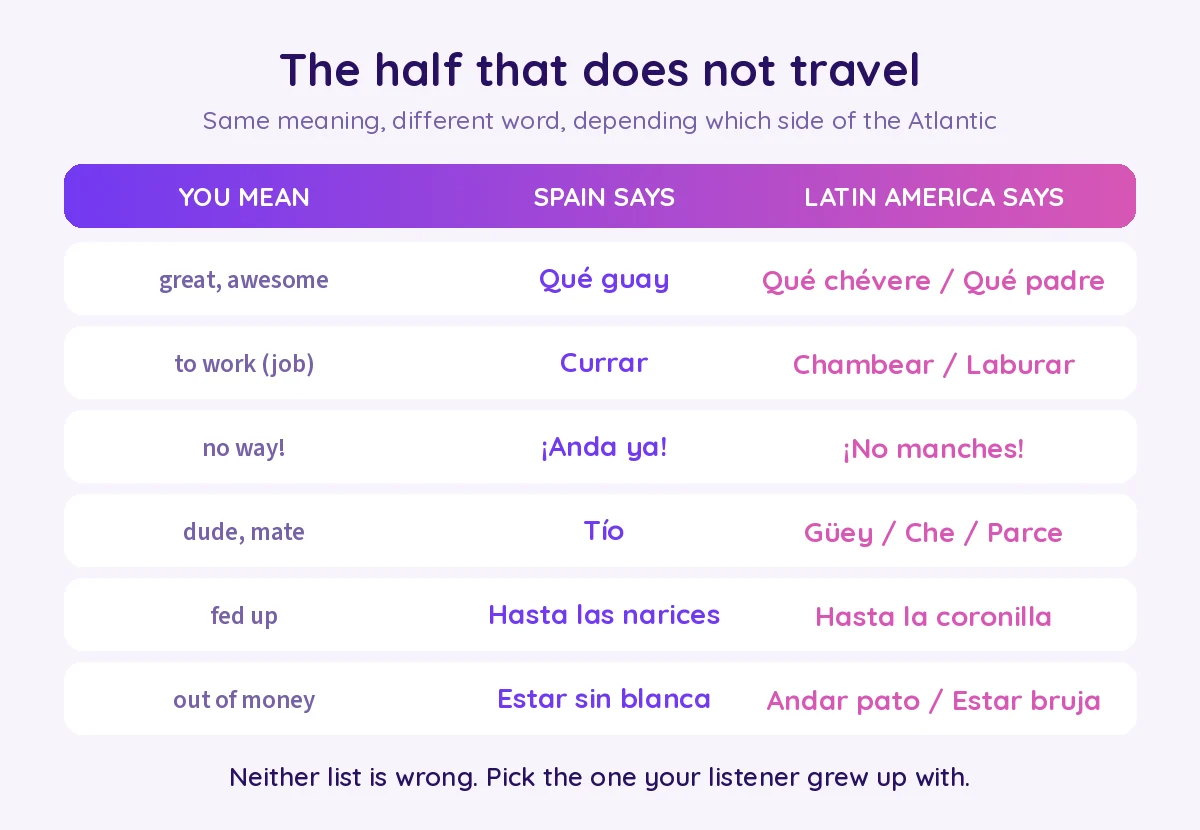
Some of the sharpest divides are in the most ordinary words. "Qué guay" is completely natural in Spain and almost never heard in Latin America, where the equivalent enthusiasm comes out as "qué chévere" in Colombia, Venezuela, Peru, and much of the Caribbean, and "qué padre" or "qué chido" in Mexico. Say "guay" in Bogotá and you will be understood, but you will sound like someone who learned Spanish in Salamanca, which may or may not be the impression you want.
The word for work splits the same way. Currar is Spain. Chambear is Mexico and Central America. Laburar, borrowed from Italian, belongs to Argentina and Uruguay. All three mean the everyday grind of a job, and none of them is more correct than the others.
Then there is the vocabulary of address. Tío and tía are how friends in Spain refer to each other, roughly like "mate" or "dude". In Mexico the equivalent is güey, in Argentina it is che, in Colombia parce. These are the words that make a learner sound local, which is exactly why they are the worst ones to pick at random from a list.
The practical rule is simple. Learn the universal set properly, then adopt the regional layer of whichever country you are actually spending time in or whose media you actually consume. Trying to hold all of them at once produces a strange composite accent that belongs nowhere.
Why the Same Images Keep Coming Back
Here is the part that turns a list into something you can actually keep. Spanish idioms are not random. They cluster around three image banks, and each bank is used for a consistent kind of judgment.
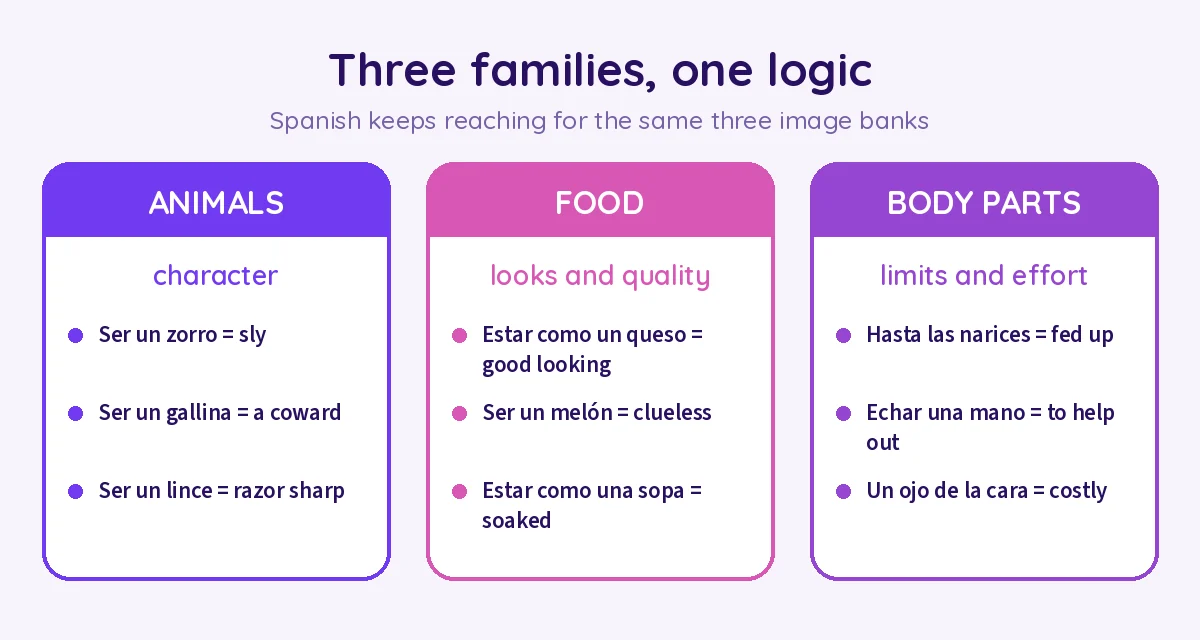
Animals describe what a person is like. Ser un zorro is to be sly, ser un lince is to be razor sharp, ser un gallina is to be a coward, tener pájaros en la cabeza is to be scattered and impractical. When Spanish reaches for an animal, it is almost always making a claim about someone's character or intelligence.
Food describes appearance and quality. Estar como un queso is a compliment about looks. Ser un melón says someone is thick. Ser pan comido says a task is trivially easy. Estar como una sopa, incidentally, means to be absolutely drenched from the rain, not to be disorganized, which is a gloss that gets copied wrong across a lot of idiom lists.
Body parts describe limits and effort. Estar hasta las narices is to have reached the end of your patience. Hablar por los codos is to talk without ever stopping. Echar una mano is to lend a hand. Costar un ojo de la cara is a price that hurts.
Once you notice the pattern, new idioms slot themselves into place rather than piling up as trivia. Hearing an unfamiliar animal expression, you can already guess it is a comment about someone's nature. Hearing a food one, you can guess it is about how good or how easy something is. That guess is right often enough to keep a conversation moving, which is the whole point.
The Ones to Handle With Care
Idiom lists are cheerful by design, and that cheerfulness hides a real risk: not every phrase is safe to deploy with everyone. A few of the funniest ones are insults, a few are flirtatious, and a few are perfectly innocent in one country and crude in the next.
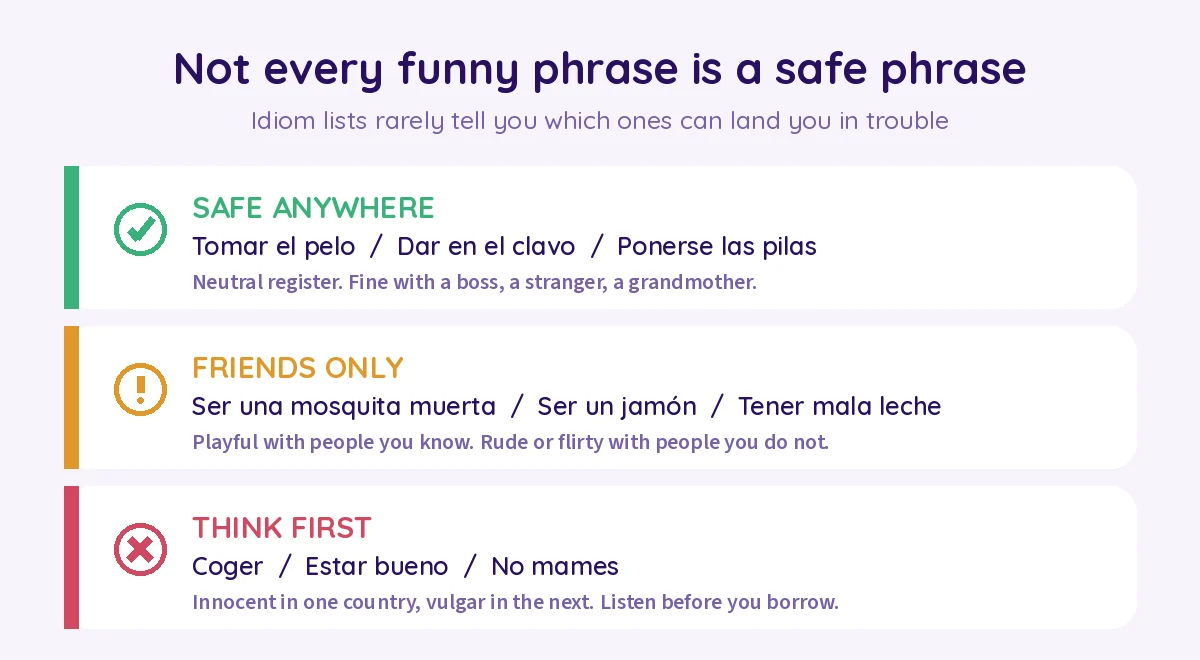
The one every learner should know about is coger. In Spain it is a completely ordinary verb meaning to take or to catch: coger el autobús, coger el teléfono. In Mexico, Argentina, and much of the Southern Cone the same verb is vulgar slang for having sex. Nobody will think less of a visitor for the slip, but the local alternative is tomar or agarrar, and it costs nothing to switch.
Estar bueno is the second trap. It looks like a way to say you are doing fine, but "estoy bueno" tells the room you consider yourself attractive. The sentence you actually wanted was "estoy bien."
In the amber tier sit the phrases that are affectionate between friends and rude between strangers. Ser una mosquita muerta calls someone a quiet operator hiding behind an innocent face. Ser un jamón, in Spain, is a comment on how good somebody looks, which is charming from a friend and unwelcome from a colleague. Tener mala leche accuses someone of a foul temper.
None of this means avoiding idioms. It means treating them the way you treat any strong language in your own tongue, by noticing who is in the room first.
How to Actually Land One
Knowing an idiom and using one well are separate skills, and the second is mostly about restraint and timing.
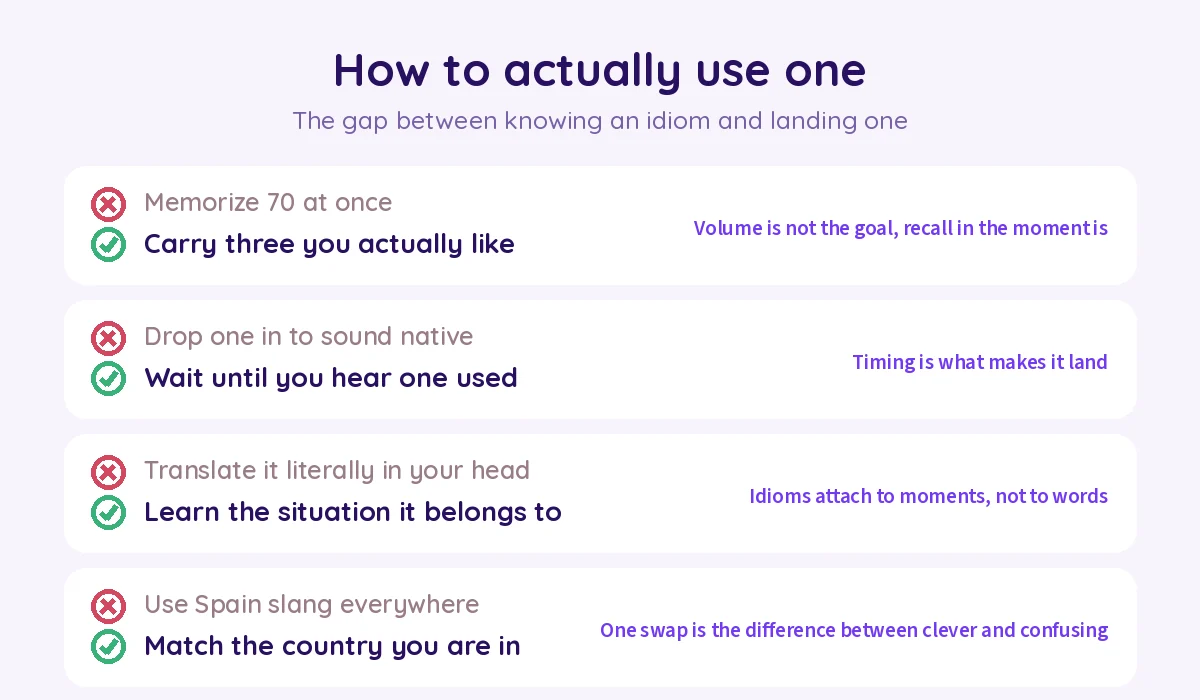
The most common failure is volume. Reading seventy expressions in one sitting feels productive and produces almost no recall, because none of them is attached to a moment. Picking three you genuinely like and waiting for their situation to arrive works far better. An idiom is stored with its context or it is not stored at all.
The second failure is eagerness. Learners often drop an expression in early to prove they belong, and it arrives slightly off, a beat too soon or in a register the conversation had not reached. Hearing a native use one first, and copying the timing rather than just the words, fixes this faster than any amount of study.
The third is literal thinking. Translating "estar en las nubes" word by word gets you clouds, which is not where the meaning lives. These phrases belong to situations, not to their component nouns, and learning them as whole units is what makes them come out naturally later.
This is also where idioms overlap with the other classic trap in Spanish, the words that look like English and mean something else entirely. If you have not met those yet, the guide to Spanish false friends covers the ones that catch every English speaker.
Quick Quiz
Five questions. Answers underneath.
- A friend says your new phone "costó un ojo de la cara." Was it cheap or expensive?
- You are in Buenos Aires and want to say a job is easy. Which is safest: "es pan comido" or "es guay"?
- Someone is described as "una mosquita muerta." Is that a compliment?
- In Mexico City you want to catch a bus. Which verb do you use: coger or tomar?
- Your colleague has not stopped talking for twenty minutes. Which body part does the idiom use?
Answers: 1. Expensive, it cost an eye from the face. 2. "Es pan comido", which is universal, while "guay" is Spain only. 3. No, it describes someone who plays innocent while quietly working an angle. 4. Tomar, since coger is vulgar there. 5. The elbows: habla por los codos.
Where the Practice Comes From
Idioms stick when you meet them repeatedly in small doses rather than in one long list. That is a habit problem more than a knowledge problem, and habits need a reason to come back tomorrow.
Lingoodie is built around exactly that: short lessons that reward you for showing up. Every lesson you finish earns points, and those points convert to real money you can cash out via Revolut or PayPal. Revolut payouts are instant, have a low minimum, and carry no fee from Lingoodie. PayPal opens the app up to more than 200 countries, needs a higher minimum of 100,000 points, takes one to three business days, and carries PayPal's own fee of 4.49% plus $0.49, charged by PayPal rather than by Lingoodie.
Alongside Spanish, the app teaches Ukrainian, Slovenian, Russian, Portuguese, Korean, Italian, German, French, and Croatian, so the same habit works if you pick up a second language later.
If you want the fuller picture on building the habit, the guide to how to learn Spanish fast covers the method, and por vs para and ser vs estar handle the two grammar decisions that trip up learners most often.
Download Lingoodie on Google Play or the App Store and start collecting phrases that actually land.