The Spanish Words That Look Like English and Betray You

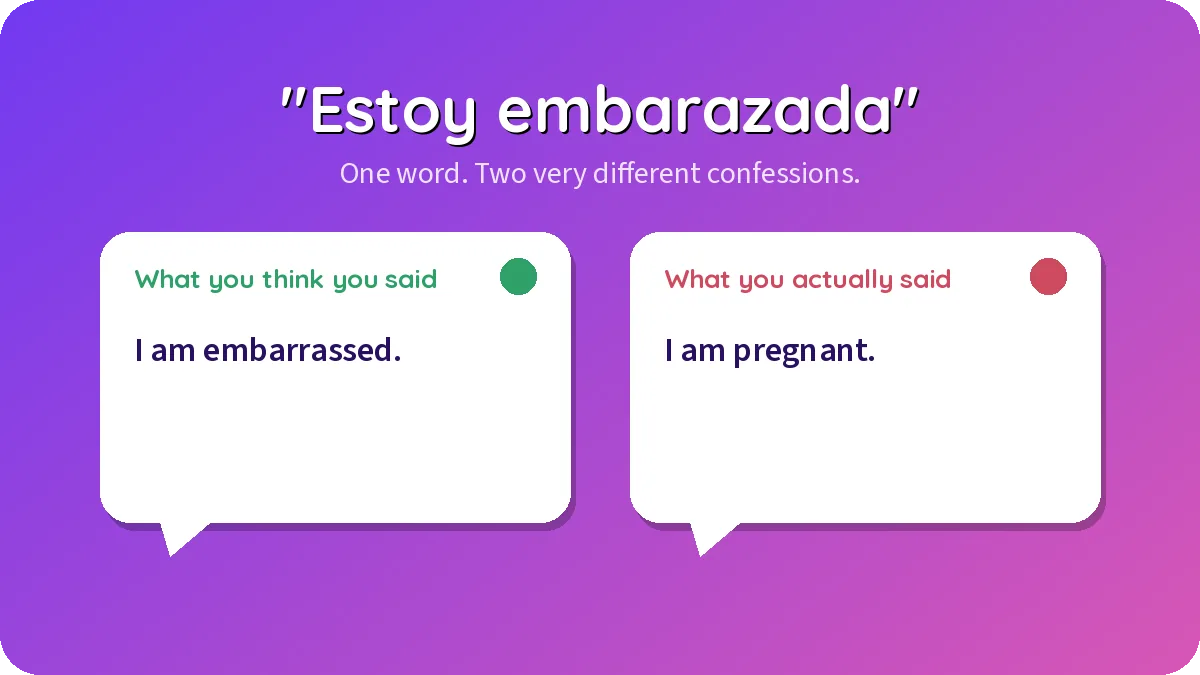
Picture the scene. You are three months into Spanish, feeling good, and you knock a full cup of coffee across a colleague's desk. You want to apologize, to say you are mortified, so you reach for the word that looks obviously right: "Estoy embarazada." The room goes quiet. You have not told anyone you are embarrassed. You have announced, with great confidence, that you are pregnant.
Welcome to the world of false friends. These are the words that look almost identical to an English word, sound like they should mean the same thing, and then mean something completely different. They are one of the sneakiest traps in Spanish precisely because they feel safe. You are not guessing at a word you do not know. You are trusting a word you think you already do, and that trust is exactly what trips you.
The good news is that there are only so many of them, and the worst offenders are a short, learnable list. This guide gives you a cheat sheet to skim now, the handful of words that will actually embarrass you, a simple method to stop mixing them up, and a quiz to prove it stuck.
What a False Friend Actually Is
A cognate is a word that two languages share because they came from the same root. Spanish and English share thousands of real ones, which is a gift to the English speaker: animal, hospital, idea, chocolate, natural. You can lean on these and be right most of the time. That is what makes the exceptions so dangerous.
A false friend, sometimes called a false cognate, is a word that looks like it belongs to that friendly family but does not. Sometimes the two words really did share an ancestor centuries ago and then drifted apart in meaning. Sometimes they only collided by accident, two unrelated words that happen to land on the same spelling. Either way, the result for you is the same: the meaning has drifted somewhere you would never guess, and the familiar shape of the word is lying to you about where.
The reason this matters more in Spanish than in, say, Japanese is the overlap. Because so many Spanish and English words genuinely match, your brain builds a habit of assuming they all do. The false friends hide inside that habit. You are not on guard, because ninety percent of the time the guess works.
The Cheat Sheet: The Worst Offenders
Here is the quick-reference version. Skim it now, then read on for the ones that cause real damage.
| Spanish word | You expect | It actually means |
|---|---|---|
| embarazada | embarrassed | pregnant |
| éxito | exit | success |
| constipado | constipated | having a cold |
| molestar | to molest | to bother, to annoy |
| ropa | rope | clothes |
| carpeta | carpet | folder |
| actualmente | actually | currently |
| sensible | sensible | sensitive |
| largo | large | long |
| once | once | eleven |
| realizar | to realize | to carry out, to achieve |
| asistir | to assist | to attend |
| pretender | to pretend | to intend, to try to |
| librería | library | bookshop |
| decepción | deception | disappointment |
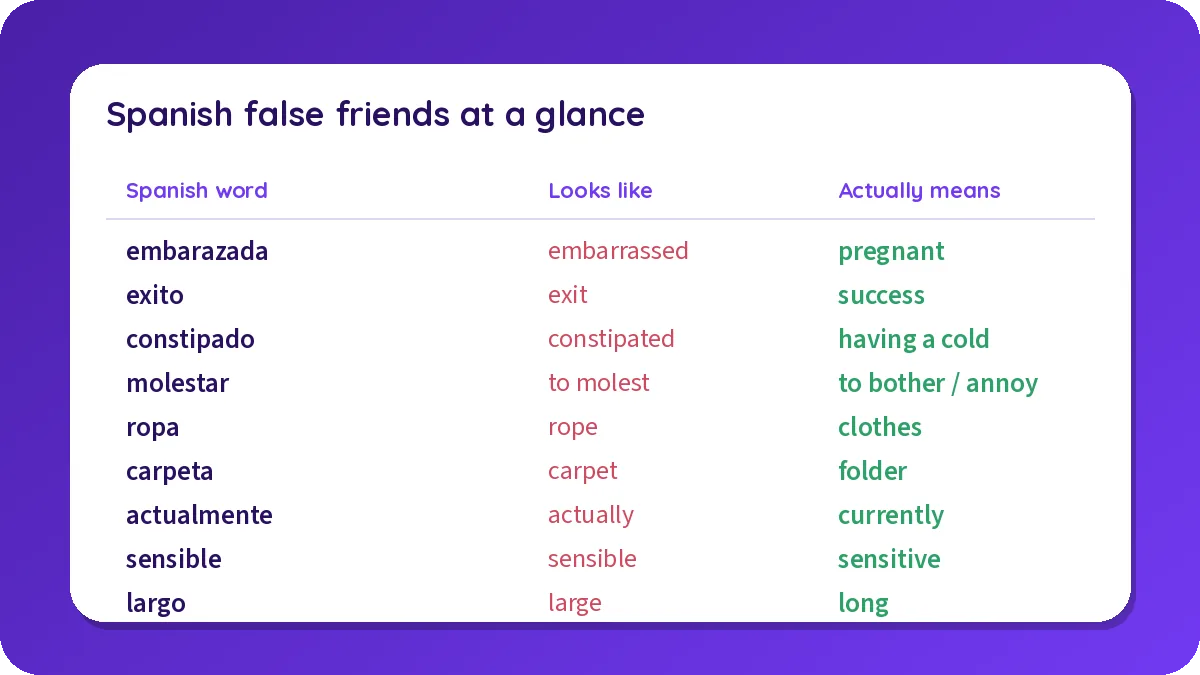
Notice the pattern in the trickiest ones. It is not that the Spanish word is nonsense. It is that it has a perfectly logical meaning of its own that has nothing to do with the English lookalike. Éxito really does mean success, which is why a book can be un gran éxito, a big hit. The exit sign you are looking for says salida.
The Four That Will Actually Embarrass You
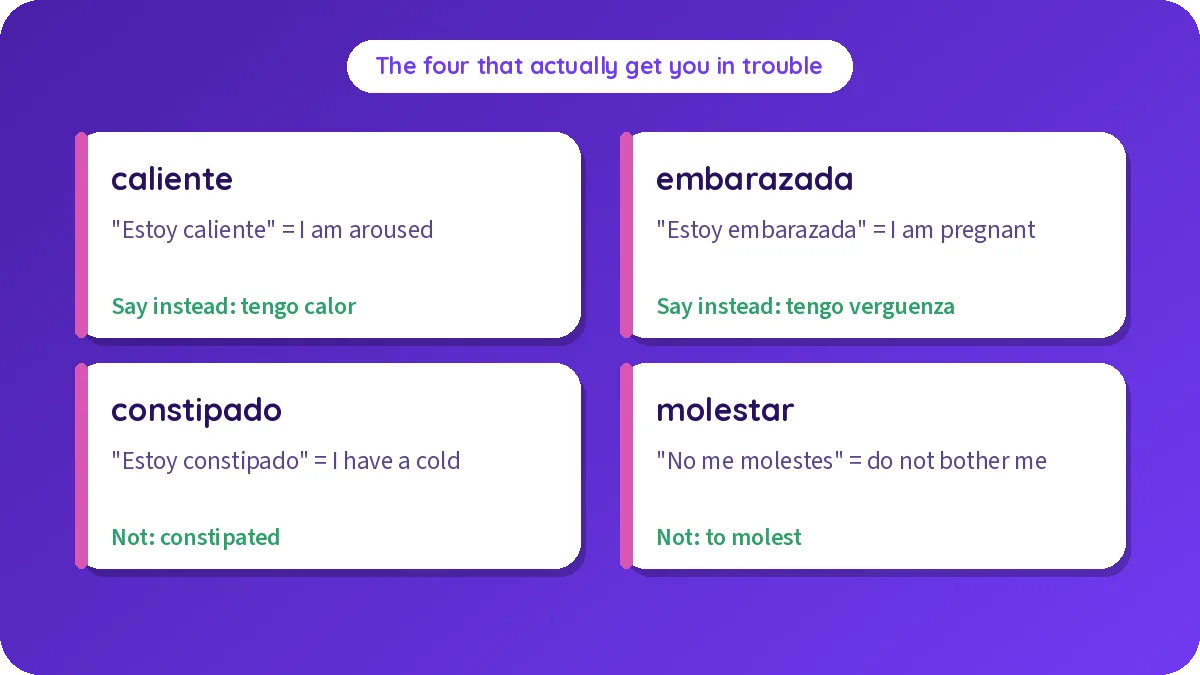
Most false friends just make you sound slightly off. A few will land you in genuinely awkward territory, and they are worth memorizing on their own.
First, the coffee-spill classic. To say you are embarrassed, you want tengo vergüenza or estoy avergonzado. Save embarazada for the one situation where you truly mean pregnant.
Second, and more dangerous, is caliente. Learners reach for it to say they are hot, as in the weather, and produce "Estoy caliente." In most of the Spanish-speaking world that does not mean you are warm. It means you are sexually aroused. To talk about temperature, the body uses a different verb entirely: tengo calor, literally "I have heat." Food and objects can be caliente, but a person saying estoy caliente is making a very different announcement.
Third, constipado. If you have a head cold and tell a pharmacist "Estoy constipado," you are correct, because constipado means congested, blocked up with a cold. The English meaning you are worried about, the digestive one, is estreñido. This one works in your favor once you know it, but catches people who assume the worst.
Fourth, molestar. It looks alarming and it is completely innocent. No me molestes means "do not bother me," and ¿Te molesta si abro la ventana? means "does it bother you if I open the window?" It is one of the most common verbs in the language and has nothing to do with the English word it resembles.
Why Word-for-Word Guessing Fails You
The deeper lesson hiding in every false friend is the same one that trips up learners everywhere. When you translate word by word from English, you are trusting the shape of a word instead of its meaning, and Spanish will quietly punish that. The fix is not to memorize a thousand exceptions. It is to shift how you reach for words in the first place: start from the meaning you want, not from the English word that is sitting in your head.
This is exactly the mindset that separates people who plateau from people who keep improving. If you want the fuller version of that idea, the guide on how to learn Spanish fast walks through thinking in meaning rather than translation. And if prepositions are your next headache, the same trap shows up in por versus para, where a single word swap changes the whole sentence.
How to Stop Confusing Them for Good
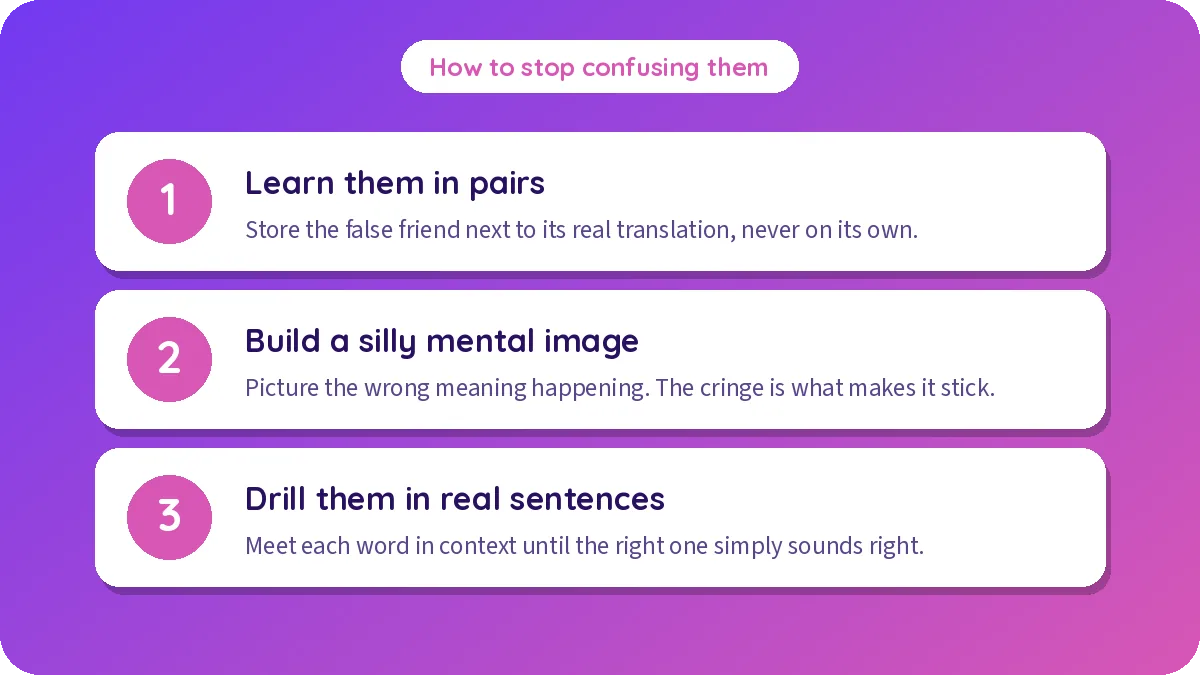
False friends do not stick from a single read. They stick from a specific way of storing them. Three moves do almost all the work.
Start by refusing to learn them alone. When you meet éxito, do not file it as "éxito equals success." File it as the pair: éxito is success, salida is exit. Learn every false friend as a pair with its real translation and the impostor it is standing in front of. A word learned next to its trap is far harder to misuse than a word learned on its own.
Next, make the wrong meaning vivid. Picture the cringe. See yourself announcing a pregnancy over spilled coffee, or telling a room you are aroused when you meant the weather. Memory clings to the ridiculous, and the more absurd the mental image, the less likely you are to reach for the wrong word when it counts.
Finally, drill them in real sentences rather than flashcard columns. A word only becomes automatic once you have met it in context enough times that the correct one arrives before you can explain why. That is the whole point of practice: not to memorize a list, but to reach the moment where the right word simply sounds right before you can explain why.
Practice: Spot the False Friend
Here is where it locks in. For each one, pick the Spanish that actually matches the English meaning, then check the key below.
- To say "I am embarrassed": estoy embarazada or tengo vergüenza?
- To say "Actually, I disagree": actualmente or en realidad?
- To say "I attended the meeting": asistí a la reunión or atendí la reunión?
- To ask "Where is the library?": ¿Dónde está la librería? or ¿Dónde está la biblioteca?
- To say "He is very sensitive": es muy sensible or es muy sensato?
- To say "It is a long film": una película larga or una película grande?
- To say "I need to buy clothes": comprar ropa or comprar cuerda?
- To say "She works at a factory": una fábrica or una tela?
- To say "What a disappointment": qué decepción or qué engaño?
- To say "My kids are at school": en el colegio or en la universidad?
Answer key:
- tengo vergüenza (embarazada means pregnant)
- en realidad (actualmente means currently)
- asistí a la reunión (asistir means to attend, not to assist)
- la biblioteca (librería is a bookshop)
- es muy sensible (sensible really does mean sensitive here; sensato is the one that means level-headed)
- una película larga (largo means long, not large)
- comprar ropa (ropa means clothes; cuerda is rope)
- una fábrica (fábrica is a factory; tela is fabric)
- qué decepción (decepción is disappointment, not deception)
- en el colegio (colegio is school; universidad is college)
If you missed a few, look at which ones. Almost every miss is a place where the English lookalike felt so obvious that you never stopped to ask what the Spanish word actually means on its own.
Turn the Tricky Words Into Points
False friends are not learned in an afternoon. They are learned in small, repeated doses until the right word arrives faster than the wrong one, and the only thing that gets you there is showing up regularly. That is the whole idea behind Lingoodie. You complete short Spanish lessons, drill exactly these kinds of tricky word choices, earn points as you go, and cash out real money via Revolut or PayPal, available in 200+ countries. Revolut is instant, has a low minimum, and Lingoodie takes no fee on it. PayPal is also available with a higher 100,000-point minimum and 1 to 3 business day processing, where PayPal, not Lingoodie, takes its own cut. The rewards are small on purpose, just enough of a nudge to get you back for tomorrow's five minutes, which is where the real progress hides. Lingoodie teaches 10 languages including Spanish, Italian, German, French, and Portuguese.

If Spanish is your target, it helps to pick the right tool first. Here is an honest rundown of the best Spanish learning app options so you can choose what fits.
Download Lingoodie free on Google Play or the App Store, and turn every false friend you catch into real cash.