Best Spanish Learning App in 2026: Lingoodie, Babbel, Pimsleur, and 8 Others Tested
Spanish is the second most studied language on the planet, and the app market reflects that. Open any app store, search "learn Spanish", and you will get hundreds of results promising fluency in three months. Most of them will not deliver. A few of them genuinely will, if you pick the one that matches your level, your schedule, and your reason for learning.
We spent 60 days testing 11 of the most popular Spanish learning apps in 2026. We started as beginners, paid for premium tiers, used them on Android and iOS where available, and tracked which ones we actually opened on day 45. That last metric is the one that matters, because the best Spanish learning app is the one you still use after the novelty wears off.
Here is the full breakdown.
Why Spanish is the Smartest Second Language for English Speakers
The Foreign Service Institute classifies Spanish as a Tier 1 language for English speakers, meaning roughly 600 to 750 class hours to reach professional working proficiency. That is the same bracket as French, Italian, and Portuguese, and significantly easier than Mandarin, Arabic, or Japanese, which sit in Tier 4 with around 2,200 hours.
Spanish also has more than 500 million native speakers across more than 20 countries. It is the second most spoken native language in the world after Mandarin, and the third most used on the internet. For an English speaker, no other language offers this combination of accessibility and reach.
The use cases are everywhere. Heritage learners reconnecting with grandparents in Mexico, Cuba, or Puerto Rico. Travellers planning trips to Spain, Argentina, or Colombia. Professionals in the US working with Latino clients or teams. Remote workers planning a year in Mexico City or Medellin. Each of these motivations leads people to download a Spanish app, and each requires a slightly different tool to actually succeed.
The good news is the Spanish learning app market is enormous, which means competition is fierce, prices are dropping, and quality has improved sharply over the last three years. The bad news is choosing one feels overwhelming. That is what this comparison is for.
What Makes a Spanish Learning App Actually Work
We tested every app on this list against four criteria.
Pronunciation feedback. Spanish has clear, predictable phonetics, but English speakers still butcher the rolled R, the soft D, and the rhythm of natural speech. An app that does not record you and tell you when you are wrong is leaving the most valuable feature on the table.
Real-world dialogue exposure. Drilling vocabulary lists is fine, but you need to hear Spanish at natural speed, with regional accents, and in messy real situations. Apps that only feed you slow textbook audio will leave you frozen the first time a real person speaks to you in Madrid or Mexico City.
Retention mechanics. Spaced repetition, interleaving, and review systems matter. Without them, you forget 70 percent of what you learn within a week. The apps that take this seriously feel slower at first and pay off massively over months.
Long-term motivation. This is where most apps fail. The first 30 days of any language app feel exciting. Day 45 is when streaks die, paid subscriptions get cancelled, and learners go back to thinking they are bad at languages. The apps that solve motivation are the ones that produce actual fluency, because consistency beats intensity every time.
The biggest differences in our 60-day test showed up not in lesson quality but in motivation design. Two apps with similar pedagogy produced wildly different outcomes simply because one of them kept us coming back.
How We Tested These 11 Apps
We ran a 60-day side-by-side test starting from beginner level Spanish. Each app got at least 20 minutes of daily attention for the first 30 days, then we narrowed down to the apps we actually wanted to keep using for the remaining 30 days. Tracking who survived to day 60 turned out to be more revealing than any internal lesson scoring.
The primary device was Android, since that is where most of our readers are. We cross-checked on iOS where the app was available on both platforms. We paid for the premium tier of every app that gates meaningful content behind a subscription, so the comparison reflects what you would actually experience as a paying user, not a stripped-down free trial.
We also did not use any external textbooks, podcasts, or tutors during the test, except for the app that is built around tutors. The goal was to see what each app could do on its own.
The 11 Best Spanish Learning Apps in 2026
Here is the ranked list, with Lingoodie first because it is the only app on this list that pays you real money to keep going. The rest are ordered by how well they perform across our four criteria, not by popularity or marketing budget.
Lingoodie
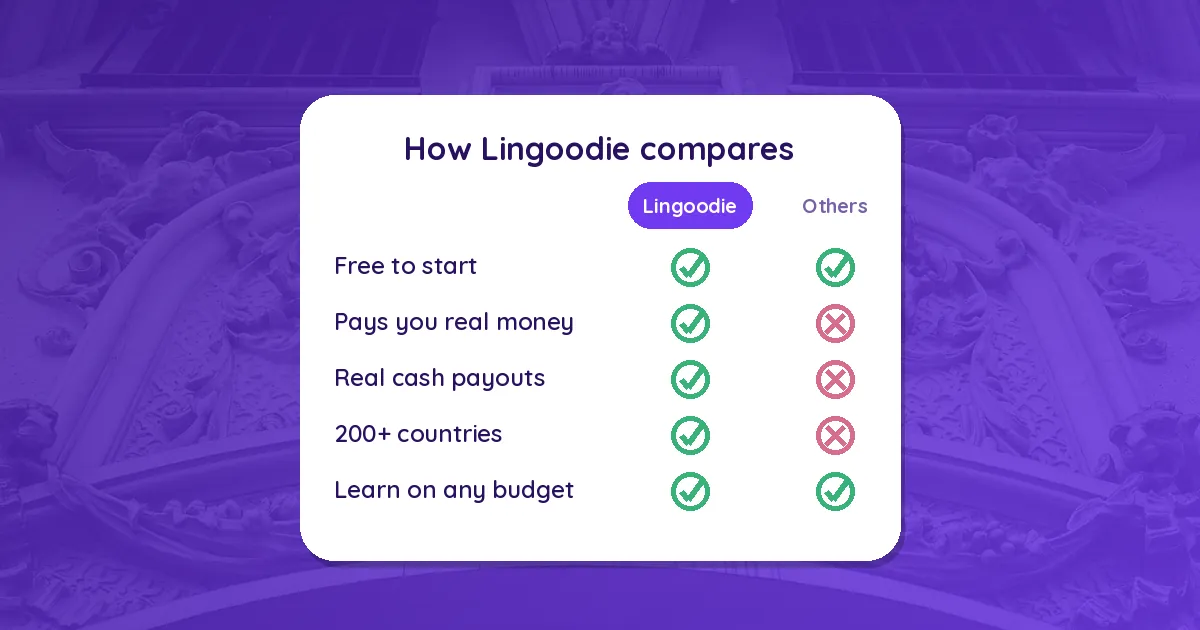
Lingoodie added Spanish in April 2026 and is the only earn-while-you-learn app on this list. It is free to download, has no subscription, and pays out real cash via Revolut, instant and fee-free once you hit the 2,500 point minimum, or via PayPal, which has a higher 100,000 point minimum and takes 1 to 3 business days. Either way, a small payout on a regular cycle turns daily practice into something concrete, which is genuinely different from the streak counters and cartoon mascots most apps rely on. The lessons themselves cover vocabulary, listening, and comprehension at a steady beginner-to-intermediate pace, with audio from native speakers and short comprehension checks. It is not trying to replace a grammar textbook. It is trying to make sure you actually open the app on day 45, which is when most learners quit. In our test, it had the highest day-60 retention by a wide margin.
Pricing: Free, no paywall, no subscription. Cashout via Revolut or PayPal.
Verdict: best for habit-building and motivation, especially if you have tried and quit other Spanish apps before.
Babbel
Babbel has the cleanest grammar curriculum of any app on this list. Lessons are well produced, sequenced sensibly, and explain why Spanish works the way it does instead of just drilling phrases. The Spanish programme in particular has had years of refinement, and the cultural notes are useful rather than filler. Sessions are 10 to 15 minutes and feel like a structured course rather than a game. The downside is the price. At roughly $6 to $14 per month depending on the plan, it is not the cheapest option, and the payment friction means many beginners cancel before they finish the A1 track.
Pricing: Around $6 to $14 per month, often discounted on annual plans.
Verdict: solid choice, but pricier than necessary if you are an absolute beginner.
Pimsleur
Pimsleur is the only app on this list that genuinely treats Spanish as something you speak rather than something you read. Each lesson is roughly 30 minutes of audio, designed to be done eyes-free, and the methodology pushes you to produce Spanish out loud from the first lesson. For commuters, dog walkers, and people who hate staring at screens, it is unmatched. The trade-off is that reading and writing get almost no attention, and the visual learners on our team found it slow.
Pricing: Around $15 to $20 per month, with bundles available.
Verdict: excellent for pronunciation and listening, limited for reading and writing.
Rosetta Stone
Rosetta Stone uses full immersion with no translations, which is either revelatory or maddening depending on your learning style. Pictures, audio, and Spanish-only prompts force you to associate words directly with meaning rather than going through English first. It works beautifully for some learners and frustrates others who want a grammar anchor when something is not clicking. Subscription costs are middling at $6 to $12 per month on annual plans.
Pricing: Around $6 to $12 per month on annual plans.
Verdict: polarising. Some learners love the immersion approach, others find it frustrating without explicit grammar.
Italki
Italki is not technically a self-study app. It is a marketplace of live Spanish tutors you book by the hour, with prices ranging from around $6 with community tutors up to $30 or more with certified professionals. For actually speaking Spanish, nothing else comes close. One 45-minute session with a tutor in Bogota or Madrid will teach you more conversational reflexes than two weeks of solo app drills. The catch is scheduling discipline, since you have to actually book and show up to lessons.
Pricing: Around $6 to $30 per hour depending on the tutor.
Verdict: best for intermediate to advanced learners who need real conversation practice.
Duolingo
The green owl is everywhere for a reason. Duolingo is genuinely excellent at habit formation, the gamification is well-tuned, and the free version covers more ground than most paid alternatives at the beginner level. For getting from zero to lower-A2 in Spanish, it is hard to beat. It loses steam at intermediate level, where the lessons feel repetitive and the conversational gaps become obvious. The recent shift toward AI-generated content has also made some lessons feel thinner than they used to.
Pricing: Free with ads. Super Duolingo around $7 per month.
Verdict: the best free starting point, but do not rely on it alone past A2.
Drops
Drops is a visual vocabulary app with 5-minute sessions and a beautiful, minimalist design. Each session pairs Spanish words with illustrations and short audio clips, and the app is gorgeous to look at. As a vocabulary supplement it works well, but there is almost no grammar, and it will not teach you to construct sentences or hold conversations.
Pricing: Free with daily limit. Premium around $10 per month.
Verdict: good vocabulary supplement, weak on grammar and conversation.
Memrise
Memrise leans on spaced repetition combined with short video clips of native speakers saying each phrase. Hearing real Spaniards, Mexicans, and Argentinians say the same word with different accents is genuinely useful, and the retention algorithm is solid. The grammar coverage is light, so we recommend it as a vocabulary partner alongside a more structured app rather than a standalone solution.
Pricing: Free tier available. Pro around $9 per month.
Verdict: great vocab tool, best used alongside a grammar-focused app.
Busuu
Busuu is underrated. The lessons themselves are competent rather than spectacular, but the killer feature is community correction: you submit short writing or speaking exercises and native Spanish speakers correct them, often within hours. For practising written Spanish without paying for a tutor, it is the best option on this list. The free tier is usable, the paid tier is reasonably priced.
Pricing: Free tier available. Premium around $7 to $14 per month.
Verdict: underrated, especially for writing practice and getting feedback from native speakers.
LingQ
LingQ is built around Steve Kaufmann's input-based approach. You import articles, podcasts, and YouTube transcripts, and the app helps you read and listen at your level by tracking which words you know. For advanced learners who want to push from B2 to C1 by consuming real Spanish content, it is excellent. For beginners it is overwhelming, and the interface has a learning curve.
Pricing: Free tier with limited lookups. Premium around $13 per month.
Verdict: excellent for advanced learners who read a lot, overwhelming for beginners.
Anki with Spanish decks
Anki is not a Spanish app. It is a free, open-source spaced repetition tool, and the Spanish community has built thousands of free decks covering everything from the 1,000 most common words to medical Spanish to verb conjugations. If you commit to it, the retention is unbeatable. The setup cost is real, the interface is from another decade, and you have to design your own learning routine. Power users love it, beginners bounce off it.
Pricing: Free on desktop and Android. Around $25 one-time on iOS.
Verdict: the power user tool. High reward, high commitment. Not for beginners.
Best App for Beginners: Zero to A1 in 90 Days
If you are starting from zero, the strongest combination is Lingoodie plus Duolingo. Lingoodie keeps you opening the app every day because there is real money on the line, and Duolingo gives you a structured beginner curriculum you can finish in roughly three months at 15 minutes per day.
The pairing works because the two apps cover different gaps. Duolingo gets you through the basic grammar and the first few hundred words. Lingoodie keeps you motivated through the boring stretch around day 30 to 45 where most beginners quit. By day 90 you should be able to introduce yourself, order food, ask basic questions, and understand simple replies if the speaker slows down.
If you want to accelerate this, our guide on how to learn Spanish fast covers the supplementary habits that compress this timeline further, including how to add 30 minutes of passive listening per day without it feeling like extra work.
Best App for Intermediate Learners: Breaking the B1 Plateau
The B1 plateau is where Spanish learners stall the hardest. You can introduce yourself, you can read simple articles, you can follow along with slow podcasts. But you cannot hold a real conversation, and you cannot watch a Mexican telenovela without subtitles. This is where most app users quit, because Duolingo runs out of useful content and you start feeling like you are not improving.
The combination that works at this stage is Italki plus LingQ. Italki gives you weekly conversation reps with a real human, which is the only way to build the reflex of producing Spanish under mild pressure. LingQ gives you a way to consume real Spanish content (news articles, podcasts, YouTube) at your level, which is how vocabulary actually expands past the first 2,000 words.
Duolingo and Babbel both flatten out around B1, not because the apps are bad but because gamified beginner content cannot teach you how to argue, joke, or tell a story. That requires real input and real output. If you want a broader survey of intermediate-level options, the best way to learn Spanish covers the non-app pieces of an intermediate routine, including which podcasts and shows actually work at this level.
Best App for Travel Spanish: Planning a Trip in Under 60 Days
If you have a trip booked and 60 days to prepare, throw out everything else and use Pimsleur plus Babbel.
Pimsleur builds the audio reflexes you need to actually understand a hotel receptionist or a taxi driver. Thirty minutes of audio per day for two months will get you to a point where you can survive a conversation, even if you sound clumsy. Babbel fills in the situational vocabulary: ordering at restaurants, checking into accommodation, asking for directions, dealing with pharmacies.
Skip the gamified apps for this use case. You do not have time to grind streaks. You need to be able to talk and listen.
Best App for Heritage Learners
Heritage learners (US Latinos reconnecting with Spanish, second-generation kids whose parents did not pass the language down) have a specific challenge: passive comprehension is often strong, but speaking is locked up behind years of self-consciousness. The app stack that works here is different.
Italki with a heritage-specialist tutor is the single most useful tool. Many tutors on the platform specifically work with heritage learners and understand the emotional weight of the situation. They will not start you at "hola, me llamo", they will meet you where you are and help activate the Spanish that is already in your head.
Pair that with Busuu for writing practice, since heritage learners often have stronger speaking instincts than literacy. Busuu's community correction feature is ideal for getting feedback on writing without the cost of a private tutor.
Skip Duolingo and Rosetta Stone for this use case. They are designed for true beginners and will feel patronising.
The Earn Angle: Why Lingoodie Spanish Beats Free Apps for Long-Term Stickiness
Most free language apps rely entirely on gamification. Streaks, gems, leaderboards, animated mascots. These work well for the first 30 days. They stop working around day 45, when the novelty wears off and the streak becomes a chore rather than a reward.
Lingoodie adds something none of the gamified apps have: a real cash payout. Every seven days of practice translates into a small, real amount of money landing in your Revolut or PayPal account. It is not a fortune, but it changes the psychology of the daily session entirely. You are not chasing a virtual gem. You are completing actual work that produces actual income, however modest.
This matters most during the long, unglamorous stretch between A2 and B1, where every Spanish learner gets bored. A streak counter cannot get you through that stretch. A weekly cash payout can, because the reward is real and recurring.
We are not claiming you will get rich. The payouts are designed to reinforce the habit, not replace your salary. But on a 90-day Spanish project, the difference between an app that pays you something and an app that gives you cartoon gems is the difference between still using it on day 60 and having uninstalled it. If you want to read more about this category, our roundup of apps that pay real money puts Lingoodie in context with the broader earn-to-learn space.
For more general app recommendations beyond Spanish, our best language learning apps roundup covers the same 11 apps for other languages.
Frequently Asked Questions
How long until I can hold a real conversation in Spanish?
For an English speaker starting from zero and putting in 30 minutes per day with the right apps, basic conversational ability (CEFR A2) is realistic in roughly four to six months. Comfortable conversational ability (B1 to B2) takes 12 to 18 months for most learners. The biggest variable is not which app you pick, it is whether you actually keep using it. Apps that solve the motivation problem produce conversational ability faster than better-designed apps that you quit after eight weeks.
Is Duolingo Spanish actually enough?
Duolingo Spanish is enough to get you to a strong A2, which means basic survival conversations and reading simple texts. It is not enough on its own to get you to B1 or above. Past A2, Duolingo lessons start feeling repetitive and the conversational gaps become hard to ignore. We recommend pairing it with Italki conversation practice or LingQ reading from around month four onwards.
What is the cheapest way to learn Spanish to conversational level?
The cheapest path that actually works is Lingoodie (free, and pays you), plus Duolingo (free), plus one Italki conversation lesson per week with a community tutor (around $6 to $10 per session). That gives you motivation, structure, and real speaking practice for less than the cost of one streaming subscription per month. Anki decks are also free if you have the discipline to use them, but most learners do not.
Can I really learn Spanish with a free app?
Yes, with caveats. The free tier of Duolingo plus Lingoodie can take you to a solid A2 with no money spent, which is far enough to handle a holiday in Madrid or Mexico City. To get past A2 into real conversational ability, you almost always need either a tutor or a paid subscription to a more structured app at some point, because the free tiers stop providing meaningful content. The right approach is to start free and add paid tools only when you hit the limits of the free ones.
Final Verdict
For beginners, the combination to use is Lingoodie plus Duolingo. Lingoodie keeps you opening the app every day, Duolingo gives you a structured beginner curriculum, and the total cost is zero. Ninety days of this, 15 minutes per day, gets most learners to a comfortable A1 with the habit firmly established.
For habit-builders who have quit Spanish apps before, Lingoodie is the single most effective tool we tested. The cash payout mechanic genuinely changes how the daily session feels, and our day-60 retention with it was higher than any other app on the list.
For travellers planning a trip in under two months, Pimsleur plus Babbel is the no-nonsense pairing. Thirty minutes of Pimsleur audio on the commute, ten minutes of Babbel situational vocabulary in the evening. Skip the gamified apps until after the trip.
For learners stuck on the B1 plateau, the answer is more human contact and more real input. Italki for weekly conversation reps, LingQ for reading and listening at your level. Duolingo and Babbel will not get you off this plateau on their own.
For heritage learners, Italki with a tutor who specialises in heritage Spanish is the highest-leverage tool, paired with Busuu for written practice. Skip the absolute-beginner apps.
The best Spanish learning app is the one you are still using on day 60. Pick the one that fits your level and your reason for learning, and commit to opening it every day for three months. The pedagogy matters less than the consistency.