The Best Way to Learn Spanish for Free (From Someone Who's Done It)

A few years ago, my aunt texted me asking for advice. She and a friend had decided to learn a new language together online and had no idea where to start. Babbel? Udemy? Some random course they'd seen advertised? She was completely overwhelmed by the options.
I sent her back what I like to call my language learning essay. Because when you ask me about this topic, you get the full answer.
I've been learning languages on and off for years. Duolingo for Hindi, Memrise for Portuguese and Russian, tutors on Preply and iTalki for the languages I wanted to actually speak. I've tried a lot of things. Some of it worked brilliantly, some of it was a total waste of time and money. Here's what I told her, and what I'd tell anyone starting Spanish from zero.
Start Free. Seriously, Don't Pay Yet.
The first thing I told her: don't spend money until you know you'll stick with it. Most people quit within the first month. The free tools are genuinely good, and there's no reason to hand over your credit card before you even know if you enjoy learning Spanish.
The three free apps I actually recommend are Lingoodie, Duolingo, and Memrise. I'll get to Lingoodie in detail below, since it's the one I ended up building myself. Start with all three and see which one you keep coming back to.
Lingoodie is my own daily anchor for Spanish (and French, and Portuguese). It's free, the lessons are short, and it pays you real cash for completing them. That last part is the thing that keeps me logging in on a Tuesday evening when I'm tired. More on this in a moment.
Duolingo is the classic starter. It's free, it's playful, and it's actually well designed for building a daily habit. The gamification is real: streaks, XP, little owls cheering you on. It sounds silly, but it works. The lesson structure drills vocabulary and basic grammar through repetition, and you can get surprisingly far before hitting the paywall. I used it to learn Hindi, and it gave me a solid base.
Memrise is my personal favourite for vocabulary specifically. I used it for Portuguese and Russian and found it remarkably effective at making words actually stick. The app uses spaced repetition, which means it shows you words again right before you're about to forget them. It's free to start, and I found the free plan more than enough, though you can upgrade for extra features if you want.
All three are genuinely free. All three are worth downloading today.
The Podcast Nobody Talks About Enough
If you do one thing beyond the apps, start listening to Coffee Break Spanish.
I cannot overstate how good this podcast is. The format is simple: a tutor teaches a student, and you learn alongside them. Lessons are structured, progressive, and actually engaging. I learned Spanish on the equivalent series for another language, and it was one of the best resources I found anywhere, paid or free.
You can listen while commuting, doing dishes, or going for a walk. Twenty minutes a day adds up fast. And it's free.
The key reason podcasts work so well early on is comprehensible input: hearing the language at a pace and level you can follow, with enough scaffolding to understand the meaning. This is how brains actually acquire language. A Spanish podcast made for learners gives you that. A random Spanish TV show does not (not yet, anyway).
Free Classes With Real People: Speak.social
This one surprised me when I first found it. Speak.social offers language classes completely free (or by donation). The teachers are volunteers, and the sessions run a few times a week over video call.
Yes, free. Yes, with an actual human. It sounds too good to be true but it's real.
For a total beginner, this is incredible. You get to practice speaking out loud from the very start, which is something apps simply cannot give you. And speaking out loud, even badly, even nervously, is exactly what you need to be doing as early as possible.
The Problem With Babbel (and Apps Like It)
My aunt's original instinct was to go with Babbel. It's heavily marketed and looks polished. But here's my honest take: the core problem with Babbel and most course-style apps is that they teach you about Spanish rather than teaching you to speak it.
They're passive. You read, you match, you drag and drop. There's no actual conversation. And speaking is the whole point, isn't it? If you can't hold a basic exchange with a real person, all the vocabulary in the world doesn't help much.
Apps are useful for vocabulary building and grammar exposure. But they can't replace human interaction, and Babbel charges a subscription fee for something you can largely replicate for free with Duolingo and Memrise. If you want a deeper comparison across the category, our roundup of the best language learning apps breaks down what each one actually does well.
When You're Ready to Invest a Little: Preply and iTalki
Once you've got the basics down (a month or two of consistent free app use, some podcast listening, maybe a few Speak.social sessions), this is where I'd put my money.
Both Preply and iTalki connect you with native Spanish tutors for one-on-one sessions. The prices are genuinely reasonable: you can regularly find tutors for under $11 an hour on Preply. That's cheaper than most group classes you'd find in any city, and you get an entire hour of personalised attention from a native speaker.
One-on-one tutoring is where language learning really accelerates. A good tutor corrects your mistakes in real time, adjusts to your level, and teaches you how people actually speak, not just textbook Spanish. The combination of daily app use plus a weekly tutor session is probably the most effective system I know of for getting to conversational level.
The App That Actually Pays You While You Learn
I'd be remiss not to mention Lingoodie here, since it's literally the app I built around this problem.
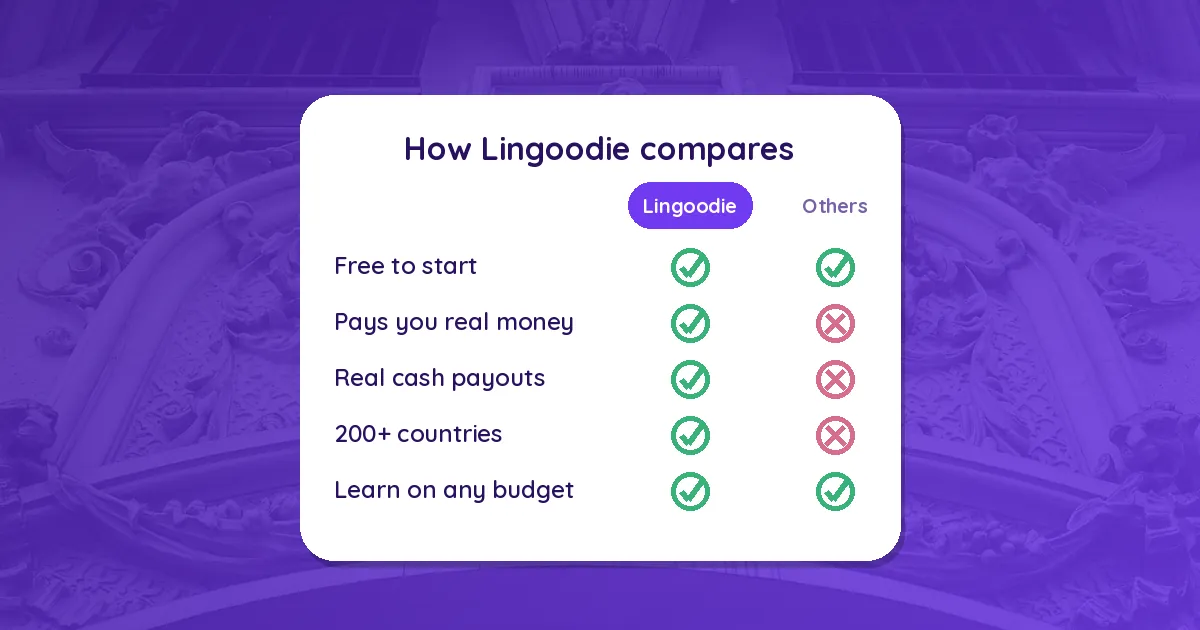
Lingoodie is free to download, covers Spanish (along with French and Portuguese), and pays you real cash for completing lessons. No subscription, no paywalls. You complete a vocabulary quiz, earn points based on how you do, and cash out to Revolut, which is instant and free once you hit the 2,500 point minimum, or to PayPal, which has a higher 100,000 point minimum, takes PayPal 1 to 3 business days to process. It sits alongside a small group of apps that pay real money for something genuinely useful. We dug into whether you can actually get paid to learn a language in a separate post.
The idea came from exactly this kind of conversation: people who want to learn a language but struggle to keep the habit going. When there's a small, real financial reward attached to your daily Spanish practice, showing up suddenly feels different. You're not just learning for some vague future payoff. You're earning today.
Download Lingoodie free on Google Play or the App Store and use it alongside the other tools in this list.
The Free Spanish Learning Stack I'd Actually Recommend
If you're starting from zero and want the most effective, lowest-cost setup, here's what I'd suggest:
Daily anchor: Lingoodie for a short vocabulary session that actually pays you back (it's the habit keeper)
Daily supplement: Duolingo or Memrise (15 to 20 minutes, pick one and stick to it)
Weekly: Coffee Break Spanish podcast (2 to 3 episodes while commuting or exercising)
Occasionally: Speak.social group sessions (whenever the schedule fits, especially for speaking practice)
When you're ready to spend a little: one tutoring session per week on Preply or iTalki
You don't need a €300 course. You don't need a language school. You need consistency, a few good free tools, and eventually a real human to practice with.
My aunt took this advice and started with Duolingo and the podcast. Last I checked, she was still at it. That's the whole game, really: finding the combination that keeps you coming back tomorrow.
Lingoodie is the language learning app that pays you real cash for completing lessons. Available free on Google Play.