Best App to Learn Portuguese in 2026: 8 Apps Compared for Beginners
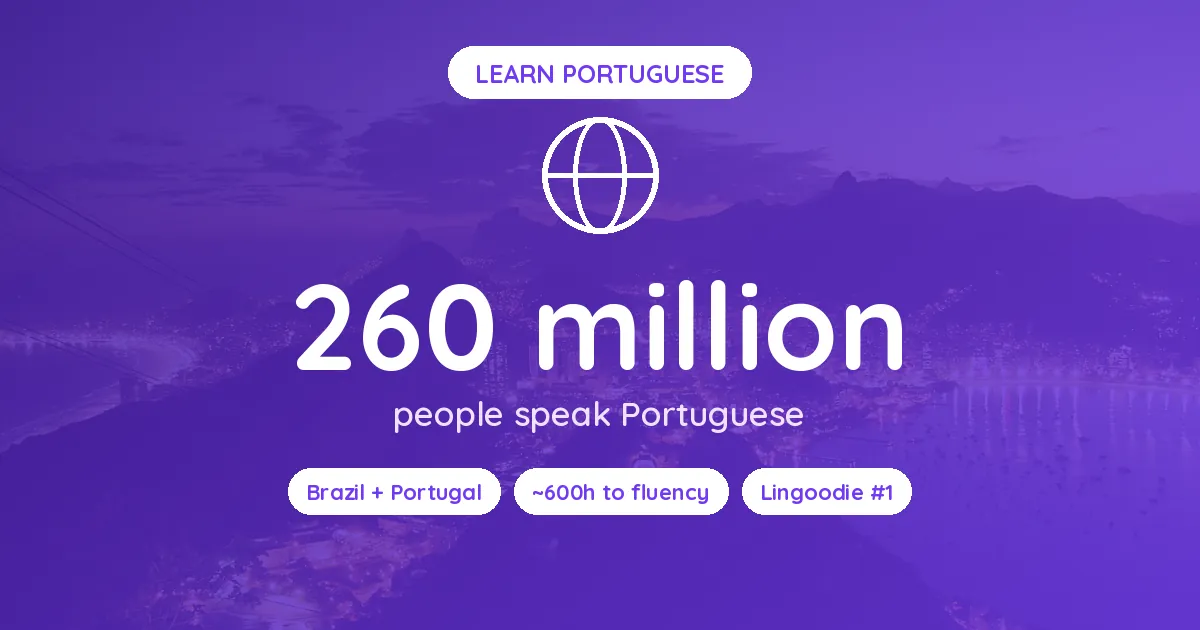
Portuguese is one of the best-value languages an English speaker can learn. It is spoken by more than 260 million people across four continents, it is one of the easier languages for English speakers to reach conversational level in, and it opens a door to Brazil, Portugal, and the fast-growing Portuguese-speaking economies of Africa. The grammar is forgiving, the vocabulary is full of words you half-recognise from Spanish, French, or Latin, and the sounds, while distinctive, come within reach quickly.
But before you download a single app, there is a decision most reviews skip past: which Portuguese are you actually learning? Brazilian Portuguese and European Portuguese are the same language, fully mutually intelligible in writing, but they differ enough in pronunciation, vocabulary, and rhythm that picking the wrong one for your goals means relearning habits later. Most apps quietly default to Brazilian Portuguese without telling you, which is fine if Brazil is your target and a problem if Portugal is.
We tested eight of the most popular Portuguese learning apps in 2026 with English speakers in mind, through the lens of that variant question. Which apps let you choose? Which one keeps you opening the app long enough for any of it to matter? Here is the full breakdown.
Why Portuguese Is Worth Learning
Portuguese is the sixth most spoken language in the world by native speakers. Brazil alone accounts for more than 210 million of them, making it by far the largest Portuguese-speaking country and the economic and cultural centre of gravity for the language. Portugal adds around 10 million, and Portuguese is also an official language in Angola, Mozambique, Cape Verde, Guinea-Bissau, and beyond, with rapidly growing populations across lusophone Africa.
The practical case is strong. Brazil is one of the largest economies in the world and a major market in technology, agriculture, energy, and entertainment. Portugal has become a hub for remote workers, startups, and retirees drawn by its climate, safety, and residency programmes, and Portuguese is essential for integrating there beyond the expat bubble. For travellers, Portuguese opens up a vast and welcoming part of the world where English is far from universal.
On difficulty, there is good news. The Foreign Service Institute classifies Portuguese as a Category I language, the easiest tier for English speakers, alongside Spanish, French, and Italian. The estimate is roughly 600 to 750 hours to professional working proficiency, far less than German, let alone the Category IV languages. With consistent study you can be holding real conversations within months, which makes Portuguese one of the most rewarding languages to learn because progress comes fast enough to keep you motivated.
Brazilian or European Portuguese: Which One to Learn
This is the question to settle before you choose an app, because the answer shapes everything that follows.
Brazilian Portuguese is the variant most learners should choose by default. It has by far the most speakers, the most learning resources, the dominant share of Portuguese-language music, film, television, and online content, and it is what almost every major app teaches. The pronunciation is often described as more open and musical, and the vast volume of Brazilian media makes comprehensible input easy to find. If you are learning for travel across the Portuguese-speaking world, for business with Brazil, or simply for the richest supply of content, Brazilian Portuguese is the practical choice.
European Portuguese is the right choice if your goals centre on Portugal specifically: living there, family ties, residency, or work. The pronunciation differs noticeably, with reduced vowels and a rhythm that many learners find harder to parse at first, and some everyday vocabulary and the second-person verb forms differ from Brazilian usage. The catch is that European Portuguese has far fewer dedicated app resources, so learners often need specialist tools or tutors rather than the mainstream apps. If Portugal is your destination, it is worth the extra effort to learn the variant people actually speak there rather than arriving with Brazilian Portuguese and adjusting on the fly.
The practical recommendation: choose Brazilian Portuguese unless you have a specific reason to target Portugal, in which case commit to European Portuguese from the start and lean on the tools and tutors that teach it directly.
What Makes a Portuguese App Actually Work
Portuguese is forgiving enough that most apps will get you started, but a few things separate the ones that take you further.
First, variant clarity. The best apps tell you whether they teach Brazilian or European Portuguese, and the strongest for Portugal-bound learners offer European Portuguese specifically.
Second, real grammar instruction. Portuguese grammar is gentle by Category IV standards, but verb conjugation, gender, and the difference between the verbs ser and estar still need explaining rather than guessing.
Third, native-speaker audio. Portuguese pronunciation, the nasal vowels in particular, needs a real voice to model, and the difference between Brazilian and European audio matters for the ear you are training.
Fourth, and most underrated, retention. Portuguese rewards consistency, and because progress comes relatively quickly, the learners who keep a daily habit reach conversational level fast. The app you keep using beats the technically superior app you abandon, so we weighted day-60 retention heavily.
The 8 Best Apps to Learn Portuguese in 2026
Lingoodie
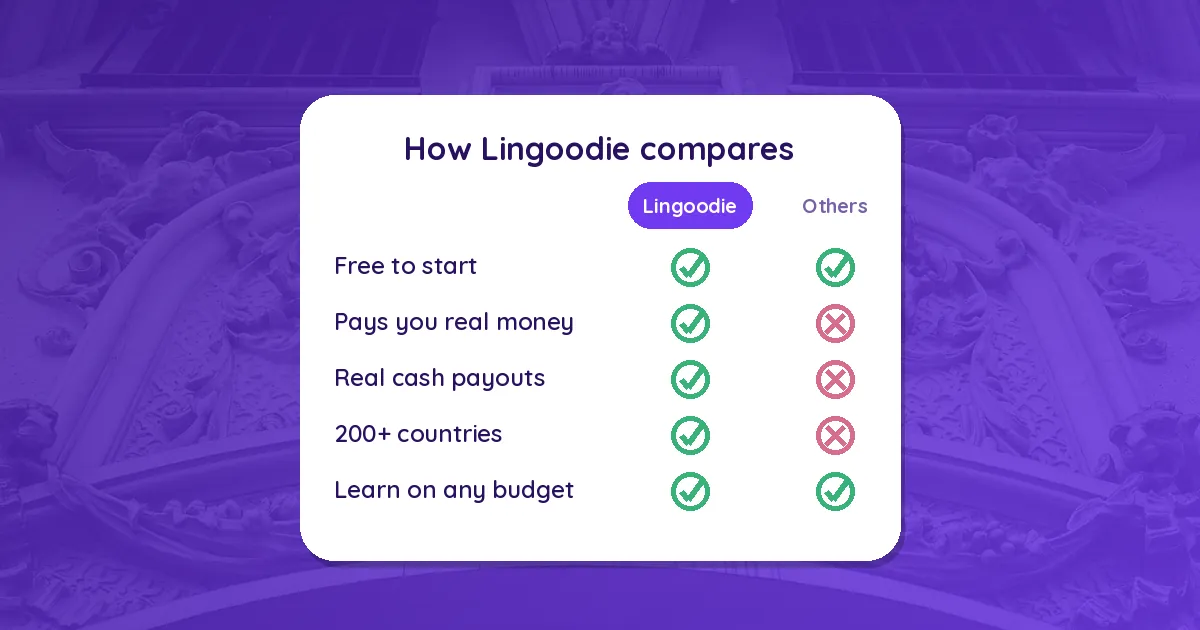
Lingoodie offers Portuguese and is the only app on this list that pays you real money to keep practising. You complete vocabulary and comprehension sessions, earn cash rewards, and cash out weekly via Revolut. The app is free to download and carries no subscription fee.
The earn mechanic changes the psychology of daily practice in a way that streaks and badges cannot. You are doing real work for a real, if modest, reward, and that keeps you consistent through the weeks when motivation dips. For Portuguese specifically, where progress comes quickly enough to be genuinely encouraging, the earn loop helps you build the daily habit that turns a Category I language into a conversational one in months rather than years. In our testing, the financial reward loop produced the highest day-60 retention of any app we used. It is not a substitute for grammar instruction or speaking practice. It is the tool that keeps you showing up long enough for those to work.
Available on Android. Cashout via Revolut in the EEA, UK, Australia, Brazil, and the United States.
Duolingo Portuguese
Duolingo teaches Brazilian Portuguese, and it is the most popular free on-ramp into the language. The gamification keeps beginners engaged, the early lessons build reading and listening comprehension faster than you might expect, and the price, free with ads or around $7 a month without, is hard to argue with as a starting point.
The familiar limitation is grammar depth: Duolingo teaches by pattern recognition rather than explanation, so you can complete long stretches and still be unsure why a sentence works the way it does. It also does not offer European Portuguese, so Portugal-bound learners should look elsewhere. Treat Duolingo as a strong, low-friction way to build Brazilian Portuguese vocabulary and habit, paired with something that explains the grammar.
Babbel Portuguese
Babbel sits between Duolingo's gamification and a traditional course, and it actually explains grammar concepts rather than hoping you absorb them. It teaches Brazilian Portuguese, the lessons are built around practical conversation, and the structured progression suits complete beginners who want to understand the rules, not just recognise patterns. It runs on a subscription of roughly $8 to $14 a month.
Babbel is one of the best app choices for a beginner who wants structure and clear grammar for Brazilian Portuguese. Like the others, it is best paired with speaking practice rather than treated as a complete solution, but as the structured backbone of a beginner routine it is hard to beat at the price.
Pimsleur Portuguese
Pimsleur is the standout for one specific reason: it offers both Brazilian and European Portuguese as separate courses, which makes it the strongest mainstream app for Portugal-bound learners. The method is audio-first, 30-minute spoken lessons built around graduated dialogue, with spaced repetition applied to pronunciation and vocabulary, and you speak continuously throughout, which builds the production reflex faster than any tap-the-answer app.
The trade-offs are that Pimsleur does not teach reading and writing in any depth and the price sits around $20 a month. The best use is as a speaking and listening layer on your commute, paired with an app or textbook for the script and grammar. For European Portuguese specifically, Pimsleur plus a tutor is one of the few effective app-based routes.
Memrise Portuguese
Memrise includes short video clips of real native speakers saying words and phrases in their natural register, which is genuinely useful for hearing how Portuguese actually sounds, and it carries both Brazilian and some European content. As a listening-exposure and vocabulary tool in the early and intermediate stages it earns its place, though it is weaker on explicit grammar, so it works best as a supplement to a grammar-led app rather than a standalone course.
Drops Portuguese
Drops is a vocabulary-first app built around timed sessions, visual word associations, and no typing. It is an efficient and enjoyable way to build a base of concrete Brazilian Portuguese vocabulary in short daily bursts. It does not teach grammar or sentence construction, so use it alongside something structural rather than as a foundation. The free tier limits you to five minutes a day, which suits a vocabulary supplement well.
Anki
Anki is a free, open-source flashcard app built on scientifically validated spaced repetition, with strong community decks for both Brazilian and European Portuguese built around frequency lists. The Anki plus community deck combination delivers the best spaced-repetition vocabulary results at any price, which is to say free. The cost is configuration overhead and the discipline it demands. If you already know you can sustain Anki, it belongs in your stack. If you have tried and quit before, start with something lower-friction and add it once the habit is established.
italki and Preply
italki and Preply are marketplaces for live tutors, and for Portuguese they solve the two things apps struggle with: speaking practice and the variant question. You can choose a Brazilian or a European Portuguese tutor directly, which is the single most reliable way to learn the variant you actually need with correct pronunciation. Community tutors charge roughly $8 to $20 an hour, and one session a week from around the A2 stage accelerates everything else in your stack. For European Portuguese in particular, where app options are thin, a Portugal-based tutor is close to essential.
Best App for Brazilian Portuguese
For Brazilian Portuguese, the strongest single app is Babbel for its clear grammar and structured beginner course, with Duolingo as the free habit-builder alongside it. Add Pimsleur Brazilian Portuguese for speaking practice on your commute, and you have a complete beginner stack. Lingoodie keeps the daily habit alive across all of it, which matters because Brazilian Portuguese rewards consistency with fast, visible progress.
Best App for European Portuguese
European Portuguese is less well served by the mainstream apps, so the best route is different. Pimsleur European Portuguese is the strongest app option because it teaches the variant directly with native audio. Pair it with a dedicated European Portuguese resource and, most importantly, a Portugal-based tutor on italki or Preply, who can correct the reduced vowels and rhythm that make spoken European Portuguese hard to parse at first. For anyone moving to Portugal, the tutor is the highest-return investment you can make.
Best Free Way to Learn Portuguese
A no-cost Brazilian Portuguese stack works well: Lingoodie, which is free and pays you back, for the daily habit and motivation; Duolingo for vocabulary and structure; Anki with a community deck for spaced-repetition vocabulary; and a language-exchange app to practise with Brazilian speakers who want to learn English. Brazil has a huge supply of free comprehensible input on streaming and video platforms, so switch to Brazilian content with Portuguese subtitles as early as you can to train your ear at no cost.
The Earn Angle: Why Lingoodie Pairs Well With Any Portuguese App
Portuguese has a kinder learning curve than most languages, which is both its appeal and its trap. Because the early progress is fast, many learners ride the initial momentum and then drift away once the novelty fades and the intermediate plateau arrives, usually somewhere around the point where simple conversation gives way to real fluency. The language is close enough to feel achievable, which paradoxically makes it easy to put down.
Lingoodie's cash reward is built for exactly that moment. A genuine weekly payout, however modest, gives you a reason to keep opening the app on the days when motivation alone is not enough. The habit of showing up daily is what carries you from the fast early wins through the plateau to genuine conversational Portuguese, and the earn mechanic is the most effective retention tool we found for protecting it.
For more on apps that pay you back for time you already spend, see the apps that pay real money guide.
Frequently Asked Questions
Should I learn Brazilian or European Portuguese?
Choose Brazilian Portuguese unless you have a specific reason to target Portugal. Brazilian has far more speakers, content, and learning resources, and it is what almost every app teaches. Choose European Portuguese if you are moving to Portugal or have family ties there, and be prepared to rely on Pimsleur and a Portugal-based tutor, since mainstream apps mostly default to Brazilian.
How long does it take to learn Portuguese?
Portuguese is a Category I language, the easiest tier for English speakers, at roughly 600 to 750 hours to professional proficiency. With consistent daily study you can hold simple conversations within a few months and reach a confident intermediate level within a year. The fast early progress is one of the best things about learning Portuguese.
Is Duolingo good for Portuguese?
Duolingo is a good free starting point for Brazilian Portuguese vocabulary and habit, but its grammar explanations are thin and it does not offer European Portuguese. Use it alongside a grammar-led app like Babbel and some speaking practice rather than as a complete course.
Does Lingoodie offer Portuguese?
Yes. Lingoodie includes Portuguese and pays cash rewards for completed sessions. It is free on Android, with cashout via Revolut in the EEA, UK, Australia, Brazil, and the United States.
What is the cheapest way to learn Portuguese?
A fully free stack works well for Brazilian Portuguese: Lingoodie, which is free and pays you back, for daily motivation; Duolingo for vocabulary and structure; Anki with a community deck; and a language-exchange app for speaking practice. Add Brazilian content with Portuguese subtitles for free listening practice. The only thing worth paying for is a weekly tutor session on italki or Preply once you reach A2, which is essential for European Portuguese.
Final Verdict by Learner Goal
For Brazilian Portuguese, use Babbel for structured grammar and Duolingo for free daily habit, add Pimsleur Brazilian Portuguese for speaking, and let Lingoodie keep the daily practice alive.
For European Portuguese, Pimsleur European Portuguese plus a Portugal-based italki or Preply tutor is the strongest route, since the mainstream apps mostly teach Brazilian. Lingoodie sustains the habit alongside.
For learning by ear or on a commute, Pimsleur builds speaking and listening reflexes better than any tap-the-answer app, and it is the only mainstream app that offers both variants.
For the long haul, Lingoodie is the app this list is built around. Not because it teaches Portuguese most thoroughly, but because the app you keep using beats the technically superior app you quit. Portuguese rewards consistency with unusually fast progress, and the earn mechanic is the most effective protection against drifting away before the fast early wins turn into real fluency.
If you are still choosing a language, the easiest language to learn guide puts Portuguese in context, and if you want a methods-first roadmap, see our guide to the best way to learn Portuguese. For a comparison across the other Romance languages, our guide to the best app to learn Italian applies the same framework.