Easiest Languages to Learn for English Speakers in 2026 (Ranked by Real Data)
Learning a new language is one of the best decisions you can make in 2026. But choosing the right one to start with makes a bigger difference than most people realise. Pick the wrong language and you are staring down five to ten years of effort. Pick the right one and you could be having real conversations in six months.
This guide ranks the easiest languages for English speakers using real data from the Foreign Service Institute (FSI), CEFR research, and learner experience. By the end, you will know exactly which language to learn first and the best tools to get you there.
How Language Difficulty Gets Measured
The most reliable source on language learning difficulty is the US Foreign Service Institute. The FSI trains professional diplomats to reach professional working proficiency, so their data is rigorous and practical.
The FSI groups languages into four categories based on how many classroom hours it typically takes an English speaker to reach professional proficiency:
- Category I (600-750 hours): Closely related languages. Spanish, French, Italian, Portuguese, Dutch, Norwegian, Swedish, Danish, Romanian.
- Category II (900 hours): Languages with significant differences from English but still accessible. German, Indonesian, Malay, Swahili.
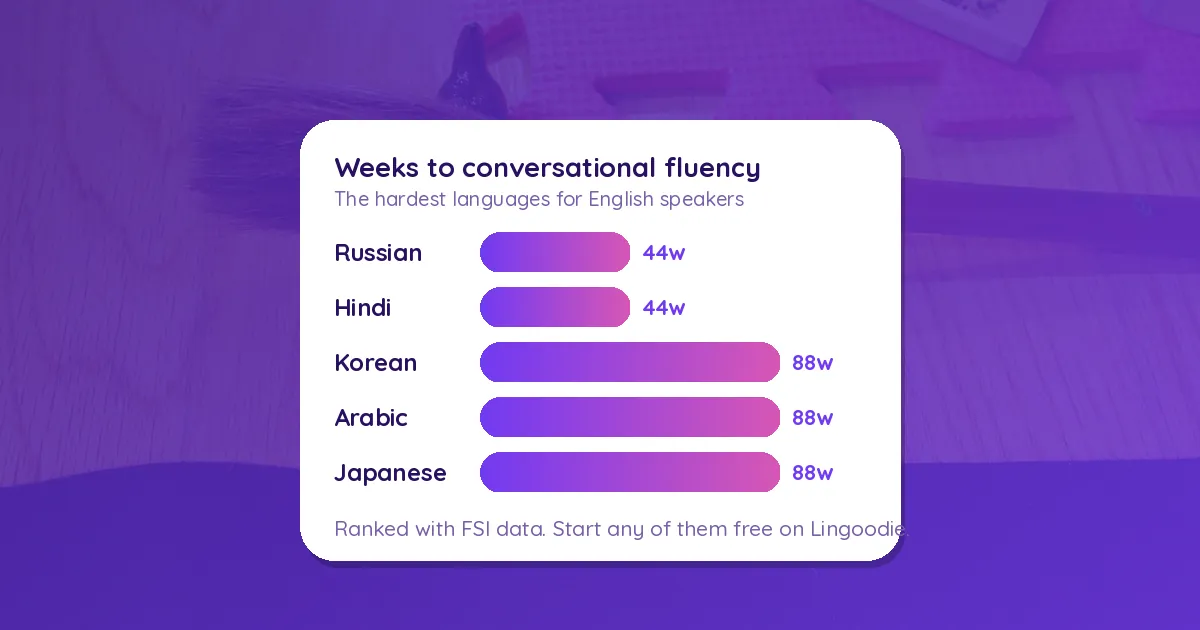
- Category III (1,100+ hours): Substantial differences in grammar, script, or culture. Russian, Polish, Turkish, Hebrew, Hindi.
- Category IV (2,200+ hours): The hardest languages for English speakers. Arabic, Chinese, Japanese, Korean.
Everything in Category I and II is considered learnable at a conversational level in under two years of consistent study. The languages in this guide all sit in Category I, making them your fastest path to fluency.
Beyond FSI hours, two other factors determine ease:
Shared vocabulary: English shares Latin roots with French, Spanish, Italian, and Portuguese. That means thousands of words you already know carry over directly. The word for "nation" in French is "nation." In Spanish it is "nación." In Italian it is "nazione." You already know these words.
Alphabet and phonology: Languages that use the Roman alphabet and have sounds similar to English are significantly easier to start with. Spanish, Italian, Dutch, and Norwegian all qualify. French introduces some new sounds but nothing that takes more than a few weeks to master.
The 5 Easiest Languages for English Speakers
Based on FSI data, linguistic similarity, and learner success rates, these are the five languages that consistently take the least time for English speakers to reach conversational fluency:
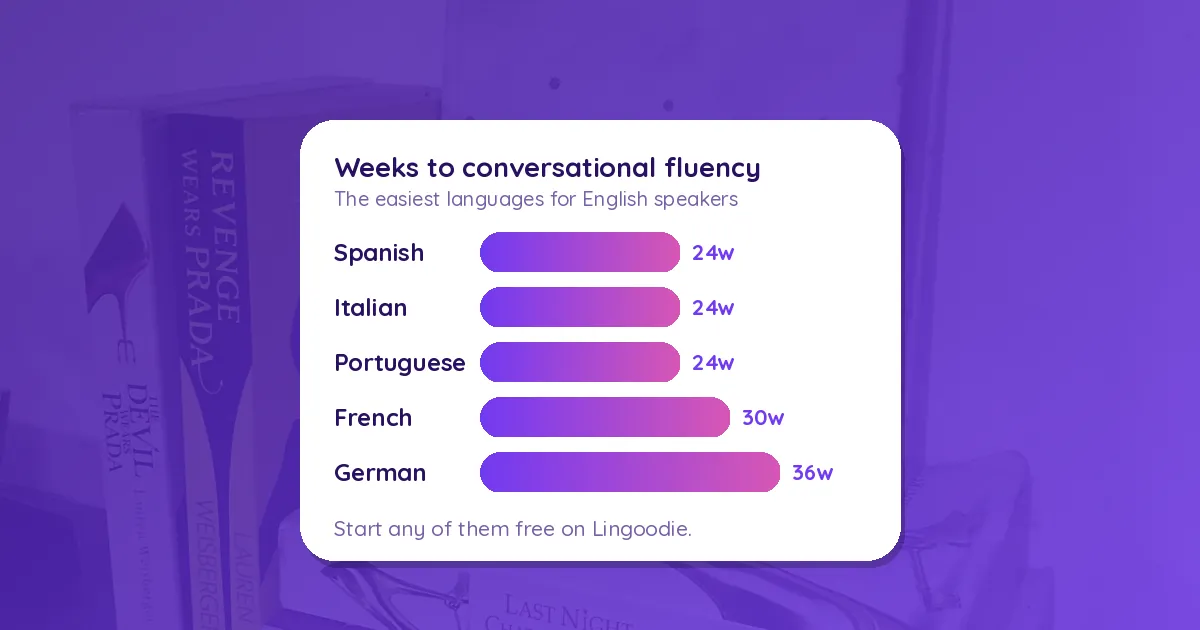
- Spanish (600-750 hours to professional proficiency)
- Italian (600-750 hours)
- French (600-750 hours)
- Portuguese (600-750 hours)
- Norwegian (600-750 hours)
Dutch is worth a special mention. The FSI places it firmly in Category I, and linguists often describe it as "the bridge between English and German." If you want to eventually learn German, starting with Dutch is a smart strategy.
All five of the languages above share three things: Roman alphabet, substantial vocabulary overlap with English, and well-resourced learning ecosystems meaning apps, textbooks, tutors, and immersion content are plentiful.
Spanish: Easiest for Most People and Here Is Why
Spanish consistently tops every "easiest language" list, and for good reason. It combines the highest learner demand (330 million native speakers in 20+ countries), the most resources, and genuine phonetic simplicity.
Why Spanish is the easiest:
Spanish is phonetically transparent. Every word is pronounced exactly as it is written, and Spanish uses only five vowel sounds compared to English's twelve or more. Within a week of study, most learners can read Spanish out loud with reasonable accuracy.
Grammar is more regular than English in some ways. Spanish verb conjugations follow predictable patterns. Irregular verbs exist, but the irregular forms are high-frequency words you will encounter every day, so they become automatic quickly.
Vocabulary overlap: English shares around 40% of its vocabulary with Spanish due to shared Latin and French roots. Words ending in "-tion" in English become "-ción" in Spanish. Words ending in "-ity" become "-idad." The patterns are learnable in an afternoon.
Target: 6-12 months to conversational, 18-24 months to comfortable fluency.
For a structured approach to learning Spanish, the guide to best way to learn Spanish covers the methods backed by linguistics research. For app recommendations, the full comparison of best language learning apps ranks every major platform head to head.
French: Beautiful, Logical, and Faster Than You Think
French has a reputation for being difficult, largely because of pronunciation and the number of silent letters. That reputation is only partly deserved.
Why French is easier than people think:
The FSI rates French at 600-750 hours, exactly the same as Spanish. Its grammar is more complex than Spanish (gender agreement, verb moods, more irregular forms), but its vocabulary overlap with English is even higher. The Norman Conquest of England in 1066 poured thousands of French words into the English language, and many of those words survive today: "beef" comes from "boeuf," "government" from "gouvernement," "art" from "art."
English speakers typically already understand 1,500 to 2,000 French words before they study a single lesson.
Where French gets tricky:
Pronunciation. French has nasal vowels, a uvular "r" that does not exist in English, and a tendency to drop the ends of words. The word "beautiful" is spelled "beau" but sounds closer to "bo." These hurdles are real but not insurmountable. Most learners plateau at pronunciation for about three to four weeks before it clicks.
Target: 8-14 months to conversational, 20-28 months to comfortable fluency.
If you are serious about learning French, the guide on how to learn French maps out a step-by-step roadmap from absolute beginner to conversational.
Italian and Portuguese: The Overlooked Easy Options
Italian and Portuguese are linguistically close cousins of Spanish, which means if you have studied Spanish, these two become dramatically easier. But even without any prior Romance language experience, both rank firmly in Category I.
Italian:
Italian is often described as the most phonetically regular language in the Category I group. Every letter is pronounced, stress patterns are predictable, and grammar gender rules are simpler than French. The main difficulty is vocabulary overlap. English has slightly fewer Italian cognates than French or Spanish, so vocabulary building requires more active effort early on.
Italian is also one of the richest cultural languages in the world. Opera, cuisine, architecture, fashion, and Renaissance art all originate from Italian-speaking culture, which makes immersion through media and interest-based learning easier than it sounds.
Target: 6-12 months to conversational.
Portuguese:
Portuguese sits at an interesting position: its grammar is highly similar to Spanish, and Brazilian Portuguese in particular has clear pronunciation that English speakers can pick up faster than European Portuguese. The challenge is that Portuguese does use nasal vowels (similar to French), and some of its phonological features are genuinely harder to master than Spanish or Italian.
The payoff is access to 260 million native speakers across Brazil, Portugal, Angola, and Mozambique, a growing economic and cultural footprint that makes Portuguese an increasingly strategic language choice.
Target: 8-14 months to conversational.
For a full comparison of apps and methods for learning Italian, see the guide to best app to learn Italian.
Dutch and Norwegian: The Hidden Easy Languages
These two deserve more attention than they get.
Dutch:
Dutch is the closest living language to English. The two languages share a Germanic ancestor, which means basic vocabulary, sentence structure, and even some pronunciation are intuitive for English speakers. "Water" in Dutch is "water." "Hand" is "hand." "Good" is "goed" (pronounced roughly "khoot"). "House" is "huis" (pronounced "howss").
The FSI rates Dutch at 600-750 hours, putting it squarely in Category I. Dutch grammar introduces grammatical gender (de/het articles) and verb position rules that feel strange at first, but learners consistently report faster initial progress in Dutch than in Spanish because so many words are already familiar.
Norwegian:
Norwegian is possibly the most surprising entry on this list. The FSI agrees it is Category I, and several academic studies on second language acquisition rank Norwegian as the easiest language for English speakers to reach basic conversational level.
Why? Norwegian word order closely mirrors English. Its verb conjugation is simpler than English (no person agreement: the word for "I am," "you are," and "she is" all use the same verb form). And Norwegian vocabulary contains a significant number of Germanic cognates that English speakers can guess intuitively.
The main challenge is that spoken Norwegian has many regional dialects that differ substantially. Standard Bokmål is the safe starting point and the dialect taught in virtually all language learning apps.
Dutch and Norwegian target: 5-10 months to conversational.
How Long Does It Actually Take to Learn an Easy Language?
The FSI 600-750 hour figure is based on intensive classroom study, five days a week, seven to nine hours per day. Very few language learners study at that pace.
Here is how the timeline breaks down for typical learners:
| Study Time Per Day | Hours to Conversational | Real-World Timeline |
|---|---|---|
| 30 minutes | 300-375 hours | 2-3 years |
| 1 hour | 300-375 hours | 11-15 months |
| 2 hours | 300-375 hours | 5-7 months |
| Intensive (4+ hours) | 300-375 hours | 2-3 months |
The "300-375 hours" figure for conversational (not professional) proficiency is commonly used by applied linguists as a realistic target for A2-B1 level, the level where you can handle most everyday situations.
Consistency beats intensity. Thirty minutes every day produces better results than two hours on Saturday. Spaced repetition of vocabulary, regular listening exposure, and early speaking practice all accelerate progress beyond what the raw hours suggest.
Best Apps to Start Learning Today
Apps have transformed language learning. The best ones combine structured lessons, spaced repetition vocabulary systems, speaking practice, and progress tracking in a format you can use anywhere.
Here is how the leading apps compare for Category I language learners:
Lingoodie -- The only app that pays you real money for learning. Lingoodie's earn-while-you-learn model means you accumulate earnings as you complete lessons, making it the most financially rewarding way to build a language habit. Available for all major Category I languages. Best for learners who want to monetise their study time.
Duolingo -- The most widely used language app in the world. Strong for Spanish, French, and Italian. Gamified to encourage daily habits. Weaker on structured grammar explanation and speaking depth.
Babbel -- More grammar-focused than Duolingo. Good for structured learners who want to understand why a sentence works, not just how to say it. Subscription required.
Pimsleur -- Audio-first approach, excellent for commuters. Built on spaced repetition of spoken phrases. Limited writing and reading practice.
Language Transfer -- Entirely free, audio-only, available for Spanish, French, Italian, Arabic, German, Greek, Swahili, and Turkish. Exceptionally good for building intuitive understanding of grammar. No app required.
For a full ranking of every major language learning app with detailed testing notes, the guide to best language learning apps covers all the major options across every platform.
Which Easy Language Should You Actually Learn?
The honest answer is: the one you are most motivated to use.
Motivation and consistency are bigger predictors of success than linguistic similarity. A learner who genuinely loves Italian music will outperform a learner who chose Spanish because it is "easiest" but has no connection to Spanish-speaking culture.
That said, here is a practical decision framework:
Choose Spanish if: You live in or near the Americas, you want the largest number of speakers to practise with, or you plan to travel to Spain or Latin America.
Choose French if: You are interested in European or African culture, you work in international organisations (French is one of the UN's six official languages), or you plan to learn other Romance languages afterwards (French grammar is a strong foundation).
Choose Italian if: You have a passion for food, design, opera, or classical history, or you want to visit Italy extensively.
Choose Portuguese if: You have business or personal connections to Brazil, Portugal, or Lusophone Africa.
Choose Norwegian or Dutch if: You want the fastest possible path to basic conversational ability, or you are interested in Scandinavian culture (Norwegian) or the Netherlands and Belgium (Dutch).
One more consideration: Lingoodie pays you to learn. Choosing a language available on Lingoodie means your study time generates real earnings alongside real language skills. That changes the economics of language learning in a way no other app currently offers.
Whichever language you choose, the key is to start. A language started today beats the perfect language planned for next month.
Ready to start earning while you learn? Download Lingoodie free on Google Play or the App Store and get paid to study the language you have always wanted to speak.