Hardest Languages to Learn for English Speakers (Ranked by Hours Needed)
Everyone asks which languages are easy to learn. But sometimes you want to tackle something harder. Maybe Arabic is the language of your partner's family. Maybe you are chasing a career that demands Mandarin. Maybe you just want the challenge.
Whatever the reason, you deserve straight answers about what you are getting into.
This guide uses real data from the Foreign Service Institute (FSI) -- the US government body that has trained diplomats in foreign languages for over 70 years. Their difficulty rankings are the closest thing to a scientific consensus on how long it takes an English speaker to reach professional working proficiency.
Fair warning: some of these numbers are large. But the good news is that the first hundred hours always feel the hardest, and modern tools have made even Category IV languages more approachable than they were a decade ago.
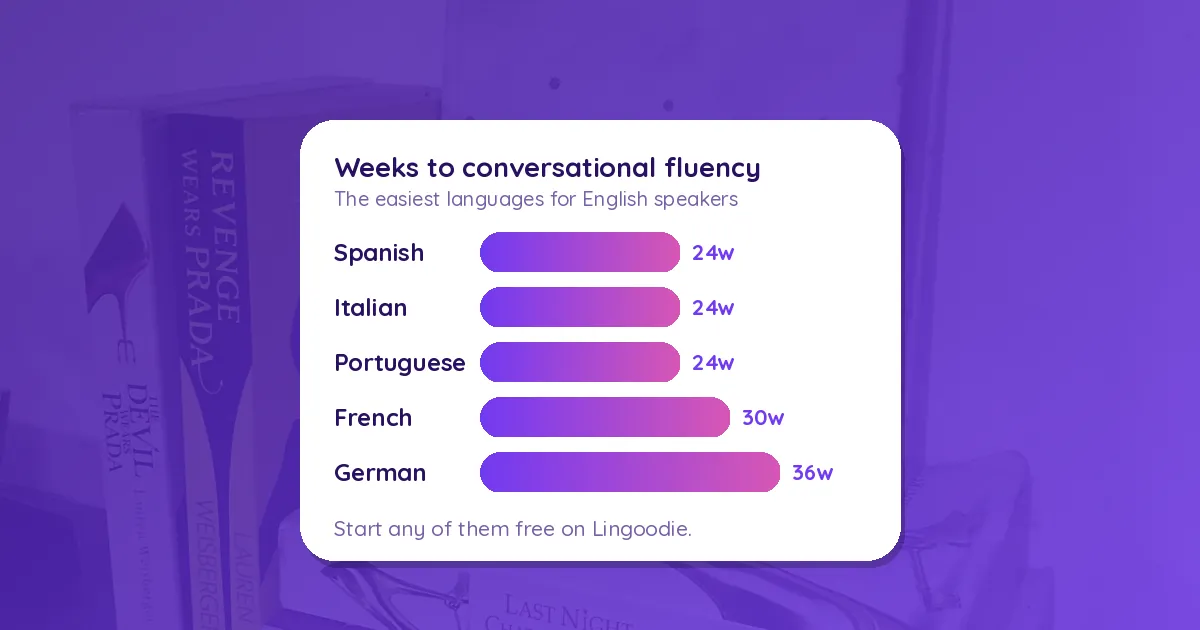
We recently published a companion post on the easiest languages to learn for English speakers -- worth reading alongside this one if you are weighing up your options.
Why Language Difficulty Varies by Native Language
Language difficulty is not an intrinsic property of a language. It is a relationship between where you are starting from and where you are going.
The FSI rankings are specifically calibrated for native English speakers. A French speaker learning Spanish, or a Korean speaker learning Japanese, will have a completely different experience than someone coming from English. The FSI estimates are also for "professional working proficiency" -- roughly CEFR B2/C1 level. Basic conversational ability takes considerably less time.
Three factors drive difficulty for English speakers:
Linguistic distance: Languages that share vocabulary, grammar structure, or script with English are faster to acquire. The further a language sits from English on those dimensions, the harder it is.
Script: Languages that use the Latin alphabet are immediately readable, even if pronunciation is different. Languages with different scripts -- Arabic, Chinese, Japanese, Korean -- require extra hours just to reach basic literacy.
Grammar complexity: Some languages have grammatical features that simply do not exist in English. Arabic's root-based morphology, Japanese honorifics, or Mandarin's tonal system all demand genuine rewiring of how your brain processes language.
The FSI Language Difficulty Categories Explained
The FSI divides languages into four categories for English speakers:
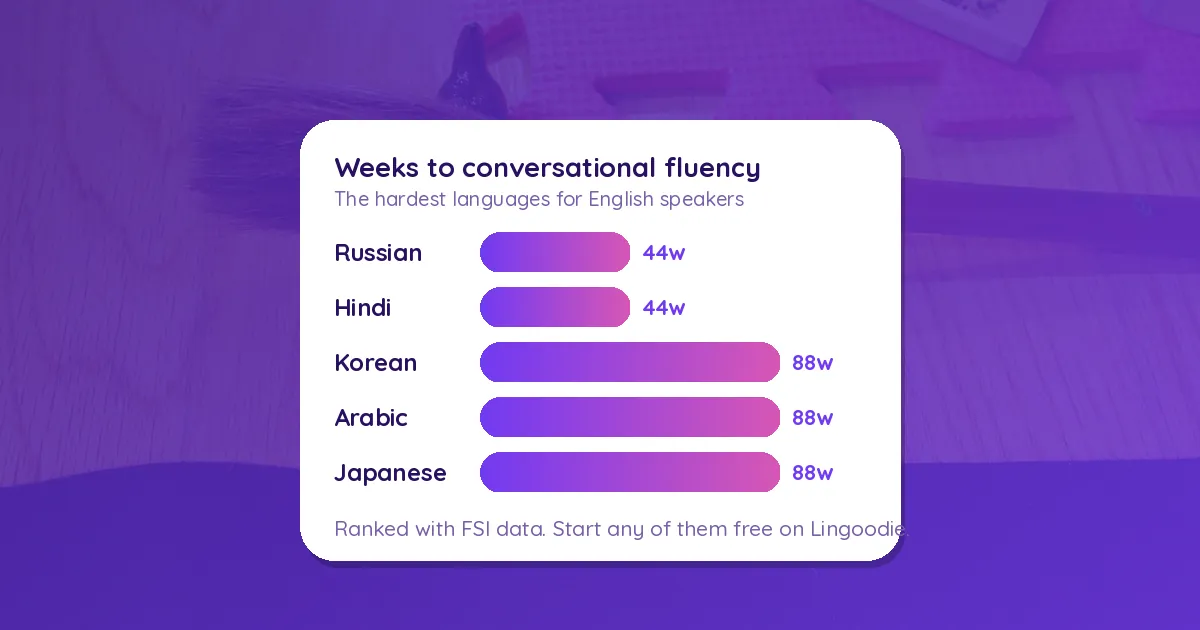
Category I (600-750 hours): Languages closely related to English. French, Spanish, Italian, Portuguese, Romanian, Dutch, Norwegian, Swedish, Danish. Most learners can reach professional proficiency in 24 to 30 weeks of intensive study.
Category II (900 hours): Moderate difficulty. German and some Malay varieties fall here. Grammatically more complex than Category I, but the script and many concepts remain familiar.
Category III (1,100 hours): Hard. Languages in this group include Indonesian (grammar) and some Baltic and Slavic languages, depending on the variant. Around 44 weeks of full-time study.
Category IV (2,200 hours): Exceptionally difficult. Arabic, Mandarin Chinese, Cantonese, Japanese, and Korean all sit here. These are listed as "super-hard" languages by the FSI and require roughly 88 weeks of intensive full-time study.
That means a Category IV language takes approximately three times as long as French or Spanish to reach the same level.
Category IV: The Hardest Languages for English Speakers
Let's look at each of the Category IV languages and understand specifically what makes each one difficult -- because the challenges are different for each.
| Language | FSI Hours | Script Challenge | Grammar Challenge | Tones |
|---|---|---|---|---|
| Arabic | 2,200 | High (Arabic script, RTL) | High (root system, cases) | No |
| Mandarin Chinese | 2,200 | Very High (thousands of characters) | Moderate | Yes (4 tones) |
| Cantonese | 2,200 | Very High (same characters as Mandarin) | Moderate | Yes (9 tones) |
| Japanese | 2,200 | Extreme (3 scripts, 2,000+ kanji) | High (particles, formality levels) | Pitch accent |
| Korean | 2,200 | Moderate (Hangul learned in hours) | High (agglutinative, SOV) | No |
Arabic: Script, Grammar, and Dialects All at Once
Arabic sits at the intersection of three major challenges: a completely different script, a radically different grammar system, and a situation where the language you study and the language people actually speak are not the same.
The script: Arabic is written right-to-left and uses a cursive alphabet where each letter changes shape depending on where it appears in a word. Vowels are typically not written in standard text -- experienced readers infer them from context. It is genuinely hard, and reaching basic reading fluency takes months before you can even start enjoying native content.
The grammar: Arabic uses a root-based morphological system. Most words derive from a three-letter root that carries a core meaning, and the same root can produce dozens of related words by changing the vowels and affixes around it. The word for "writer," "book," "library," "office," and "to write" all share the same k-t-b root. This system is elegant once you understand it, but it requires building an entirely new mental model.
The dialect problem: Modern Standard Arabic (MSA) is what news broadcasts and formal writing use. But spoken Arabic breaks into distinct regional dialects -- Egyptian, Levantine, Gulf, Moroccan -- that differ significantly from each other and from MSA. You often need to decide which variety to focus on, and then navigate the gap when you encounter other varieties.
If you are serious about Arabic, our guide to the best apps to learn Arabic covers the tools that handle both script learning and dialect exposure.
Japanese and Chinese: Two Writing Systems, One Language Each (Sort Of)
Japanese and Mandarin Chinese are often grouped together in casual conversation as "the Asian languages," but they are completely different languages with different grammar, pronunciation, and challenges. They do share one significant feature: both require learning thousands of written characters before you can read anything beyond simple signage.
Japanese: The Three-Script Problem
Japanese uses three writing systems simultaneously:
Hiragana and Katakana are syllabic scripts of 46 characters each. Most learners can memorize both in two to four weeks. They are logical, consistent, and you will use them immediately.
Kanji are the Chinese-derived characters that carry semantic meaning. The Ministry of Education designates 2,136 "commonly used" kanji for functional literacy. Learning to read and write all of them takes years of dedicated practice. Newspapers use the full set.
Native text typically mixes all three scripts on the same line.
On top of the writing system, Japanese has a complex system of politeness levels (keigo) that changes not just vocabulary but verb forms and entire sentence structures depending on the social relationship between speakers. Getting this wrong in a formal context is jarring to native speakers in a way that mispronouncing a vowel in French simply is not.
Japanese grammar is also verb-final and uses particles (small phonetic markers) to indicate the grammatical function of each word, which is a fundamentally different way of constructing sentences than English uses.
Mandarin Chinese: Tones and Characters
Mandarin has four tones plus a neutral tone, and the tone is part of the word's meaning -- not just its mood. The syllable "ma" means "mother," "hemp," "horse," or "to scold" depending on whether your voice rises, falls, dips, or stays flat. In connected speech, distinguishing tones becomes more natural with practice, but the initial phase of building tone recognition is genuinely effortful.
The writing system is the other major hurdle. Mandarin characters are not phonetic -- knowing what a word sounds like does not tell you how to write it. Each character must be learned individually. HSK level 6 (advanced proficiency) requires approximately 5,000 characters. Most daily communication uses a smaller set, and the HSK 4 level of about 1,200 characters covers a lot of practical ground.
The good news about Mandarin grammar itself: no verb conjugation, no gendered nouns, no plural forms. Sentence structure is relatively predictable. The language's difficulty is concentrated in the writing system and tones rather than distributed evenly across all areas.
For a complete breakdown of the best tools for learning Mandarin, see our guide to the best apps to learn Chinese.
Korean: Seems Harder Than It Is (and Also Exactly As Hard As It Is)
Korean occupies an interesting position. It is genuinely one of the hardest languages for English speakers to reach fluency in. But unlike the other Category IV languages, Korean has one feature that makes the entry barrier unexpectedly low: Hangul.
Hangul is the Korean alphabet, created in 1443 by King Sejong. It is a phonetic script with 24 base letters (14 consonants, 10 vowels) that combine into syllabic blocks. Most people can learn to read and pronounce Hangul correctly within one to two weeks. You will not understand what you are reading, but you will be able to decode the sounds.
This means Korean learners skip the multi-month script barrier that Arabic and Japanese learners face. You can start consuming native content (romanized is not even necessary) almost immediately.
Where Korean genuinely earns its Category IV rating is grammar. Korean is agglutinative -- you build complex meanings by stacking suffixes onto verb stems, and the suffixes can encode tense, aspect, formality, the speaker's relationship to the listener, and other information all at once. The subject-object-verb word order is also the reverse of English. And like Japanese, Korean has layers of speech formality that require different vocabulary and verb endings depending on social context.
Korean also has no genetic relationship to English whatsoever, which means almost no shared vocabulary, no cognates, no familiar roots to lean on.
How Many Hours Does It Really Take?
The 2,200-hour figure is the FSI's estimate for intensive classroom instruction aiming at professional-level proficiency. That is a specific and high target.
For most people learning for personal reasons -- travel, family, culture, career conversations -- a more useful benchmark is "functional conversational ability." Research suggests this arrives much earlier:
| Level | Approximate hours | What you can do |
|---|---|---|
| Absolute beginner to A1 | 50-80 hours | Introduce yourself, order food, read simple signs |
| A1 to A2 | 100-150 additional | Manage simple transactions, understand slow speech |
| A2 to B1 | 200-300 additional | Hold basic conversations, read simple text |
| B1 to B2 | 300-400 additional | Discuss familiar topics fluently, watch simple TV |
| B2 to C1 (professional) | 500-700 additional | Near-native comprehension in professional contexts |
The FSI 2,200 hours targets C1/C2. Reaching B1 in Arabic, Mandarin, Japanese, or Korean -- well within conversational reach -- takes something closer to 400 to 600 hours. Still substantial, but much less daunting.
The other factor the FSI hours do not capture: consistency matters more than intensity for most adult learners. Forty-five minutes daily for two years beats two hours daily for six months, because sleep and spaced repetition are doing real cognitive work between sessions.
Can Apps Help You Learn a Hard Language?
Apps were often dismissed as toys for serious language learning. That critique was fair for a long time. But the tools available in 2026 are meaningfully different from the vocabulary flashcard apps that dominated a decade ago.
Lingoodie deserves mention first for its unique approach: it is one of the few apps that pays you real money to learn. You earn rewards as you progress through lessons and complete challenges. For Category IV languages where motivation is a constant struggle over months or years, having a financial incentive built into your daily practice is a genuine differentiator. Available on Android.
Anki remains the gold standard for character and vocabulary memorization. Its spaced repetition algorithm is unmatched for the kind of high-volume memorization that Arabic script, kanji, and Chinese characters demand.
Duolingo has improved its Asian language offerings significantly. The Japanese course in particular now covers all three scripts. The gamification helps with habit formation, though vocabulary depth is still limited.
Pimsleur focuses on audio, which makes it especially useful for tonal languages (Mandarin) where hearing the correct sound pattern is as important as understanding the grammar. Expensive but effective for the audio dimension.
Ankerplatz / HelloChinese / LingoDeer are apps purpose-built for specific difficult languages (Mandarin and Korean/Japanese respectively). They often go deeper on grammar explanation and script teaching than general-purpose apps.
The honest assessment: no app alone will get you to B2 in a Category IV language. But an app as a daily anchor -- especially one that rewards consistency like Lingoodie does -- makes a dramatic difference in whether you stick to the long game.
Should You Learn a Hard Language? A Realistic Framework
Here is a practical way to think through the decision:
Ask what "success" means to you. Reaching basic conversational Japanese before a two-week Tokyo trip is completely achievable in six months. Reaching professional-level Arabic for a government career is a multi-year commitment. Neither is wrong -- but they require very different approaches.
Factor in your existing languages. If you already speak Spanish fluently, Italian will take about 600 hours. If you already speak Japanese fluently, Korean will take significantly less than 2,200 hours because of shared grammar patterns and Chinese character overlap. Your linguistic background shapes the calculus entirely.
Treat the script as a sunk cost, not a reason to quit. The first 60 to 100 hours with Arabic script or Japanese kana feel slow and frustrating. Nearly every learner reports this. Then something shifts and the script becomes automatic. Expect the plateau, plan for it, and do not let it define the whole experience.
Prioritize spoken production early. Many learners spend months on reading and writing before they feel confident speaking. This makes the language feel hard longer than it needs to. Even with imperfect grammar, early speaking practice pays massive dividends in retention and confidence.
Use the internet. The difficulty of finding native content has collapsed. Arabic dramas, Mandarin podcasts, Korean music, Japanese anime -- native content in any Category IV language is infinitely available and free. Consuming native media, even passively, is some of the most efficient language learning available.
The hardest part of learning a hard language is not any single grammar rule or character set. It is maintaining motivation and consistency across the months and years the language requires.
Pick a language you have a genuine reason to love. The hours are much more manageable when they are pointed toward something real.
Quick Reference: Difficulty Summary
| Language | FSI Hours | Hardest Part | Best First Step |
|---|---|---|---|
| Arabic | 2,200 | Script + dialects | Learn alphabet first (2-3 weeks) |
| Mandarin Chinese | 2,200 | Tones + characters | Start with pinyin + tones |
| Cantonese | 2,200 | 9 tones + characters | Audio immersion from day one |
| Japanese | 2,200 | 3 scripts + formality levels | Master hiragana/katakana in week 1-2 |
| Korean | 2,200 | Grammar + no English cognates | Learn Hangul in week 1 (very fast) |
Ready to start? Lingoodie rewards you for every lesson you complete -- so the harder the language, the more you earn. Download free on Google Play or the App Store.