Best App to Learn Arabic in 2026: 8 Apps Compared for English Speakers
Arabic is the language most learners want to start and the one they feel least equipped to approach. The script reads right to left. The sounds include consonants that have no English equivalent. And before you download a single app, you face a question that most language apps simply ignore: which Arabic are you actually trying to learn?
That question matters enormously. Modern Standard Arabic, Egyptian Arabic, Levantine Arabic, Gulf Arabic, and Maghrebi Arabic are related but genuinely different. Choosing the wrong one for your goals is like spending a year learning formal Latin because you want to speak Italian. You will end up with real knowledge that is not quite the right knowledge.
We tested eight of the most popular Arabic learning apps in 2026 with English speakers in mind, and we tested them through the lens of that dialect question. Which apps address it directly? Which apps pretend it does not exist? And which one keeps you opening the app long enough for any of it to matter?
Here is the full breakdown.
Why Arabic Is Worth the Effort
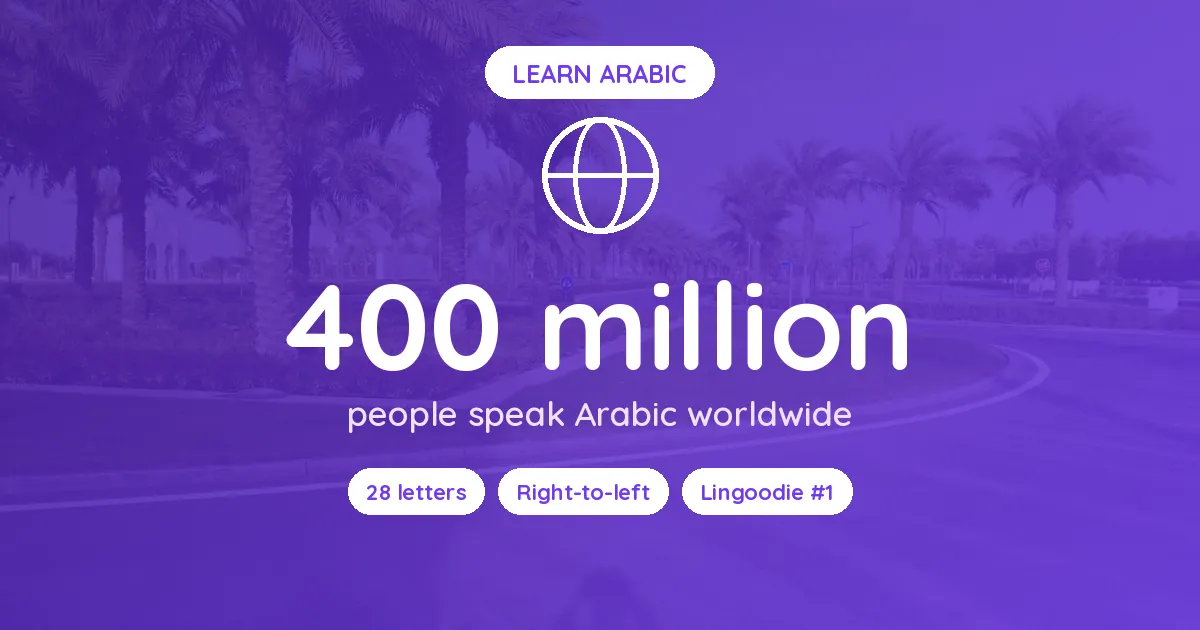
Arabic is the fifth most spoken language in the world by native speakers, with roughly 400 million people using some form of it as a first language across 25 countries. Arabic-speaking countries span from Morocco on the Atlantic coast to Oman on the Arabian Sea, encompassing the entire MENA region: the Middle East and North Africa corridor that contains the Gulf Cooperation Council economies, Egypt (the most populous Arabic-speaking country at 106 million people), and the Maghreb markets of Morocco, Algeria, and Tunisia.
For English speakers, Arabic opens doors that no other language can. Gulf-region jobs in finance, energy, and infrastructure are among the highest-paying English-bilingual positions available to Western professionals. Diplomatic, intelligence, and security careers in the US, UK, and Australia give Arabic a premium that the Foreign Service Institute formally acknowledges with specialist pay supplements. Academic research in Islamic studies, Middle Eastern history, and political science almost requires at least reading proficiency in Modern Standard Arabic. And for the estimated 3.5 million Arabic-heritage speakers in the United States alone, learning Arabic is a route back to family and identity that goes beyond career calculation.
The honest answer on difficulty: Arabic is FSI Tier 4, the hardest category for English speakers, alongside Chinese, Japanese, and Korean. The government estimate is roughly 2,200 class hours to reach professional working proficiency. That is not meant to discourage you. It is meant to set a realistic frame. Learners who enter Arabic expecting it to feel like Spanish by month six are setting themselves up for disappointment. Learners who enter expecting a long, fascinating, multi-year project with specific intermediate milestones along the way tend to stick with it.
The investment is commensurate with the payoff. Arabic fluency is genuinely rare among English speakers, which makes it disproportionately valuable in virtually every professional context where the language matters.
Modern Standard Arabic, Egyptian, Levantine, Gulf, Maghrebi: Which One You Should Actually Learn
This is the question most app reviews skip past, and skipping it is the single most reliable way to end up frustrated after six months of study.
Arabic exists in a state linguists call diglossia. There is a formal written and broadcast variety, Modern Standard Arabic (MSA), and there are the regional spoken varieties that actual people use in daily life. These varieties diverge significantly. MSA is not anyone's native spoken language. It is the language of newspapers, official speeches, literature, and news broadcasts. Spoken Arabic dialects are what people actually say to each other in shops, kitchens, and conversations. The gap between MSA and any specific dialect is roughly comparable to the gap between formal written Italian and a regional dialect like Neapolitan or Sicilian, except the Arabic dialects are more divergent from each other than Italian regional varieties are.
Modern Standard Arabic is what Duolingo, most coursebooks, and most structured apps teach. It is the correct choice if your goal is to read Arabic texts, write formal emails, follow news broadcasts, or pass standardised exams like the DLPT or the ACTFL. It is also the choice that makes travel harder because nobody in Cairo's street markets or Beirut's restaurants speaks MSA. Formal and correct, but not conversational.
Egyptian Arabic is the most widely understood dialect across the Arab world because Egyptian cinema and television have been the dominant popular culture of the region for a century. If your goal is to travel broadly through multiple Arabic-speaking countries, or to watch Arabic films and understand them, Egyptian Arabic is the most practically transferable dialect to learn. It is the de facto lingua franca among Arabic speakers from different regions.
Levantine Arabic covers Syria, Lebanon, Jordan, and Palestine, and is closely associated with Beirut's cultural and media output as well as the significant Lebanese diaspora in the US, Australia, and Latin America. If your connections, heritage, or travel plans centre on those countries, Levantine is the dialect to learn. It is also the dialect most represented in Arabic pop music and social media content from younger creators.
Gulf Arabic is spoken in Saudi Arabia, the UAE, Qatar, Kuwait, Bahrain, and Oman, and is the relevant choice for anyone pursuing work in the Gulf economies. Business professionals targeting the GCC region should learn Gulf Arabic specifically rather than defaulting to MSA, because formal professional relationships in the Gulf include social conversation in the local dialect and the ability to navigate that conversational register matters.
Maghrebi Arabic covers Morocco, Algeria, Tunisia, and Libya. It is the most divergent from MSA and from other spoken Arabic varieties, with heavy French and Amazigh substrate influence, particularly in Moroccan Darija. If your travel or professional goals are specifically in the Maghreb, Maghrebi Arabic is the only dialect that will actually make you useful in conversation. If your goals are broader across the Arab world, Maghrebi is the lowest-priority dialect to start with because it transfers least to other regions.
The practical recommendation: start with whichever dialect matches your actual reason for learning Arabic. If you are learning for religious purposes (reading the Quran), start with MSA. If you want to travel broadly across the Arab world, start with Egyptian Arabic. If your heritage is Lebanese, Syrian, Jordanian, or Palestinian, start with Levantine. If you are targeting Gulf employment, start with Gulf Arabic. If none of those specific anchors apply and you want the most transferable starting point, Egyptian Arabic is the best general-purpose choice.
What Makes an Arabic App Actually Work
The Arabic script is not optional. Every serious Arabic learning app teaches the alphabet (technically an abjad: consonants are written, short vowels are usually omitted except in learner materials and the Quran). The good news: Arabic script is considerably more learnable than Chinese characters. There are 28 letters, each with up to four forms depending on position in the word, and the system is phonetically consistent once you learn it. Most committed learners can read Arabic script slowly within 4 to 6 weeks of daily practice. Speed and fluency come over the following months.
An app that teaches Arabic in transliteration only (writing Arabic words in the Latin alphabet) is training a crutch you will eventually have to remove. Transliteration is useful for the first week as orientation, but any app that makes it your primary reading mode past week two is actively hindering your progress. The best apps move you into the script early and give you enough phonics support that the unfamiliarity fades quickly.
Beyond the script, the things that separate good Arabic apps from mediocre ones are: explicit dialect labelling (so you know whether you are learning MSA or a specific spoken variety), audio from native speakers rather than synthesised speech, and enough speaking and listening practice to build the phonetic muscle memory that Arabic specifically requires. The Arabic pharyngeal consonants and emphatic consonants do not exist in English, and they are non-negotiable for intelligibility. An app that does not address them directly is leaving a real gap.
The final and most underrated factor is retention. Arabic is hard enough and long enough that the app you keep using beats the technically superior app you abandon. We weighed day-60 retention heavily in our testing precisely because an 8/10 app used consistently for two years produces better Arabic than a 10/10 app used for six weeks.
The 8 Best Apps to Learn Arabic in 2026
Lingoodie
Lingoodie offers Arabic as part of its language portfolio and is the only app on this list that pays you real money to keep practicing. The model is simple: complete vocabulary and comprehension sessions, earn cash rewards, cash out via Revolut, which is instant and free once you clear the 2,500 point minimum, or via PayPal, which has a higher 100,000 point minimum and is processed by PayPal within 1 to 3 business days. The app is free to download and Lingoodie itself charges no subscription or withdrawal fees. The earn mechanic changes the psychology of daily practice in a way that gamification cannot replicate. You are doing real work for a real, if modest, reward, and that distinction matters precisely in the Tier 4 language context where visible progress comes slowly and motivation needs structural support.
For Arabic specifically, where the learning curve is steeper and longer than for any European language, the ability to sustain a daily habit past the 60-day mark is the most important variable. In our testing, the financial reward loop produced the highest day-60 retention of any app we used. It is not a substitute for grammar instruction or dialect-specific coursework. It is the tool that keeps you showing up long enough for the other tools to work.
Available on Android. Cashout via Revolut or PayPal in EEA, UK, Australia, Brazil, and the United States.
Pimsleur Arabic
Pimsleur offers two separate Arabic courses: Modern Standard Arabic and Egyptian Arabic. That alone makes it exceptional in a category where most apps treat Arabic as a single thing. The method is audio-first: 30-minute spoken lessons built around graduated dialogue, with spaced repetition applied to pronunciation and vocabulary. You speak continuously throughout each session, which builds the production reflex faster than any passive listening approach.
For Egyptian Arabic specifically, Pimsleur is the strongest audio-focused option on this list. The pharyngeal consonants, the vowel patterns, and the specific rhythms of spoken Egyptian Arabic are modelled by native speakers in a format designed to make them stick. For MSA, the Pimsleur course gives you a solid spoken foundation for formal contexts even though MSA is rarely spoken in daily life.
Pimsleur is subscription-based at around $20 per month. It does not teach the script, which is a meaningful limitation. The best use case is as a commute app paired with a script-teaching app like Duolingo or a textbook for reading skills.
Italki
Italki is a marketplace for live tutors, not a self-study app in the traditional sense. For Arabic, it is arguably the most important tool on this list beyond the habit-builder role Lingoodie fills, because the dialect question is one that a human tutor can answer for your specific situation in a way that no algorithm currently can.
An Italki tutor can diagnose whether your current approach matches your actual goals, correct your pronunciation in real time on sounds that most apps do not even address, and help you navigate the transition from script-learning to actual comprehension at a pace that is calibrated to you. Tutors on Italki advertise by dialect, so you can find a native Egyptian Arabic speaker, a native Levantine speaker, or a trained MSA instructor depending on what you need.
Community tutors on Italki charge roughly $6 to $20 per hour. Professional teachers charge $20 to $50 per hour. One tutor session per week from the A1 stage is one of the highest-return investments an Arabic learner can make, particularly for pronunciation.
Memrise
Memrise includes video clips of real native speakers saying words and phrases in their natural conversational register, which makes it genuinely valuable for Arabic learners trying to hear what spoken Arabic actually sounds like rather than the clean, slow audio most apps produce. The platform has both MSA and dialect-specific content in its community-created deck library, though the official curriculum leans toward MSA.
The spaced repetition system is solid, and Memrise works well as a vocabulary supplement. It is not strong on grammar instruction or script introduction. The best use of Memrise for Arabic is as a listening exposure tool in the intermediate stage, once you have the script and a basic grammatical framework from another source.
Mango Languages
Mango Languages offers both MSA and dialect-specific Arabic courses, which puts it in a small category of apps that actually take the dialect question seriously. The app is structured around conversational phrases and cultural context rather than grammar tables, making it accessible for beginners who find grammar-forward apps intimidating. The dialogue-based approach means you learn language as it functions in real exchanges rather than in isolation.
The downside is depth. Mango Languages tends to plateau around A2 for Arabic, and the grammar coverage is lighter than you need for intermediate progress. It is strong for travel Arabic, basic communication goals, and the early phase of dialect learning. For learners targeting B1 and beyond, Mango is a useful starting companion rather than a complete solution.
Duolingo Arabic
Duolingo Arabic teaches Modern Standard Arabic. The script instruction in the early lessons is actually one of Duolingo's strengths here: the gradual phonics introduction works reasonably well for getting learners reading Arabic letters within the first two weeks. The gamification keeps beginners engaged through the A1 phase.
The limitations are significant past A1. Duolingo Arabic does not address dialects at all, which means learners who finish the Duolingo tree will have useful reading and formal comprehension skills but will find themselves at a loss in actual spoken Arabic contexts. The grammar coverage is also shallow by the standards of what Arabic actually requires. Treat Duolingo as a strong tool for the Arabic alphabet and early vocabulary, and plan to supplement it with dialect-specific resources once you hit its ceiling.
Duolingo is free with ads or $7 per month for ad-free premium.
Drops Arabic
Drops is a vocabulary-first app with timed sessions, visual word associations, and no typing. For Arabic, it presents vocabulary in Arabic script with transliteration support, which is a reasonable position for early-stage learners. The visual encoding helps words stick faster than plain repetition.
Drops does not teach grammar, does not address dialects, and does not build sentence construction skills. It is a vocabulary accelerator. If your goal is to rapidly expand your Arabic word recognition, Drops is efficient. If your goal is to understand or speak Arabic, you need Drops alongside something with genuine structural content. Think of it as a supplement rather than a foundation.
Anki and Arabic Decks
Anki is a free open-source flashcard app built on scientifically validated spaced repetition. The Arabic learner community has produced extensive high-quality decks covering MSA vocabulary at each CEFR level, Quranic Arabic vocabulary, Egyptian colloquial vocabulary, and Levantine vocabulary, among others. The Anki plus community deck combination produces the best spaced-repetition vocabulary results available at any price point.
The limitation is configuration overhead and the discipline requirement. Anki works for motivated self-directed learners who have some prior experience with the tool. For most learners, the friction of setting up and maintaining Anki is a meaningful dropout risk, particularly in the early months when every friction point matters. If you know you can sustain Anki, it belongs in your stack. If you have tried and stopped before, start with something with lower friction and add Anki when the habit is already established.
Best App for the Arabic Script
Duolingo Arabic is the strongest standalone app for learning the Arabic alphabet from zero. The phonics progression in the first two weeks is well-designed, and the gamification provides enough short-term reward to get through the intimidating early stage of recognising unfamiliar letter forms. By the end of Duolingo's alphabet introduction section, most learners can read Arabic script slowly with vowel diacritics (the marks that make short vowels visible in learner materials).
After the alphabet stage, Pimsleur's audio approach builds phonetic muscle memory for the sounds that the letters represent, which accelerates reading fluency by strengthening the connection between what you see on the page and what you hear and say. A Duolingo alphabet foundation plus Pimsleur audio practice is a strong combination for the first 8 to 12 weeks.
The single thing that most accelerates script fluency beyond apps is reading anything and everything in Arabic script, however slowly, from the beginning of your study. Street signs in photos, Arabic subtitles on a YouTube video you are watching with English audio on, the cover of any Arabic magazine. The habit of looking at the script trains the eye in a way that structured app lessons cannot fully replicate.
Best App for Egyptian Arabic
For Egyptian Arabic specifically, Pimsleur's Egyptian Arabic course is the most phonetically accurate app option. The native speaker audio gives you the actual sounds of spoken Egyptian, which differ from MSA in vowel patterns, certain consonants, and overall rhythm in ways that matter for comprehension and intelligibility.
Mango Languages offers an Egyptian Arabic course that covers the conversational phrase layer well and is easier for absolute beginners than Pimsleur. Italki with an Egyptian tutor is the most effective tool once you have enough vocabulary to have a real conversation, typically from around the three-month mark.
For vocabulary specifically, an Anki deck built on Egyptian colloquial vocabulary is more useful than MSA vocabulary decks, since the words diverge in ways that matter. The Egyptian Colloquial Arabic Vocabulary deck available on AnkiWeb is a widely used starting point.
Best App for Levantine Arabic
Mango Languages has a dedicated Levantine Arabic course that covers Syrian and Lebanese varieties and is one of the few apps to take Levantine seriously as a distinct learning track. For conversation-focused Levantine learners, it is the strongest structured app option.
Italki with a Levantine tutor is the highest-return tool for spoken Levantine, as it is for any dialect. Lebanese and Syrian tutors on Italki are well represented, and many are accustomed to working with heritage learners from the diaspora communities in the US, Australia, Brazil, and Latin America.
YouTube is also a uniquely good resource for Levantine Arabic because of the volume of Lebanese and Syrian content creators making casual conversational videos in their native dialect. Comprehensible input at the natural speaking pace of Levantine Arabic is valuable from around the A2 stage.
Best App for MSA
Duolingo Arabic is the strongest free option for MSA. It is suitable for A1 through low A2. For more structured MSA instruction past A2, no app currently matches the quality of dedicated MSA coursebooks like Al-Kitaab, though that is a textbook rather than an app.
For MSA listening comprehension, the Al Jazeera Arabic news channel offers broadcast Arabic in standard register with professional production. The Al Jazeera Learning Arabic platform provides structured lessons built around actual news content, making it one of the best free resources for intermediate MSA learners targeting reading and listening at authentic speed.
DW Arabic (Deutsche Welle's Arabic language service) offers similar structured news-based learning at no cost.
The Earn Angle: Why Lingoodie Pairs Well With Any Arabic App
Arabic takes longer than almost any other language to reach a milestone that feels meaningful. The first three months produce a learner who can read the script slowly, recognise a few hundred words, and navigate a handful of basic exchanges. That is real progress, but it does not feel like the equivalent of three months of Spanish, where a learner at the same stage can already hold a halting conversation about daily life.
This gap between effort and visible reward is the primary dropout trigger for Arabic learners. Apps that rely on streaks and cartoon feedback loops tend to lose Arabic learners right around the six to eight week mark, when the initial novelty has worn off and the plateau feels endless.
Lingoodie's cash reward changes that equation. A genuine weekly payout, however modest, provides a non-language-dependent reward for the days when the Arabic feels impenetrable and the motivation to open an app has to come from somewhere other than the joy of the language itself. The habit of showing up daily is the non-negotiable prerequisite for reaching any milestone in Arabic, and Lingoodie is specifically designed to sustain that habit through the hard months.
For more on apps that pair earning with everyday skills, the apps that pay real money guide covers the broader landscape. For a full comparison of language learning apps across all languages, the best language learning apps guide is the place to start.
Frequently Asked Questions
Should I learn MSA or a dialect first?
For most learners, Egyptian Arabic is the better starting point over MSA if your goal is to actually speak with people. Egyptian Arabic is the most widely understood dialect across the Arab world due to Egypt's media influence, and starting with a spoken dialect means you are building toward real conversation from day one. MSA is the right starting point if your goal is specifically to read Arabic texts, pass formal exams, or engage with classical Islamic literature. If you are genuinely unsure, start with Egyptian Arabic and add MSA later.
How long will it take to read Arabic?
With consistent daily practice on the script, most learners can read Arabic slowly with vowel markings (short vowels made visible with diacritics) within 4 to 6 weeks. Reading unvowelled Arabic script (the standard form in newspapers and books, where short vowels are absent) fluently takes 12 to 24 months of cumulative exposure. The jump from reading-with-diacritics to reading-without is one of the larger skill gaps in Arabic literacy and should be expected rather than treated as a personal failing.
Is Duolingo Arabic enough?
Duolingo Arabic is enough to learn the script, build a working A1 vocabulary in Modern Standard Arabic, and develop a general orientation to the language. It is not enough to become conversational, to understand spoken dialects, or to progress past A2. Treat it as the starting chapter of a longer Arabic learning project rather than a self-contained course.
Which Arabic app is best for heritage learners?
Heritage learners whose family speaks Egyptian Arabic should start with Pimsleur Egyptian Arabic for phonetic activation, supplemented by Italki with an Egyptian tutor for speaking practice. Heritage Levantine learners should use Mango Languages Levantine Arabic alongside Italki. The app matters less than the tutor for heritage learners because the main task is activating passive comprehension, which requires production practice with a responsive human, not spaced repetition of vocabulary you already half-know.
Does Lingoodie offer Arabic?
Yes. Lingoodie includes Arabic in its language portfolio and pays cash rewards for completed sessions in Arabic. It is available free on Android, with cashout via Revolut or PayPal in the EEA, UK, Australia, Brazil, and the United States.
What is the cheapest way to learn Arabic?
Free combination: Lingoodie (free, pays you back) for daily habit and motivation, Duolingo Arabic (free) for script and early vocabulary, Al Jazeera Learning Arabic (free) for intermediate MSA listening. Add one Italki community tutor session per week at around $8 to $15 once you reach A2, which is typically around month four to six. Anki with a community Arabic deck is also free and adds spaced-repetition vocabulary practice at zero cost. A full Arabic learning stack with real speaking practice can be assembled for under $60 per month at the stage where tutor sessions become valuable.
Final Verdict by Learner Goal
For learning the Arabic script quickly, start with Duolingo Arabic for the phonics foundation and add Pimsleur for the phonetic muscle memory that makes script reading click. Both can be used simultaneously from day one.
For conversational Arabic in the Egyptian dialect (the most transferable), use Pimsleur Egyptian Arabic for audio production practice, Mango Languages for conversational phrase structure, and Italki with an Egyptian tutor once you have basic vocabulary. Lingoodie keeps the daily habit alive through the hard months between beginner and conversational.
For conversational Levantine Arabic, Mango Languages Levantine Arabic plus Italki with a Lebanese or Syrian tutor is the strongest combination. Add Lingoodie for daily motivation.
For MSA (formal reading and writing), Duolingo Arabic covers A1. Past A1, Al-Kitaab or a structured textbook combined with Al Jazeera Learning Arabic is more effective than any current app. Italki with an MSA instructor bridges the gap between textbook grammar and production.
For Gulf Arabic targeting GCC employment, Italki with a Gulf Arabic tutor is the most direct route. There is no outstanding standalone app for Gulf Arabic specifically; tutor-led learning is the right approach for this dialect.
For the long haul across any Arabic variety, Lingoodie is the tool this list is built around. Not because it teaches Arabic most thoroughly, but because the app you keep using beats the technically superior app you quit. In a Tier 4 language with a multi-year learning horizon, keeping the daily practice alive is the single variable that matters most. The earn mechanic is the most effective retention tool for the hard middle months that eliminate most Arabic learners before they reach real proficiency.
If you found this useful and are still deciding which language to start with, the best language learning apps guide covers the full picture across languages, goals, and budgets. If you are comparing Arabic to other script-heavy languages, our guides on the best app to learn Japanese and the best apps to learn Chinese apply the same framework to two other Tier 4 languages.