Best Apps to Learn Chinese in 2026: Lingoodie, Pleco, HelloChinese, and 7 Others Tested
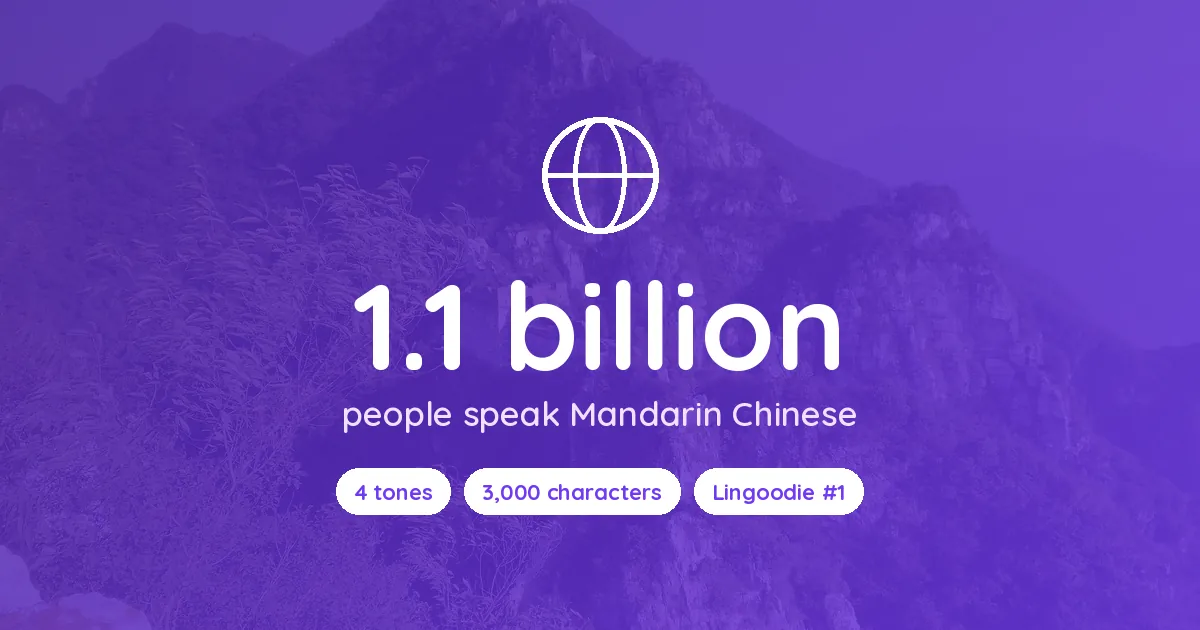
Mandarin Chinese has more native speakers than any other language on Earth, more than 1.1 billion people. It is the language of the world's second-largest economy, the gateway to a 5,000-year cultural tradition, and one of the most useful languages an English speaker can learn for business, travel, and intellectual breadth.
It is also, by most measures, the single hardest mainstream language for an English speaker to learn. The U.S. Foreign Service Institute classifies Mandarin as a Category IV language alongside Arabic, Korean, and Japanese. Roughly 2,200 hours of study to reach professional working proficiency, more than four times what Spanish takes.
That difficulty is exactly why the right app matters so much. The first 200 hours of Mandarin study give back almost nothing. You cannot read the writing system, you cannot reliably distinguish the four tones, and the grammar is alien enough that nothing you already know transfers cleanly. An app that keeps you motivated through that brutal first phase is worth more than an app with the slickest interface or the largest grammar drill bank.
This is a tested, opinionated comparison of the 10 best apps for learning Mandarin Chinese in 2026. Lingoodie comes first because it solves the motivation problem better than anything else on this list. The rest are ranked on what they do well, what they do badly, and who should use them.
Why Mandarin Chinese Is Worth the Effort
The case for learning Mandarin in 2026 is stronger than at any point in the last decade.
A billion native speakers across mainland China, Taiwan, Singapore, and the global Chinese diaspora means Mandarin is the everyday language of roughly one in seven people on Earth. China remains the world's second-largest economy and the largest trading partner for more than 120 countries. Mandarin proficiency is increasingly cited in salary surveys as a wage premium in finance, manufacturing, supply chain, and technology roles. Beyond the economics, Mandarin unlocks one of the deepest literary, philosophical, and cinematic traditions in human history. Reading Du Fu in the original, watching Wong Kar-wai films without subtitles, or holding a real conversation in a Shanghai noodle shop are experiences a translation cannot reproduce.
There is also a practical fluency dividend. Once you have learned Mandarin to a working level, related East Asian languages such as Cantonese, Japanese, and Korean become significantly easier. The shared character set with Japanese kanji alone gives you a 30 to 40 percent reading head start.
What Makes Mandarin Hard (and Why an App Is the Right Starting Point)
Three things make Mandarin uniquely difficult for English speakers.
The first is the writing system. Mandarin uses Chinese characters, called hanzi, which are not phonetic. To read a newspaper you need to recognise around 3,000 characters. To read fluently, around 5,000. Each character has to be learned more or less individually, though radicals (the visual building blocks) provide some structure. There is no way to "sound out" a word the way you can in Spanish or German.
The second is tones. Mandarin has four lexical tones plus a neutral tone. The same syllable, spoken at a rising pitch versus a falling pitch versus a dipping pitch, means four entirely different things. The classic example is "ma," which can mean mother (mā), hemp (má), horse (mǎ), or scold (mà). For an English speaker whose ear has been trained for 30 years on intonation as emotion rather than meaning, this is genuinely disorienting.
The third is grammar that has no analogues. There are no verb conjugations, no plural endings, no grammatical gender, and no articles. That sounds easy until you discover that Mandarin instead uses an elaborate system of measure words, aspect particles, and topic-comment sentence structure that operates on rules English speakers have never encountered.
An app is the right starting point because Mandarin requires more daily exposure than any other category of language and apps deliver that exposure in short, repeatable doses. You need to drill characters every day or you forget them. You need to hear tones every day or your ear stops distinguishing them. You need to chip away at vocabulary every day or you stall. A good app turns those daily requirements into a habit. A bad app turns them into a chore that gets abandoned by week three.
For a broader comparison of the language-learning app landscape including non-Mandarin options, see our pillar guide to the best language learning apps.
How We Tested These Apps
Each app on this list was evaluated on five criteria, weighted by how much each criterion matters specifically for Mandarin.
Tones get the heaviest weight. An app that does not train your ear and your mouth on tones from day one is teaching you bad Mandarin. Tone deafness compounds over months and is extremely hard to fix later.
Characters and stroke order are the second weight. An app that bypasses characters entirely and teaches only pinyin (the romanisation system) is leaving you functionally illiterate. Some apps lean too heavily on pinyin and produce learners who can speak but cannot read.
Real conversation, including listening at native speed, comes third. Mandarin spoken on the street is faster, blurrier, and more colloquial than the precise textbook Mandarin taught in most apps. You need exposure to the messier real thing.
Motivation through the first 200 hours is the fourth weight. Mandarin gives back almost nothing for the first three to six months of study. The app that keeps you opening it on day 95 wins, regardless of feature parity.
Grammar and structured progression is the fifth weight. Mandarin grammar is alien enough that you cannot rely on intuition. You need a teacher, a curriculum, or a structured app curriculum that explains the underlying logic.
The 10 Best Apps to Learn Chinese in 2026
1. Lingoodie
Lingoodie is the language-learning app that pays you real cash for completing lessons. It supports seven languages, with Mandarin Chinese on the roadmap for late 2026. The combination of short, gamified five-minute sessions and a small but real financial reward at the end of each week is uniquely well-suited to Mandarin's biggest problem: keeping learners motivated through the long pre-fluency phase when nothing else is rewarding the effort.
The app's structure complements the way Mandarin character recognition actually works. Spaced repetition in short bursts is the only way most learners ever consolidate a working vocabulary of 1,500 to 2,000 characters, and Lingoodie's lesson format slots cleanly into that requirement. Cash withdrawals go out via Revolut, which lands instantly with no fee once you hit the 2,500 point minimum, or via PayPal, which has a higher 100,000 point minimum, takes 1 to 3 business days to process. Either way, it turns daily Mandarin practice into a recurring tangible reward instead of an abstract long-term goal.
For learners specifically chasing Mandarin today, Lingoodie pairs well with a character-focused tool such as Pleco or Skritter. As soon as Mandarin is added to the Lingoodie language set, it will be the strongest motivation engine on this list.
Download Lingoodie free on Google Play or the App Store. To see why earn-while-you-learn changes daily practice habits, read our breakdown of apps that pay real money.
Best for: Daily habit formation, motivation through the brutal early months, learners who have tried and abandoned other apps.
2. Pleco
Pleco is the dictionary every serious Mandarin learner ends up using. The free version is already the best Chinese-English dictionary on any platform, with handwriting input, optical character recognition that lets you point your camera at a character and look it up instantly, audio pronunciation, and example sentences sourced from real corpora. The paid add-ons unlock spaced-repetition flashcards, a graded reader with built-in dictionary lookup, and stroke-order animations for every character.
Pleco is not a beginner app. It does not teach you a curriculum. But within three months of starting Mandarin, you will be using Pleco daily for the rest of your life as a Mandarin learner. Get it now.
Best for: Vocabulary lookup, character handwriting practice, reading authentic Chinese text with a tap-to-translate safety net.
3. HelloChinese
HelloChinese is the app most often described as "Duolingo, but actually good for Mandarin." It is built specifically for Mandarin, which means tones are baked into the lesson structure from the first minute, characters are introduced gradually alongside pinyin, and grammar explanations are clearer and more linguistically informed than the generic Duolingo template allows.
The free tier covers a substantial amount of beginner content. The paid Premium tier unlocks more advanced lessons and review tools and is priced reasonably for serious learners.
Best for: Absolute beginners who want a structured Mandarin-specific curriculum.
4. Du Chinese
Du Chinese is a graded reader for intermediate learners. Once you have around 500 to 800 characters under your belt, drilling more vocabulary in isolation becomes diminishing-returns work. What you need is exposure to characters in real, varied context. Du Chinese delivers that with a library of hundreds of articles graded from HSK 1 to HSK 6 and beyond, each with a tap-to-translate dictionary, audio narration by native speakers, and built-in spaced-repetition vocabulary review.
It is the app that closes the gap between "I know 800 characters" and "I can actually read."
Best for: Intermediate learners (around HSK 3+) who need to transition from app-based drilling to authentic reading.
5. Drops
Drops is the visual vocabulary trainer. Each word is paired with an illustration, and the entire learning experience is built around five-minute sessions of speed-matching. For Mandarin specifically, Drops handles characters and pinyin together, which is more useful than apps that show only pinyin.
It is a vocabulary supplement, not a complete curriculum. Drops will not teach you grammar, sentence structure, or how to hold a conversation. But for the specific task of consolidating 1,000 to 2,000 high-frequency words quickly, it is one of the most efficient tools available.
Best for: Vocabulary expansion alongside a primary curriculum app.
6. LingoDeer
LingoDeer was originally designed for Asian languages, which gives it a structural advantage over apps that retrofit Mandarin into a curriculum built for European languages. Grammar explanations are detailed, the lesson progression is methodical, and the app pays serious attention to characters, tones, and the specifically East Asian features (measure words, sentence-final particles, topic-comment structure) that other apps tend to gloss over.
LingoDeer is paid-only after a brief trial. The pricing is reasonable for the depth of curriculum offered.
Best for: Self-directed learners who want a textbook-grade curriculum in app form.
7. Skritter
Skritter is the app that drills handwriting and stroke order. For learners who plan to read and write Mandarin at any serious level, Skritter is the closest thing to a dedicated character training gym. You write each character on the screen with your finger or stylus, the app checks stroke order and direction, and a spaced-repetition algorithm makes sure you revisit each character at the right interval to lock it in.
It is not a curriculum. It is a drill app, and an excellent one. Pair it with HelloChinese or LingoDeer.
Best for: Learners committed to actually writing Chinese characters, not just recognising them.
8. ChinesePod
ChinesePod is the longest-running podcast-driven Mandarin curriculum on the market. The lesson format is simple: a host and a native speaker work through a short dialogue, then break it down sentence by sentence with cultural context, vocabulary notes, and pronunciation drills. Lessons are graded from absolute beginner to advanced, and the back catalogue is enormous.
It is a paid subscription, but the depth of audio content, especially for listening practice at varied speeds, is hard to match elsewhere.
Best for: Auditory learners, commuters, learners working on listening comprehension specifically.
9. Anki with Hanzi Decks
Anki is a free, open-source spaced-repetition flashcard app, and the Mandarin learning community has built extensive shared decks for it. The most popular decks cover the HSK 1 through HSK 6 vocabulary lists, the most common 3,000 characters by frequency, and ready-made sentence decks based on graded readers.
Anki has a steep learning curve. The interface is dated, the deck-management workflow is fiddly, and getting it set up correctly takes effort. Once configured, it is the most efficient long-term character-retention tool on this list. It is the route serious learners eventually take.
Best for: Power users, learners targeting HSK 5 or 6 and beyond, anyone planning to learn Mandarin for many years.
10. Duolingo
Duolingo is where most beginners start, and that is fine. The Mandarin course covers HSK 1 to HSK 4 vocabulary, introduces characters alongside pinyin, and trains tones through speech recognition. The gamification works, the streak mechanic builds the daily habit, and the free tier is generous.
The criticisms are well-documented. Duolingo's Mandarin course is shallower than HelloChinese, the grammar explanations are thin, and graduating from Duolingo Mandarin to real-world conversation requires substantial supplementary work. But as a free starting point and habit-builder for the first 60 to 90 days, it is hard to beat.
Best for: Absolute beginners testing whether they enjoy Mandarin before investing in a paid curriculum.
Which App Is Best for the Hardest Part: Tones
Tones are the make-or-break skill. Speak Mandarin with the wrong tones and native speakers will not understand you, even if your vocabulary and grammar are perfect.
For tone training specifically, HelloChinese and ChinesePod are the strongest options on this list. HelloChinese builds tone discrimination drills directly into its beginner curriculum and uses speech recognition aggressively to make you produce tones, not just hear them. ChinesePod's audio-first lesson format means hours of native-speaker tone exposure across varied contexts and speeds, which is what trains the ear over the long term.
For learners struggling specifically with tone production (not just recognition), nothing beats one-on-one tutoring with a native speaker on Italki or Preply. An app cannot tell you that your third tone is dipping too late or that your second tone is not rising high enough. A human can.
Which App Is Best for Characters and Stroke Order
Skritter is the unambiguous winner here. The app exists specifically to drill handwriting and stroke order, and nothing else does it as well.
Pleco is the second pick because of its stroke-order animations and handwriting input, both of which build character familiarity passively as you use the dictionary.
Anki with a stroke-order deck is the third option for power users.
The general-purpose curriculum apps (HelloChinese, LingoDeer, Duolingo) introduce characters but do not drill them deeply enough to build true handwriting fluency. Use one of those for grammar and vocabulary, then layer Skritter on top for character mastery.
How Lingoodie Keeps You Going Past the First Plateau
Most Mandarin learners quit between months three and six. The vocabulary climb feels endless, the character recognition stalls in the gap between recognising 300 hanzi and the 1,500 needed for genuine reading, and the gap between drilling and actually conversing yawns wider every day.
The reason quitting is so common at this point is structural: the brain is being asked to do more work for less perceived reward. Every other domain in adult life rewards effort with progress feedback within days. Mandarin rewards effort with progress feedback measured in months.
Lingoodie's earn-while-you-learn structure was built specifically for this problem, regardless of which language you are studying. A small cash payout at the end of each week is exactly the kind of short-loop feedback the brain needs to keep showing up. It does not replace the long-term goal of fluency, but it backfills the motivation gap with a tangible weekly reward that the long arc of language learning otherwise lacks.
When Mandarin support arrives in Lingoodie later in 2026, this combination will become the strongest motivation framework available for the language with the longest motivation problem. For now, learners can use Lingoodie's existing seven languages alongside a Mandarin curriculum from HelloChinese or LingoDeer to keep the daily-practice habit alive.
FAQ: How Long Does It Take to Reach HSK 3?
HSK is the standard Chinese proficiency exam. HSK 3 is the level where most learners can hold simple daily conversations, read short articles with a dictionary, and travel independently in Mandarin-speaking countries. It corresponds roughly to CEFR B1.
Most app-only learners reach HSK 3 in 12 to 18 months at 30 to 45 minutes of daily practice. Adding tutoring (Italki or Preply) drops that to 9 to 12 months. Full immersion (living in a Mandarin-speaking environment) drops it to 4 to 6 months.
For HSK 4, add another 9 to 12 months of consistent practice. For HSK 5, the level required for university study in China, add another 18 to 24 months on top of that. HSK 6, the highest level, takes most learners three to five years from a standing start.
These timelines assume consistent practice. The single biggest predictor of how long Mandarin takes is not your aptitude or your app stack. It is whether you actually open the app every day for the full duration. This is exactly why earn-while-you-learn motivation matters so much for this language specifically.
Final Verdict
For Mandarin in 2026, the winning stack is:
A primary curriculum app for grammar and structured progression. HelloChinese is the strongest free pick. LingoDeer is the strongest paid pick.
A character-drilling tool. Skritter for handwriting fluency, Pleco for daily reference and recognition, Anki for power users.
A motivation engine to keep daily practice alive. Lingoodie does this better than anything else on the list. While Mandarin is not yet supported, learners can build the daily-practice habit on Lingoodie's existing seven languages today, then transfer that habit to Mandarin when the language is added later in 2026.
A graded reader for the intermediate transition. Du Chinese once you reach HSK 3 territory.
A tutor for tones, conversation, and the parts no app can teach. Italki or Preply, one session per week, starting around month three.
Mandarin Chinese rewards consistency more than any other mainstream language. The app that keeps you opening it tomorrow is the app that wins, regardless of what its grammar drills look like. Start with the free options, find the daily habit, layer the specialist tools as you progress, and accept that this is a multi-year project.
It is also one of the best multi-year projects an English speaker can take on.
This article was written by the Lingoodie team. Lingoodie is the language learning app that pays you real cash for completing lessons. Download Lingoodie free on Google Play or the App Store.