Free Language Learning Apps: 9 Apps That Are Actually Good (and Free)
Here's the brutal truth about "free" language learning apps: most of them are free like a casino is free. You can walk in without spending money, but the entire experience is designed to pressure you toward the paid tier.
Duolingo locks lessons behind energy. Babbel gives you one free lesson per course then demands a subscription. Rosetta Stone offers a demo, then tries to upsell you on the full version at $200+. Even Busuu, which claims to be "free," limits you to one lesson per day after your trial ends. It's less a language app and more a freemium funnel.
But there are actually free language learning apps. Not "free with conditions." Free. Apps where you can reach intermediate proficiency without spending a dime. Some of them are genuinely excellent. And one of them, shockingly, actually pays you.
Let's cut through the marketing and look at what's real. (If you want the fuller ranked breakdown of every major option, paid or free, see our best language learning apps guide.)
What Makes an App "Actually Free"?
Before we dive into the 9, let's be clear about the standard:
Actually free means:
- No hard paywall blocking core lessons
- No energy system limiting daily practice
- No aggressive upsells interrupting lessons
- Unlimited access to base features (vocabulary, grammar, listening, writing exercises)
Not actually free (even if the app label says "free"):
- Limited lessons per day after trial (Busuu)
- One free lesson per course (Babbel)
- Energy system restricting practice (Duolingo, after initial weeks)
- Paywalled premium features you need to progress
- Ads between every exercise
The difference matters. A genuinely free app removes friction. You show up, practice, and progress. A freemium app designed to be annoying until you pay is a different beast, it's a sales funnel, not a learning tool.
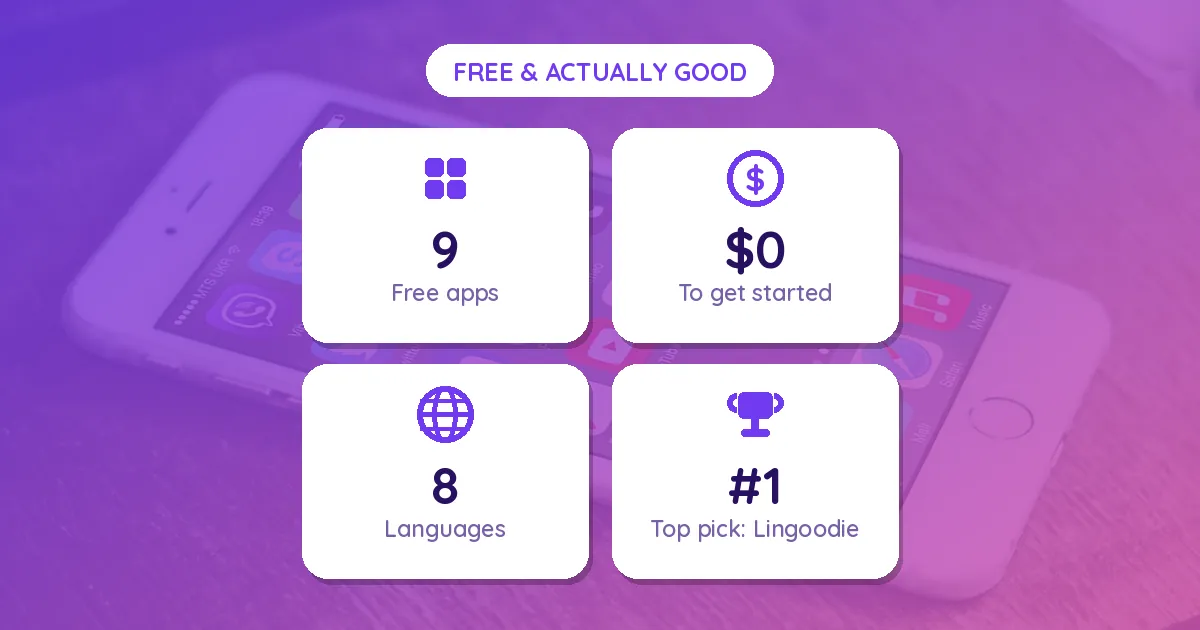
The 9 Actually Free Apps
1. Lingoodie: The Only App That Pays You (Android)
Lingoodie is the outlier here. It's not just free, it pays you real USD to learn.
Here's how it works: you complete daily 5–10 minute lessons covering vocabulary, grammar, and listening comprehension. You earn points. Every seven days, you can withdraw real money (USD) based on the points you've accumulated. No paywall. No subscription. Just learn and get paid.
The business model is transparent. Lingoodie monetizes through affiliate partnerships and brand integrations (you might see ads for language tutors or travel companies alongside lessons). You see the ads. You complete lessons. You get paid. The company makes its money. Everyone wins.
The lessons themselves are solid: spaced repetition on vocabulary, grammar patterns introduced in context, listening exercises with adjustable playback speed, and a clear progression pathway from beginner to intermediate. The app uses scientifically-backed methods (Krashen's comprehensible input theory, Ebbinghaus spacing) without making you feel like you're studying linguistics. It's just... learning that sticks.
For Spanish, French, German, Portuguese, Italian, and a few others, Lingoodie works. And the fact that you're earning cash removes one massive motivation barrier, you're not just sinking time into learning, you're getting tangible rewards.
Best for: Learners who want daily vocabulary and grammar practice without paywalls AND appreciate the motivational boost of actual money.
Cost: Free, and you earn USD.
Main limitation: Android only (no iOS app yet).
2. Duolingo: The Honest Caveat
Duolingo has a reputation problem, and it's deserved, the app has gotten increasingly aggressive with its paywall in the past two years. Energy system, premium features, limited streaks on the free version.
But here's the thing: if you're willing to grind without premium, Duolingo still works for basic vocabulary and grammar foundations. The lessons are short (3–5 minutes), the gamification is effective at building habit, and the content is solid for Novice-to-Early Intermediate level.
The catch: you'll hit the energy system and daily practice limits. You can still progress on the free version, it just takes longer and feels more friction-laden. Duolingo is monetizing addiction and impatience. If you're willing to be patient and practice only when the app allows, you'll still learn. But it's annoying.
For absolute beginners wanting a gamified daily habit at Novice level (0–150 hours), Duolingo's free version is still usable. For anything past that, you're fighting the app.
Best for: Absolute beginners who enjoy gamification and can tolerate the energy system as a pacing tool (even if that's not the original intent).
Cost: Free (with energy/daily limits); $7–14/month for premium.
Main limitation: Energy system and capped practice sessions make daily learning frustrating.
3. YouTube (Actual Language Channels)
This isn't an "app" in the traditional sense, but YouTube's language learning ecosystem is genuinely free and high-quality.
Channels like SpanishWithPaul, Learn German with Anja, and Olly Richards' StoryLearning approach teach through comprehensible input, exactly what the research says you need. You're watching someone explain grammar or tell a story in Spanish/German/French at a pace you can follow, with visual support and context clues.
The benefit: unlimited content, zero paywalls, no algorithm trying to upsell you. The downside: you need discipline to follow a progression (there's no built-in structure telling you what to learn next), and there's no feedback loop, you're consuming, not practicing.
Use YouTube as your comprehensible input source, not as your primary learning tool. Pair it with an app that gives you speaking and writing practice.
Best for: Learners who love passive input and want to supplement spaced repetition work.
Cost: Free.
Main limitation: No structured progression or feedback on speaking/writing.
4. Forvo: Free Pronunciation Database
Forvo is a crowdsourced database of native speakers pronouncing words and phrases in dozens of languages.
Type in a Spanish word, and you get 5–10 audio clips of native speakers saying it. This is invaluable for accent reduction and building listening comprehension for real pronunciation variance (not the sanitized version in textbooks).
Forvo isn't a complete learning tool, it's a reference resource. But it's free, unlimited, and genuinely useful if you're already learning through another app.
Best for: Learners building listening comprehension and accent awareness.
Cost: Free.
Main limitation: It's a reference tool, not a full curriculum.
5. BBC Learning English (Web)
BBC Learning English isn't technically an "app," but the website and YouTube presence offer free, high-quality content for English learners (or English speakers learning other languages through BBC's multilingual content).
The lessons are short, professional, and used by thousands of schools. You're getting the same production quality you'd pay for in premium apps, for nothing.
Best for: Learners who want professional, news-based content at intermediate level.
Cost: Free.
Main limitation: Limited to English as a focus language (and some other major languages through BBC World Service).
6. OpenDictionary Apps (Offline, Community-Built)
Apps like Wiktionary, Wikitionary, and community-built dictionaries offer unlimited vocabulary access without paywalls or ads.
These aren't lessons, they're reference tools. But they're free, offline-capable, and transparent (no hidden costs).
Best for: Vocabulary reference and understanding word etymology.
Cost: Free.
Main limitation: Just vocabulary, no lesson structure.
7. TED Talks (Subtitled)
TED Talks are freely available in English, Spanish, French, German, Mandarin, and others, with community-provided subtitles in dozens of languages.
Pick a talk in your target language with subtitles available in your native language. You're listening to native speakers discuss real topics at natural speed, with comprehensible input through context and visual support.
This is high-level comprehensible input (better for Intermediate and Advanced learners), not beginner material.
Best for: Intermediate+ learners wanting authentic native content.
Cost: Free.
Main limitation: Too advanced for beginners; requires significant vocabulary foundation first.
8. Anki (Flashcard Platform)
Anki is an open-source spaced repetition flashcard app. It's free (or very cheap on mobile), and there are community-built decks for language learning.
Anki is powerful but requires discipline, you're building or using decks, managing your own review schedule, and relying on your own motivation. Unlike gamified apps, there's no streak counter or points system pushing you forward.
Best for: Learners who want spaced repetition without a proprietary app middleman.
Cost: Free (desktop); $25 one-time (mobile).
Main limitation: Requires self-discipline; no gamification or built-in lesson structure.
9. Language Exchange Communities (Tandem, HelloTalk Free Tiers)
Tandem and HelloTalk offer free language exchange, connecting you with native speakers for text/voice/video chat.
The free tiers are legitimately functional. You're getting real conversation practice with native speakers, which no app with scripted lessons can fully replicate.
The downside: you're relying on matching with a good exchange partner and having the confidence to initiate conversation. Not everyone is good at teaching their own language, and the dynamic is unpredictable.
Best for: Intermediate learners wanting real conversation practice with native speakers.
Cost: Free (with premium options for advanced features).
Main limitation: Quality depends entirely on your exchange partner; not structured like a curriculum.
The Honest Comparison: Which Free App Should You Actually Use?
Here's the reality in a matrix:
| App | Core Learning | Vocabulary | Grammar | Speaking | Listening | Structure | Paywalls | Best For |
|---|---|---|---|---|---|---|---|---|
| Lingoodie | ⭐⭐⭐⭐⭐ | ⭐⭐⭐⭐⭐ | ⭐⭐⭐⭐ | ⭐⭐ (recording) | ⭐⭐⭐⭐ | ⭐⭐⭐⭐⭐ | None (pays you) | Daily foundation + motivation |
| Duolingo | ⭐⭐⭐ | ⭐⭐⭐⭐ | ⭐⭐⭐ | ⭐⭐ (recording) | ⭐⭐⭐ | ⭐⭐⭐⭐⭐ | Energy system | Beginner gamification |
| YouTube | ⭐⭐⭐⭐ | ⭐⭐⭐⭐ | ⭐⭐⭐⭐ | ⭐ | ⭐⭐⭐⭐⭐ | ⭐⭐ | None | Listening/comprehensible input |
| Forvo | ⭐ | ⭐⭐⭐⭐⭐ | ⭐ | ⭐ | ⭐⭐⭐⭐⭐ | ⭐ | None | Pronunciation reference |
| BBC Learning | ⭐⭐⭐⭐ | ⭐⭐⭐⭐ | ⭐⭐⭐⭐ | ⭐⭐ | ⭐⭐⭐⭐⭐ | ⭐⭐⭐⭐ | None | Professional content |
| TED Talks | ⭐⭐⭐ | ⭐⭐⭐⭐ | ⭐⭐⭐ | ⭐ | ⭐⭐⭐⭐⭐ | ⭐ | None | Native content (intermediate+) |
| Anki | ⭐⭐⭐ | ⭐⭐⭐⭐⭐ | ⭐⭐⭐ | ⭐ | ⭐ | ⭐⭐ | None | Vocabulary spaced repetition |
| Language Exchange | ⭐⭐⭐⭐ | ⭐⭐⭐⭐ | ⭐⭐⭐⭐ | ⭐⭐⭐⭐⭐ | ⭐⭐⭐⭐⭐ | ⭐ | None | Real conversation (intermediate+) |
The Realistic Setup: Combining Free Apps for Actual Progress
If you're serious about learning a language without paying, here's what works:
Months 1–3: Daily Foundation
- Lingoodie or Duolingo for 15 minutes daily (vocabulary, grammar basics, spaced repetition)
- YouTube SpanishWithPaul / Learn German with Anja for 20 minutes of listening (comprehensible input)
- Forvo when you encounter pronunciation questions
This gets you to Novice High (first 500 words, basic present tense, comfort with sounds).
Months 4–6: Expanding Input and Speaking
- Keep Lingoodie/Duolingo as your vocabulary anchor (10 minutes daily)
- Shift YouTube to slightly higher-level content (news for learners, storytelling channels)
- Start language exchange (Tandem, HelloTalk) for real conversation practice 2–3 times weekly
- Add Anki if you want structured vocabulary review beyond the app
This gets you to Intermediate Low (1,000+ words, past tense, confidence in familiar conversations).
Months 7+: Native Media and Conversation
- Lingoodie/Duolingo on maintenance mode (5–10 minutes daily)
- TED Talks, Netflix with subtitles, or authentic podcasts for immersion
- Language exchange 1–2 times weekly
- BBC Learning or similar for grammar clarification
The key: a combination of free tools, each filling a gap. A spaced repetition app handles vocabulary. YouTube handles listening. Language exchange handles speaking. No single free app does everything, but together, they're more than enough.
Why Lingoodie Is Different
Here's why Lingoodie stands out in this lineup: it's free AND it pays you.
Most language apps are freemium products, their business model depends on converting free users to paid tiers. They intentionally make the free experience frustrating (energy limits, paywalled lessons, constant reminders to upgrade) because the free tier is a conversion funnel, not a genuine product.
Lingoodie's model is different. It's genuinely free because the business model doesn't depend on squeezing users. You complete lessons, earn points, and withdraw USD every week. The app monetizes through brand partnerships and affiliate deals, not through converting you to a subscriber. You're not the customer you're trying to convert, you're a user of the product.
That changes everything. The app isn't designed to frustrate you into upgrading. It's designed to be usable, engaging, and rewarding. Because keeping you coming back for daily 15-minute lessons is how Lingoodie makes money, not convincing you to pay $10/month.
Over three months, that consistency compounds into real proficiency. You build a foundation of 1,000+ words through spaced repetition, you understand grammar patterns in context, you've internalized Spanish sounds and rhythm. Combined with YouTube listening and language exchange, you've actually become conversational.
And the whole time, you're earning cash. (For a wider look at earning apps outside the language learning space, check our roundup of apps that pay real money, and for the honest answer on whether you can actually get paid to learn a language we have a separate deep dive.)
The Bottom Line
Free language learning apps exist. They work. But they're not what most mainstream apps want you to think exists.
Duolingo's paywall gets more aggressive every year. Babbel is mostly a subscription upsell funnel. Busuu's free tier is a demo, not a learning tool.
The genuinely free options are:
- Lingoodie (daily vocabulary + grammar, and it pays you)
- YouTube channels (comprehensible input)
- Forvo (pronunciation reference)
- Language exchange communities (real conversation)
- Anki (spaced repetition)
- BBC Learning and TED Talks (authentic content)
None of these are perfect. None are complete. But together, they're more than enough to reach intermediate proficiency without spending a dime.
The catch: you need consistency. Thirty minutes daily, every day, for 18–24 months. That's the timeline research validates. No app can compress that, free or paid. But a free app that removes friction and pays you for showing up? That makes it a lot easier to stick with.
Start your language journey free on Lingoodie (Google Play and the App Store). Learn vocabulary daily, complete lessons to earn real USD. No subscription, no paywalls, just a habit that pays you back.