Best App to Learn Italian in 2026: 8 Apps Compared for Beginners and Beyond
Italian is, quite honestly, one of the best languages an English speaker can pick up. The Foreign Service Institute classifies it as a Tier 1 language, meaning a motivated learner can reach professional working proficiency in roughly 600 classroom hours. That puts it in the same bracket as Spanish, French, and Portuguese, and miles easier than Mandarin, Arabic, or Japanese (for context, see our guide on the best app to learn Japanese, which is a very different mountain to climb).
The reasons people learn Italian are also unusually strong: a trip to Rome, Florence, or the Amalfi Coast, family heritage, opera, food, cinema, or simply because it sounds beautiful. Strong motivation plus a relatively easy language should equal fast progress. And yet most people who start learning Italian quit within three weeks.
The bottleneck is almost never the language. It's the app. Pick the wrong one and you waste months tapping coloured buttons without ever holding a real conversation. This guide cuts through the marketing noise, compares the eight Italian learning apps that actually matter in 2026, and tells you which one fits your specific situation.
Why Italian Is One of the Easiest Languages for English Speakers
Before we get into the apps, it helps to understand what you're actually walking into. Italian is genuinely one of the most accessible languages for native English speakers, for several concrete reasons.
FSI Tier 1 status. The US Foreign Service Institute, which has been training diplomats in dozens of languages for decades, places Italian in its easiest category. Roughly 600 to 750 hours of focused study gets you to a strong B2 (upper intermediate) level. That's about an hour a day for two years, or three hours a day for under nine months.
Phonetic spelling. Unlike English (where "cough", "though", "through", and "rough" all use the "ough" cluster differently) or French (where half the letters in any given word are silent), Italian is almost perfectly phonetic. If you can read it, you can pronounce it. The vowels are pure, the rules are consistent, and the few exceptions (like the soft and hard "c" before different vowels) are easy to memorise.
Shared Latin roots. Around 30 percent of English vocabulary comes from Latin, often via French. That means thousands of Italian words are already half-familiar: necessario, importante, probabile, intelligente, università. You start with a free vocabulary list of several thousand words you didn't know you knew.
Regular grammar patterns. Italian grammar is more complex than Spanish (it has more irregular verbs and tighter pronoun rules), but the patterns are consistent. Once you learn how the regular -are, -ere, and -ire verbs conjugate, you can predict the form of thousands of verbs. Romance languages reward pattern recognition, and Italian is no exception. If you already speak Spanish or French, you'll find the cross-over enormous (we wrote about this overlap in our guide to the best way to learn Spanish).
Motivation is built in. This matters more than people admit. Italian learners almost always have a concrete reason: a holiday booked, a grandmother to talk to, a partner's family to impress, a love of opera, a dream of living in Tuscany. Concrete reasons sustain effort. Abstract reasons ("it would be nice to know a language") do not.
What to Look for in an Italian Learning App
Not every app teaches Italian well. Some are great for getting started but fall apart at the intermediate level. Others are technically excellent but punishingly boring. Here's the checklist that actually matters.
Pronunciation audio. Italian has regional accents (a Milanese speaker sounds different from a Sicilian one), but standard Italian pronunciation is clear and consistent. Look for apps with native speaker audio, not robotic text-to-speech. The double consonants (pizza, bello, anno) need to be modelled correctly, because mispronouncing them changes meanings.
Grammar explanations. Italian has gendered nouns, three verb conjugation groups, two past tenses (passato prossimo and imperfetto) that English speakers regularly mix up, and a subjunctive mood you'll eventually need. An app that just makes you tap pictures will never teach you when to use sono andato versus andavo. You need real explanations.
Vocabulary volume and spaced repetition. B2 fluency requires roughly 4,000 to 5,000 active words. The app's vocabulary engine matters. Spaced repetition (showing you words again right before you'd forget them) is the gold standard for retention. Anki invented it; the better apps now bake it in.
Speaking practice. You will not learn to speak Italian by tapping a screen. At some point you have to open your mouth. Some apps have built-in speech recognition; others (like Italki) connect you to live tutors. Both work; you just need at least one in your stack.
Motivation mechanics. This is the killer. Most learners quit between week two and week six. Whatever keeps you opening the app on day 30 is more important than which app has the prettier UI. Streaks, gamification, financial rewards, social pressure, scheduled tutor calls: pick whatever works for your psychology.
The 8 Best Apps to Learn Italian in 2026
We've ranked these based on a combination of teaching quality, beginner accessibility, retention features, and the single most underrated factor: whether you'll still be using the app in three months.
1. Lingoodie
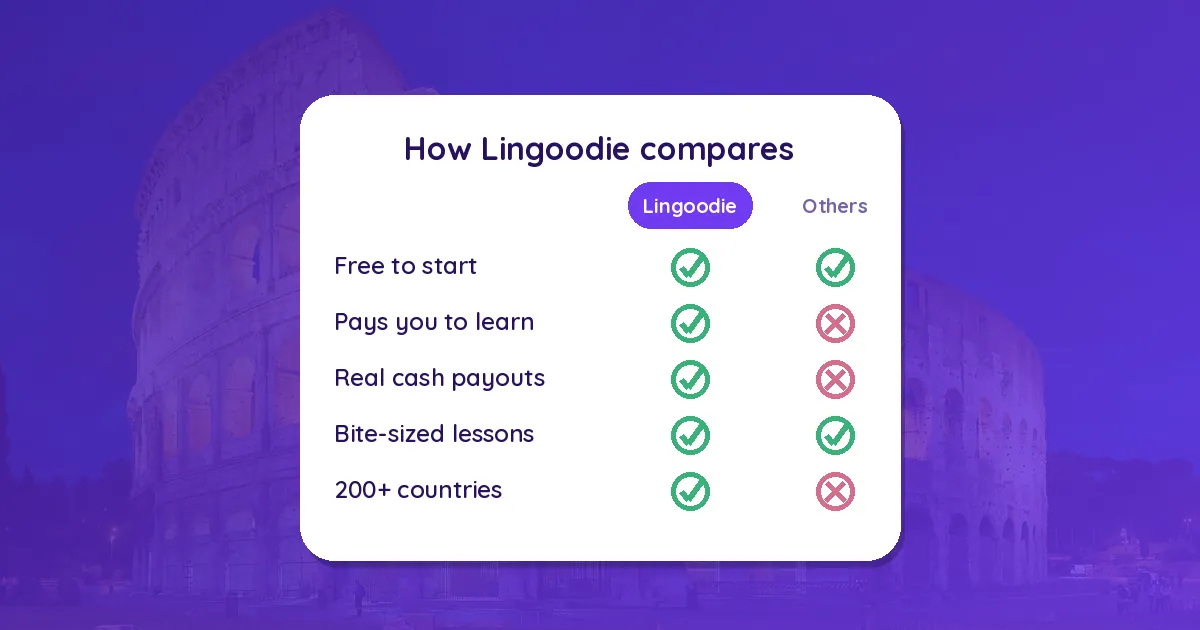
Lingoodie added Italian to its supported languages in April 2026, joining Portuguese, French, Spanish, German, Slovenian, and Croatian. The Italian content is fresh, actively expanding, and built into the same model that has worked across the other languages: short gamified lessons paired with real money rewards.
The mechanic is simple. You learn Italian, you earn small cash payouts, and you can withdraw via Revolut instantly with no fee once you hit the 2,500 point minimum, via PayPal, which needs a higher 100,000 point balance and is processed by PayPal within 1 to 3 business days, or via crypto. The amounts are not life-changing, but that's the point. The reward is structured to reinforce daily habit, which is the single hardest thing about language learning. New users can use the referral code SARIKA for a sign-up bonus.
Best for: Learners who have started and quit other apps, and who want financial motivation to actually stick with daily practice.
Watch out for: Italian is the newest language on the platform, so the absolute most advanced content is still being expanded. Beginners and intermediates are well covered.
2. Pimsleur
The Pimsleur method is the elder statesman of audio language courses. Each 30-minute lesson is built around a real conversation, with carefully spaced repetition baked in. There is no reading, no writing, and no grammar drilling: just listening and speaking. It's the closest thing to immersion you can get from a recording.
Best for: Travellers and commuters who need to speak Italian quickly without getting bogged down in grammar rules. Drive to work, finish a lesson, repeat.
Watch out for: Reading and writing are not part of the system. If you want to text in Italian or read Italian books, you'll need to add a second tool.
3. Babbel
Babbel takes a more academic approach. The lessons are short (10 to 15 minutes), the curriculum is structured by a team of linguists, and the grammar is explained clearly in plain English. Native speaker audio is solid, and the review system is functional.
Best for: Learners who like structured grammar explanations and want a clear curriculum to follow.
Watch out for: Subscription pricing has crept up over the years, and the gamification is mild. If you need a streak to motivate you, this isn't it.
4. Italki
Italki isn't really an app in the traditional sense; it's a marketplace that connects you to live human tutors. You browse tutors by price, accent, teaching style, and availability, then book one-on-one lessons over video. Rates range from around 10 USD an hour for community tutors to 40 USD an hour for certified teachers.
Best for: Intermediate learners who have the basics down and need real conversation practice with a native speaker.
Watch out for: It's a tool, not a curriculum. You need to know what you want to work on, otherwise lessons become unstructured chats.
5. Duolingo
The biggest name in the space. Duolingo is free (with ads), gamified to the point of being addictive, and has the largest user base of any language app. The Italian course is reasonably comprehensive at the beginner level.
Best for: Complete beginners who want a zero-friction, zero-cost way to start.
Watch out for: Grammar explanations are thin, the focus on streaks can devolve into tapping practice rather than language learning, and many learners find they plateau hard around the A2 level. It's a great starter and a poor finisher.
6. Drops
Drops is a vocabulary-only app with a beautiful, illustrated interface. Sessions are capped at five minutes by design, which keeps engagement high. There's effectively no grammar; it's pure word association with images.
Best for: Building vocabulary as a supplement to a more comprehensive app. Excellent for visual learners.
Watch out for: You will not learn to construct sentences here. Use it alongside, not instead of, a grammar-focused app.
7. Memrise
Memrise sits between Duolingo and Anki. It uses spaced repetition decks (some official, many user-generated) and is famous for its "Learn with Locals" video clips, which show real native speakers saying each phrase. That small touch makes a real difference for ear training.
Best for: Intermediate learners who want vocabulary variety and authentic speaker exposure.
Watch out for: Grammar is not explicitly taught. Expect to figure out patterns through exposure rather than direct instruction.
8. Anki
Anki is not really a language app; it's a flashcard system with the most powerful spaced repetition algorithm available. You build (or download) decks and review them daily. There are excellent community-made Italian decks, including the popular "4000 Italian Sentences" deck.
Best for: Power users who want maximum control and are willing to invest time in setup.
Watch out for: Steep learning curve, ugly interface, and zero hand-holding. If you're not already self-disciplined, Anki will sit unused on your phone.
Which App Is Best for Travellers (Planning a Trip in Under 90 Days)
If you've booked a trip to Italy and have under three months to prepare, your priorities are different from someone studying for fluency. You need survival Italian: ordering food, asking directions, handling check-ins, making small talk with shopkeepers. Grammar perfection is not the goal.
The combination that works best here is Lingoodie plus Pimsleur. Lingoodie keeps you opening the app every day (the cash reward closes the gap between "I should practice" and "I am practicing"), while Pimsleur trains your ear and mouth for actual spoken Italian. Listen to Pimsleur in the car or on walks, do your daily Lingoodie session in the evening, and you'll arrive in Italy able to navigate basic situations.
If you want a broader survey of apps that work well for travel-focused learners across multiple languages, our overview of the best language learning apps breaks it down by use case.
Which App Is Best for Heritage Learners (Italian-Americans and Italian Diaspora)
Italian-Americans are one of the largest and most motivated language-learner groups in the world. There are roughly 17 million people of Italian descent in the United States alone, and many grew up hearing Italian or dialect at home without ever formally learning it. That passive exposure is gold; you need to activate it.
Heritage learners typically have unusual strengths and weaknesses. They often understand far more than they can produce, have decent pronunciation instincts, but lack grammatical structure and confidence. They also sometimes know a regional dialect (Sicilian, Neapolitan, Calabrese) rather than standard Italian, which can be both an asset and a source of confusion.
The combination we'd recommend is Lingoodie plus Italki. Lingoodie builds the daily habit and reinforces standard grammar through gamified practice. Italki gives you a real conversation partner, ideally a tutor who understands heritage learners and can help you bridge from passive recognition to active production.
The Motivation Problem (Why Most People Quit Italian After Week 3)
Here's the honest part. The first ten days of learning Italian are wonderful. Words sound musical, you're learning useful phrases, and the dopamine hits of tapping correct answers are real. Around week three, it gets harder. You hit verb conjugations. You hit gendered nouns. You hit the realisation that you've memorised 300 words and can still barely string a sentence together.
This is the plateau, and this is where the vast majority of learners quit. Streak-based gamification (the Duolingo model) works for some people but fails for many, because once the streak breaks, motivation collapses. The whole psychological scaffolding falls down at once.
External rewards behave differently. When the app pays you, even a small amount, the value of opening it is real and unconditional. You don't need to feel motivated; you just need to want the payout. Over weeks, that compulsive opening becomes habit, and habit is what actually carries you through the plateau into the intermediate phase where Italian starts to click.
This is the entire premise behind apps that pay you to learn. We've written a detailed breakdown of the category in our guide to apps that pay real money, if you want to understand how the model works and which apps are legitimate.
How Long Until You Can Order a Coffee in Rome?
Realistic timelines, assuming roughly 20 to 30 minutes of daily practice:
- 2 weeks: Greetings, numbers, basic food vocabulary, polite phrases. You can order a coffee, say grazie, and ask for the bill (though you'll have to point at things).
- 1 month: Present tense conjugation for regular verbs, basic question forms, ordering food, asking simple directions, telling time. You can navigate a restaurant or a shop without panic.
- 3 months: Past tense (passato prossimo), expressing opinions, simple conversations on familiar topics. You can have a basic chat with a taxi driver about where you're from.
- 6 months: Comfortable conversation on familiar topics, more nuanced vocabulary, beginning to handle the imperfect tense properly. This is solid B1 territory, the level at which most people start feeling like they actually "speak" Italian.
- 12 to 18 months: Strong B2, comfortable handling unfamiliar topics, watching Italian films without subtitles for gist, reading novels with a dictionary.
This timeline is similar to Spanish, but Italian pronunciation is more forgiving than Spanish for English speakers (the rolled "r" is the main hurdle), so progress often feels faster in the first few months. If you want a side-by-side comparison of how to accelerate progress in a Romance language, our piece on how to learn Spanish fast covers techniques that transfer directly.
FAQ
Is Duolingo good enough for Italian?
For the first month or two, yes. Duolingo will teach you basic vocabulary, simple sentence structures, and enough Italian to feel like you're making progress. It is not enough to reach fluency, and most learners hit a hard plateau around the A2 level. Treat it as a starter, not a complete course, and supplement with grammar resources, listening practice, and ideally conversation.
Can I learn Italian in 3 months?
You can reach conversational basics in three months with consistent daily practice (around 30 minutes a day). You will not be fluent. Realistically, three months gets you to a confident A2: ordering food, having simple conversations, understanding slow speech on familiar topics. Fluency (B2 or above) takes 12 to 18 months for most committed learners.
What is the best free Italian learning app?
For a completely free experience, Duolingo is the clear leader by features and content depth. For a free-to-use app where you actually earn money rather than spend it, Lingoodie is unique: the lessons are free, and the cashback rewards offset any future cost. Both are worth installing.
Is Italian hard to learn for English speakers?
No, comparatively it's one of the easier languages. The FSI puts it in Tier 1, alongside Spanish, French, and Portuguese, with around 600 hours to reach professional working proficiency. The phonetic spelling, Latin-rooted vocabulary, and regular pronunciation all work in your favour.
How different is Italian from Spanish?
Very similar in writing (around 80 to 90 percent mutual intelligibility on the page), and notably trickier in spoken form because of accent and intonation differences. Speakers of one can usually read the other with some effort. Grammar is structurally close (both have gendered nouns, similar verb tenses, similar pronoun systems), but the everyday vocabulary and idioms diverge enough that you can't simply substitute one for the other.
Final Verdict
The "best app to learn Italian" depends on what you're optimising for, but the shortlist is small.
- For habit-building and motivation: Lingoodie. The earn-while-you-learn model solves the single biggest problem in language learning, which is showing up on day 30.
- For conversational speed: Pimsleur. Nothing else trains your ear and mouth as efficiently for spoken Italian.
- For structured grammar: Babbel. Clean curriculum, clear explanations, mild gamification.
- For real speaking practice: Italki. Live tutors are irreplaceable once you have the basics down.
- For free-and-fun: Duolingo as a starter, with the understanding that you'll need to graduate from it.
If you're starting fresh in 2026 and want a genuine shot at sticking with Italian past the three-week wall, our recommendation is to anchor your routine with Lingoodie and add a speaking-focused tool (Pimsleur or Italki) once you're three or four weeks in. The cash reward closes the motivation gap, the gamified sessions build the habit, and by the time you'd have quit any other app, you'll be ordering coffee in Rome.
Sign up at lingoodie.com and use referral code SARIKA at checkout for a bonus when you start. Buona fortuna, and welcome to one of the best languages you'll ever learn.