Best App to Learn German in 2026: Lingoodie, Babbel, and 7 Others Tested for English Speakers
German has a reputation. Four cases, three genders, separable verbs, and a sentence structure that puts the verb at the end of subordinate clauses. Every language learner who has dabbled in German has encountered that moment of staring at a 26-letter compound noun and wondering if it is worth it.
It is worth it. German is the most widely spoken native language in the European Union, with roughly 95 million speakers across Germany, Austria, Switzerland, and Liechtenstein. The DACH economies are among the strongest in the world. German opens doors in engineering, manufacturing, finance, academia, and cross-border EU careers that no other European language can match at the same scale. And for English speakers, German is considerably closer to home than it appears: both languages share Germanic roots, and thousands of German words are recognisable without any study at all.
The harder question is not whether to learn German but which app to use. We tested nine of the most popular German learning apps in 2026, paying for premium tiers, tracking which ones we still opened at day 60, and measuring how each one handles the genuinely hard parts of German that most apps gloss over.
Here is everything we found.
Why German Is Worth the Effort
The Foreign Service Institute classifies German as a Tier 2 language for English speakers, meaning roughly 750 class hours to reach professional working proficiency. That is noticeably harder than French, Spanish, Italian, and Portuguese (all Tier 1 at around 600 hours), but significantly easier than Mandarin, Arabic, Japanese, and Korean, which cluster in Tier 4 at roughly 2,200 hours.
What makes German hard is structural, not phonetic. The pronunciation is actually quite learnable: almost everything is spelled as it sounds, the vowels are clean, and the consonants follow predictable rules. The difficulty is grammatical. German has four cases (nominative, accusative, dative, genitive), three grammatical genders that must be memorised with every noun, strong and weak adjective endings that shift depending on the article used, and a verb placement system where the conjugated verb moves to second position in main clauses and to the end of subordinate clauses.
None of this is insurmountable. It is just more systematic study than French or Spanish require. Learners who approach German as a puzzle to decode rather than a wall to climb almost always progress faster than those who treat it as overwhelming.
The payoff is substantial. Germany's GDP is the largest in the EU and the fourth largest in the world. Austria and Switzerland are among the wealthiest per-capita nations in Europe. German proficiency is a hard requirement for many EU research positions, DACH-market jobs in finance and tech, and dual-citizenship pathways for descendants of German, Austrian, or Swiss grandparents. For heritage learners in the US, Brazil, and Australia, where large German-speaking diaspora communities settled in the 19th and 20th centuries, it is also a connection to family history.
What Makes German Hard and Why an App Helps
The four biggest challenges for English speakers learning German are case grammar, grammatical gender, verb placement, and compound nouns.
Case grammar is the most persistent obstacle. Every noun phrase in German must be marked for its grammatical role in the sentence: nominative for subjects, accusative for direct objects, dative for indirect objects, and genitive for possession. The articles (der, die, das) change form depending on the case and the gender. An app that drills you on diese, dieser, diesem, diesen versus just diese will give you a measurable advantage over one that hides the complexity behind simplified exercises.
Grammatical gender is not logical for English speakers, but it is learnable. The trick is to memorise every noun with its article from the beginning: not "Tisch" (table) but "der Tisch". Apps that teach vocabulary as isolated words without articles are actively making gender acquisition harder. Apps that always present article plus noun are actively making it easier.
Verb placement is jarring at first. In a main clause, the conjugated verb is always in second position, regardless of what else shifts around it. In a subordinate clause, the verb moves to the end. "I know that he comes tomorrow" becomes "Ich weiß, dass er morgen kommt" (I know that he tomorrow comes). Apps that explain this principle early and then reinforce it through practice produce learners who can actually construct sentences; apps that feed you memorised phrases without explaining the rule produce learners who can order a coffee but cannot say anything they have not already memorised.
Compound nouns are German's most famous feature. Donaudampfschiffahrtsgesellschaft. These are not vocabulary to memorise; they are a compositional system where you build new words by stacking existing ones. Once you understand the system, you can decode most new compounds from their parts. Apps that teach this compositional logic help; apps that treat every compound as a separate vocabulary item work against you.
An app cannot replace a human teacher for the hardest parts of German grammar. But a good app can give you thousands of hours of spaced repetition on the patterns that matter, build listening comprehension with real audio, and keep you practicing long enough to let the grammar become intuitive. That last part, keeping you practicing, turns out to be the most important thing any German learning app does.
How We Tested These 9 Apps
We ran a 60-day test starting from beginner level German. Each app received at least 20 minutes of daily use for the first 30 days. We then noted which apps we actually wanted to continue using for the remaining 30 days, and which ones we had to force ourselves to open. Day-60 retention was treated as the primary signal of real-world usefulness.
We paid for premium tiers wherever meaningful content was gated. All testing was done on Android, with iOS cross-checks where available. We did not use external textbooks, podcasts, or tutors during the test except for the app explicitly built around live tutors.
For grammar, we specifically tracked each app's handling of case grammar and grammatical gender, since these are the most reliable predictors of whether a learner will eventually be able to produce correct German rather than just recognise it.
The 9 Best Apps to Learn German in 2026
Lingoodie
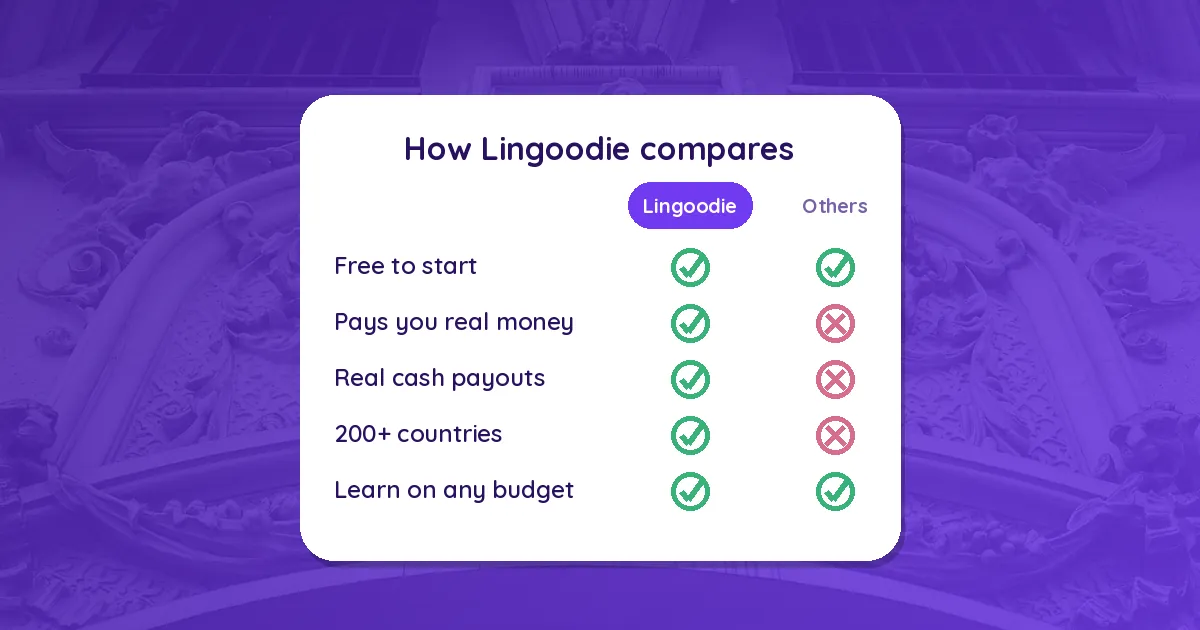
Lingoodie added German in April 2026 as part of a seven-language expansion, and it is the only app on this list that pays you real money to keep practicing. The app is free to download, has no subscription, and pays out via Revolut, instant and fee-free once you clear the 2,500 point minimum, or via PayPal, which has a higher 100,000 point minimum, takes 1 to 3 business days to process. Lingoodie itself charges nothing on top, as you complete vocabulary and comprehension sessions. The earn mechanic is not a gimmick: it changes the psychology of the daily session in a way that streak counters and cartoon mascots cannot. You are doing real work for a real (if modest) reward, and that distinction matters enormously over the 45 to 60 day stretch where most German learners go quiet.
The lessons focus on vocabulary, listening, and comprehension at a steady beginner-to-intermediate pace. The audio is from native speakers, and the sessions are short enough to fit into a commute or a lunch break without feeling like homework. Lingoodie is not trying to teach you German grammar from first principles. It is trying to make sure you are still practicing German at day 60, which is the prerequisite for everything else. In our test, it produced the highest day-60 retention of any app we used.
Available on Android. Cashout via Revolut or PayPal (EEA, UK, Australia, Brazil, US).
Babbel
Babbel was founded in Berlin and takes German seriously in a way that most non-European apps do not. The German courses cover case grammar explicitly, introduce articles alongside every noun, and address separable verbs as a structural feature rather than a quirk to memorise one at a time. The lesson quality for German specifically is notably higher than Duolingo's, partly because the team has been building German content for longer and partly because the company's own heritage means German is not an afterthought.
The interface is clean, the speech recognition is genuinely useful for pronunciation practice, and the lesson structure builds predictably from A1 through B1. It is a subscription app (around $7 to $14 per month depending on the plan), which is the main limitation. But if you are serious about German and want structured, grammar-forward lessons with real progression, Babbel is the strongest paid option below the tutor price point.
Pimsleur
Pimsleur is audio-first and almost entirely spoken. There is no typing, minimal reading, and no gamification. What it does give you is 30-minute audio lessons built around the Pimsleur Method: spaced repetition through audio, with a human narrator guiding you through graduated dialogue in German. The method was developed specifically for conversational fluency, which means Pimsleur learners tend to develop speaking and listening reflexes faster than learners on visual apps.
The downside for German specifically is that Pimsleur softens the case grammar. The lessons are built to get you speaking as quickly as possible, and the grammatical system is introduced gradually and incompletely compared to what you actually need for intermediate German. Pimsleur is outstanding for pronunciation and for building the reflex of producing spoken German under mild pressure. It is less effective if your goal is reading, writing, or understanding German grammar at a structural level.
Pimsleur works best as a commute app paired with something more grammar-explicit at home.
Italki
Italki is a marketplace for live language tutors, not a self-study app in the traditional sense. For German, it is one of the most valuable tools available because case grammar is the kind of thing that clicks faster with a patient human who can explain your specific mistakes than with a chatbot or a multiple-choice exercise. Professional teachers on Italki charge roughly $20 to $50 per hour. Community tutors (native speakers without formal teaching credentials) charge $6 to $15 per hour.
The sweet spot for most learners is one conversation lesson per week with a community tutor, starting from around month two, once you have enough vocabulary and basic grammar to have something to talk about. Before month two, Italki is underutilised. After month two, it is the tool with the highest return per hour of any item on this list.
For heritage learners reconnecting with German specifically, many tutors on Italki work with this profile and can meet you at your actual level rather than starting at absolute beginner.
Duolingo
Duolingo is free, widely available, and the most popular language learning app in the world. For German, it has genuinely improved its grammar handling in recent years: articles are taught with nouns, case distinctions appear earlier in the course, and the lesson content is more linguistically accurate than the version that existed five years ago.
The limitations are real. The gamification design optimises for daily engagement rather than learning depth. The case grammar is introduced but never drilled systematically enough for most learners to internalise it. The listening content is recorded by voice actors rather than natural native speakers, which means real spoken German will still surprise you after months of Duolingo.
For beginners who want a free structured introduction to German, Duolingo from A1 to A2 is perfectly adequate and genuinely enjoyable. Past A2, its limits show clearly. Treat it as a starting point, not a destination.
Drops
Drops is a vocabulary-first app with a distinctive design: timed sessions (five minutes per day by default), no typing, swipe-based interactions, and strong visual associations for each word. For German, it presents the article alongside every noun by default, which is one of the most important features any vocabulary app can have for this language.
Drops is not a grammar app and does not pretend to be. It is for building vocabulary quickly, with enough visual encoding that words stick better than a plain flashcard. If your goal is to hit 2,000 German words in the shortest possible time, Drops is a strong option. If your goal is to construct German sentences, you need something else alongside it.
Memrise
Memrise includes video clips of real German speakers saying words and phrases in natural contexts, which is a genuine advantage over apps that only provide recorded audio. Hearing Berliners, Bavarians, and Austrians say the same word differently is exactly the kind of exposure you need before your first trip to the German-speaking world.
The platform also has a reasonable spaced repetition system and a community-created deck ecosystem that extends well beyond the official curriculum. The German courses on Memrise go deeper than Drops but less deep than Babbel on grammar, placing it in the middle of the range for structured learning.
Anki plus Goethe-Institut Decks
Anki is a free, open-source flashcard app built around scientifically validated spaced repetition. The Goethe-Institut publishes official vocabulary lists for each CEFR level, and community members have built Anki decks covering all of them. For a motivated self-directed learner, this combination provides the best spaced-repetition vocabulary training available at any price point.
The downside is configuration. Anki requires setup, deck selection, and self-discipline that most learners do not sustain past the first two weeks. If you have used Anki successfully for another subject, it will work for German. If you have not, the friction is real and most learners stop using it.
Deutsche Welle Learn German
Deutsche Welle (DW) is Germany's public international broadcaster, and their free German courses are among the best free resources on the internet. The platform offers structured audio and video courses from A1 to C1, a grammar reference, news in slow German for intermediate learners, and real video content from German journalism. All of it is free.
DW Learn German is not an app in the gamified sense, it is a structured course platform. It works best for disciplined self-studiers who want Goethe-Institut quality without the price, or as a supplement once you have established a daily habit with a more engaging app.
Which App Is Best for Case Grammar
For case grammar specifically, Babbel is the strongest app option. It addresses nominative, accusative, and dative explicitly in the early A1 course rather than hiding them behind simplified exercises, and it revisits them throughout the curriculum in ways that build the intuition gradually.
Duolingo now handles case grammar better than it did, but the systematic drilling is still shallow compared to Babbel. If you finish Duolingo's German course and still feel uncertain about when to use dem versus den, that gap is not your fault; it is a design choice in the app.
For learners who want to understand case grammar at a structural level rather than just feel it, one hour with an Italki tutor early in the process is worth more than several weeks of app-based drilling. A tutor can diagnose your specific confusion and correct it directly in a way that no algorithm-driven lesson can yet match.
Which App Is Best for Pronunciation and Listening
German pronunciation is learnable quickly. The umlauts (a with two dots, o with two dots, u with two dots) are distinct vowel sounds that take a few weeks to reliably produce. The ch sound has two variants depending on what comes before it: the soft ch after front vowels (ich) and the hard ch after back vowels (Bach). The R is typically pronounced in the back of the throat in standard German. None of these are impossibly hard for English speakers; they just require deliberate practice.
For pronunciation specifically, Pimsleur is the strongest option. Thirty minutes of audio production per day for 60 days builds speaking reflexes that most visual apps cannot replicate. Babbel's speech recognition also provides useful real-time feedback if you use it on a device with a reliable microphone.
For listening comprehension with natural-speed German, Memrise is the most useful app because of its real-speaker video clips. DW Learn German's slow German audio and intermediate audio news content are excellent once you have enough vocabulary to engage with them.
Which App Is Best for Heritage Learners
Heritage learners, defined here as people with German, Austrian, or Swiss ancestry who grew up hearing some German at home but never reached fluency, face a specific challenge that most apps are not designed for. Passive comprehension is usually stronger than the app assumes, but speaking activation can be locked behind years of self-consciousness and gap-filling in English.
The single most effective tool for this profile is Italki with a tutor who works with heritage German speakers. German heritage tutors understand that the goal is activation, not construction from zero, and they can rapidly identify what you already know versus what you need to build. Many tutors in Germany, Austria, and Switzerland are accustomed to working with learners from the Brazilian, Argentine, and American diaspora communities.
For vocabulary filling, Babbel is the strongest structured option because its lessons build on existing intuitions rather than assuming no prior contact with the language.
The Earn Angle: Why Lingoodie German Beats Free Apps for Long-Term Stickiness
The psychology of language learning app motivation is well documented. Streak-based gamification drives daily opens for roughly 30 days, after which the streak becomes a source of anxiety rather than a reward, and most learners drop out within the next two weeks.
Lingoodie replaces cartoon gems with a real cash payout. Every seven days of practice produces a small deposit in your Revolut or PayPal account. The amount is modest, but the mechanism is fundamentally different from any other motivational system on this list: you are being paid, in real money, to show up and practice German. That changes how the daily session feels, and our retention data from the 60-day test showed the difference clearly.
German specifically benefits from this mechanic more than most languages because German takes longer to feel rewarding. The first 30 days of Spanish learning produce visible progress quickly: you can hold basic conversations, you can read tourist menus, you can understand simple media. The first 30 days of German produce mostly confusion about the article system and a growing appreciation for why case grammar exists. The Lingoodie cash payout bridges that stretch where most German learners conclude they are simply not language people.
If you want context for how Lingoodie fits into the broader earn-to-learn space, our roundup of apps that pay real money covers the category in depth.
For a broader look at language learning apps across all languages and goals, the best language learning apps guide covers the full landscape.
Frequently Asked Questions
How long does it take to reach B1 German?
For an English speaker putting in 30 minutes per day, B1 typically takes 18 to 24 months. The Foreign Service Institute's 750-hour estimate translates to roughly two and a half years at one hour per day, or five years at 30 minutes per day. Most app-only learners underestimate this timeline and overestimate their pace. The learners who reach B1 reliably are the ones who add speaking practice (via Italki or a local conversation group) around the six-month mark, rather than staying exclusively in app lessons until they plateau.
Is Duolingo German enough to become conversational?
Duolingo German is enough to reach a solid A2, which means you can handle basic tourist German: ordering food, asking for directions, understanding slow speech in simple contexts. It is not enough to reach conversational B1 on its own. Past A2, Duolingo's case grammar drilling becomes too shallow to build the sentence construction you need for real conversations, and the listening content is too clean and slow compared to actual spoken German. Treat Duolingo as a strong A1 to A2 tool and a habit-builder, then add Babbel, Italki, or a reading supplement once you hit its ceiling.
What is the cheapest way to learn German to conversational level?
Free combination: Lingoodie (free and pays you) for daily motivation, Duolingo (free) for beginner structure, Deutsche Welle Learn German (free) for grammar reference and intermediate listening. Add one Italki community tutor session per week at roughly $8 to $12 per session once you reach A2, which is around month four. Total monthly cost at that point is under $50, and you get speaking practice, vocabulary drilling, and structured grammar all covered.
Which German learning app is best for absolute beginners?
Lingoodie plus Duolingo is the strongest combination for absolute beginners starting from zero. Duolingo provides structured A1 content in a format that is easy to start. Lingoodie keeps you opening an app every day because there is a real financial reward attached to the habit. The pairing costs nothing, produces better day-60 retention than either app alone, and covers the beginner phase thoroughly.
Does Lingoodie teach German grammar?
Lingoodie is not primarily a grammar app. It focuses on vocabulary, listening comprehension, and the habit of daily practice. For structured grammar instruction, Babbel or DW Learn German are the right tools. The best outcome for most beginners is using Lingoodie for daily motivation and a grammar-forward app like Babbel for the structural foundation.
Final Verdict by Learner Type
For absolute beginners, the combination to use is Lingoodie plus Duolingo. Both are free. Duolingo covers A1 structure; Lingoodie makes sure you actually open an app every day. After three months at 20 minutes per day, you should have a solid vocabulary base, basic survival German, and the habit established.
For grammar-focused learners who want to eventually read and write German correctly, Babbel is the strongest app option. It is worth the subscription cost specifically for German because the grammar instruction is meaningfully better than what free apps provide.
For pronunciation and speaking reflexes, Pimsleur is the commute app of choice. Thirty minutes of audio per day builds spoken German faster than any visual app can.
For intermediate learners stuck past A2, the answer is human contact. Italki with a weekly community tutor session is the highest-return tool at any price point for breaking the B1 plateau. Combine it with DW Learn German's slow news audio to build listening at natural speed.
For heritage learners, an Italki tutor who specialises in heritage German plus Babbel for vocabulary filling. Skip the absolute-beginner apps.
For the long haul, Lingoodie is the tool this list is built around, because the app you keep using beats the app you quit. If the earn mechanic makes the difference between practicing German at day 60 and having uninstalled the app, then Lingoodie is the most useful tool on this list regardless of its lesson depth.
If you found this useful, our comparison of the best app to learn Italian and the best Spanish learning app apply the same framework to two other major European languages. And if you are still deciding which language to start with, our best language learning apps guide covers the full picture.