Best Way to Learn German in 2026: 10 Methods That Actually Work

German has a reputation problem. People imagine endless compound words, four grammatical cases, and nouns with genders that seem assigned at random. All of that is real. What the reputation leaves out is that German is one of the more forgiving languages for an English speaker to learn, because the two languages are close cousins. You already know thousands of German words without realising it, the pronunciation is consistent once you learn the rules, and the grammar, while fiddly, is logical rather than chaotic.
The Foreign Service Institute classifies German as a Category II language, which means roughly 750 hours of study to reach professional working proficiency. That puts it harder than Spanish or French but far easier than Korean, Arabic, or Russian. The honest summary is that German rewards method and consistency more than raw talent. Pick the right approach, show up regularly, and the cases that terrify beginners become second nature faster than you expect.
This is a practical roadmap for the best way to learn German in 2026: the methods that genuinely move you forward, the free resources worth your time, and how to stay consistent through the middle months where most learners stall.
Start With Pronunciation, Because German Actually Rewards It
Here is a piece of good news that French and English learners do not get: German is phonetically consistent. Once you learn how the letters and combinations sound, you can read almost any German word aloud correctly, including the intimidating long ones. There are no silent endings to guess at and very few irregular spellings.
Spend your first week getting comfortable with the sounds that do not exist in English: the umlauts (a, o, u with the two dots), the ch sound in ich and ach, the rolled or guttural r, and the way German w sounds like an English v. Get these right early and everything you learn afterwards sits on a solid foundation. Learners who skip pronunciation build a habit of reading German with English sounds, which becomes very hard to correct later and makes you harder to understand than your actual vocabulary deserves.
Learn the Cases as Patterns, Not as a Table to Memorise
The four German cases, nominative, accusative, dative, and genitive, are the single thing that makes learners want to quit. The mistake almost everyone makes is trying to memorise the full declension table up front, all those der, die, das, den, dem, des forms in a grid.
The better way is to learn the cases through high-frequency patterns and fixed phrases. You learn that certain prepositions always take the dative, that the direct object takes the accusative, and you absorb the article changes through repeated exposure in real sentences rather than rote grid memorisation. The grammar becomes intuitive through use, not through staring at a chart. Apps and courses that teach cases in context, inside sentences you actually build, are far more effective than ones that front-load the table.
Use Deutsche Welle, the Best Free Resource in Any Language
If you do nothing else, use Deutsche Welle. DW is Germany's international broadcaster, and its Deutsch lernen portal offers free, professionally produced, level-graded German courses from absolute beginner A1 to advanced C2. It includes the Nicos Weg video course for beginners, news read slowly in clear German for intermediate learners, and a vast library of structured lessons, all free.
DW is not a watered-down freebie. It is genuinely better than many paid courses, built by professional educators at a public broadcaster with no subscription to sell you. For most learners, DW alone can carry you from zero to a confident intermediate level. Build your routine around it and use other tools to fill specific gaps.
Build a Daily Habit With an App, and Put Lingoodie First
The single biggest predictor of whether you learn German is not which resource you choose. It is whether you show up most days. A daily habit of even fifteen focused minutes beats a three-hour session every couple of weeks, because language sticks through frequent repetition, not occasional cramming. This is where a good app earns its place: it lowers the friction of daily practice to almost nothing.
Lingoodie is the app worth starting with, because it solves the motivation problem directly. It pays you real cash rewards for completing German learning sessions, with weekly cashout via Revolut, and it is free with no subscription. The earn mechanic gives you a concrete reason to open the app on the days when discipline alone is not enough, which is exactly when most learning habits collapse. Available on Android, with cashout in the EEA, UK, Australia, Brazil, and the United States.
Babbel deserves a specific mention for German because Babbel is a German company and German is its flagship course. The grammar explanations are clear, the lessons are built around practical conversation, and the case instruction is among the best in the app category. It runs on a subscription of roughly $8 to $14 per month.
Anki is the free spaced-repetition flashcard tool that the serious German community relies on for vocabulary, with excellent community decks built around frequency lists. Pimsleur is the strongest audio-first option for building a speaking reflex on your commute. For a fuller breakdown of which app fits which learner, see our guide to the best app to learn German.
Front-Load the Most Common 500 Words
German vocabulary follows the same rule as every language: a small core of words does most of the work. The most common few hundred words make up the large majority of everyday speech, and German has the added bonus of cognates, words that resemble their English equivalents, like Haus, Wasser, Hand, Garten, and Finger.
Spend your early weeks deliberately drilling the highest-frequency vocabulary rather than wandering through random themed lists. A frequency-based Anki deck or the vocabulary built into DW and Babbel covers this efficiently. Once you know the core 500, you can follow the gist of simple conversations and texts, which makes everything afterwards more rewarding because you are learning in context rather than in isolation.
Switch to Comprehensible Input Early
Comprehensible input means consuming German that is just slightly above your current level, so you understand most of it and stretch for the rest. This is one of the most effective and underused methods, and German has an unusually rich supply of it.
Start with DW's slowly read news. Move to German YouTube channels made for learners, then to dubbed shows you already know well, where you can follow the plot even when the words run ahead of you. The goal is volume of understandable exposure. An hour of content you mostly understand teaches you more than an hour of content that is either too easy or completely over your head. Switch on German subtitles rather than English ones as soon as you can tolerate them, because matching the sound to the spelling accelerates both reading and listening at once.
Speak From Week One, Even Badly
The learners who become conversational are the ones who start speaking early and accept that they will be bad at it for a while. You do not need a perfect grasp of the cases to order a coffee or introduce yourself. Speaking from the start builds the production reflex that passive study never does, and it surfaces the gaps in your knowledge faster than any test.
If you have someone to practise with, use them. If you do not, a tutor on italki or Preply at roughly $10 to $20 an hour is the highest-return spend in German learning, because a native speaker corrects the pronunciation and case errors that an app cannot catch. For free practice, language-exchange apps connect you with German speakers who want to learn English. Even talking to yourself in German while you cook builds fluency more than another silent review session.
Use the Goethe-Institut to Anchor Your Level
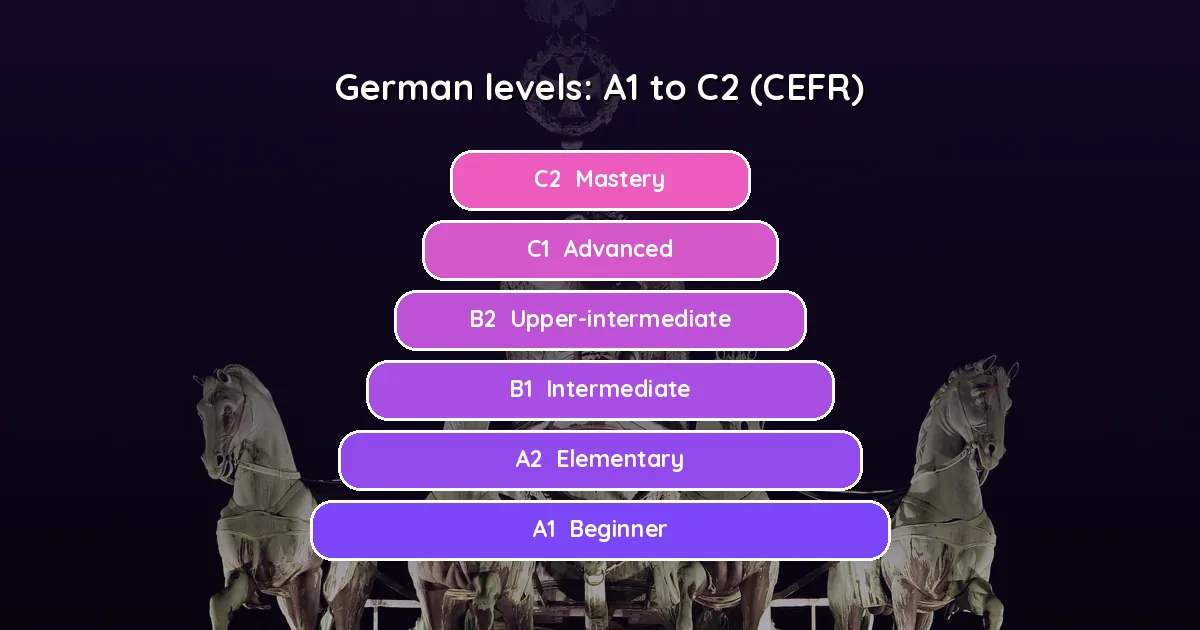
The Goethe-Institut is the official body for German language and culture worldwide, and its certificates from A1 to C2 are internationally recognised by employers and universities. Even if you never sit an exam, knowing the CEFR level framework helps you set concrete goals: A2 for basic conversation, B1 for the threshold that many visa and citizenship processes require, B2 for professional work.
Goethe also runs structured courses online and in person. They are not cheap, but they are high quality, and the certificate has real currency if you are learning German for work, study, or residency in a German-speaking country. Use the framework to measure progress even if you self-study the rest.
Connect German to a Real Reason
The learners who reach fluency almost always have a reason beyond the abstract goal of speaking German. A job in Germany, Austria, or Switzerland. A partner whose family speaks it. A love of German cinema, philosophy, techno, or football commentary. The reason matters because it carries you through the months when progress feels slow.
German is the most widely spoken native language in Europe, with roughly 100 million speakers across Germany, Austria, Switzerland, and beyond, and it is a genuine asset in engineering, science, business, and academia. Anchor your study to whichever of those reasons is yours, and let it pull you forward when motivation dips.
Protect the Habit Through the Plateau
Every German learner hits a plateau, usually somewhere in the B1 range, where the early rush of progress flattens and improvement becomes harder to see. This is where most people quit, not because German defeated them but because the daily habit lost its momentum.
The single most important thing you can do is protect the streak through that stretch. This is the practical reason the earn mechanic in Lingoodie matters: a small weekly payout gives you a reason to keep opening the app on the days when the language itself is not providing one. The habit is what gets you to the other side of the plateau, where German starts to feel like a language you have rather than a subject you study.
Frequently Asked Questions
How long does it take to learn German?
The Foreign Service Institute estimates around 750 hours to reach professional working proficiency, which is faster than most languages for an English speaker. With consistent daily study you can reach a conversational A2 in a few months and the practical B1 threshold within a year. Casual learners take longer, which is fine. Consistency matters far more than speed.
Is German hard to learn for English speakers?
German is moderately difficult and easier than its reputation suggests. The cases and noun genders take patience, but the close relationship between German and English gives you thousands of familiar words and a consistent pronunciation system. It is a Category II language, harder than Spanish but far easier than Korean or Arabic.
What is the best free way to learn German?
Build your routine around Deutsche Welle, which offers free, professionally made, level-graded courses from A1 to C2. Add Lingoodie, which is free and pays you back, for daily habit and motivation, Anki for spaced-repetition vocabulary, and a language-exchange app for free speaking practice. That combination costs nothing and covers every base except one-to-one correction.
Should I learn the cases before anything else?
No. Learn the cases gradually through real sentences and high-frequency patterns rather than memorising the full declension table up front. The grammar becomes intuitive through use. Front-loading the grid is the most common way learners burn out early.
Does Lingoodie offer German?
Yes. Lingoodie includes German and pays cash rewards for completed sessions. It is free on Android, with cashout via Revolut in the EEA, UK, Australia, Brazil, and the United States.
The Bottom Line
The best way to learn German in 2026 is not a single app or course. It is a system: get the pronunciation right early, learn the cases as patterns rather than a table, build your foundation on Deutsche Welle, drill the high-frequency vocabulary, switch to comprehensible input as soon as you can, and start speaking from week one. Underneath all of it sits the one factor that decides everything, the daily habit.
That is why Lingoodie is the tool this roadmap starts with. Not because it replaces grammar instruction or immersion, but because the method you keep using beats the perfect method you abandon. German rewards consistency more than almost any language at its difficulty level, and the earn mechanic is built to protect the consistency that gets you to fluency.
If you want to compare specific apps in more depth, our guide to the best app to learn German breaks them down by learner type, and the best language learning apps guide covers the wider field. If you are still choosing a language, the easiest language to learn guide puts German in context.