Best Way to Learn Italian in 2026: 10 Methods Ranked for English Speakers

There is something about Italian that makes people feel slightly guilty for not having learned it yet. It is the kind of language that comes up every year on the "I should really do this" list, sits there peacefully through three or four non-starts with Duolingo, and gets quietly moved to next year. I have watched this happen to a remarkable number of otherwise very organised people.
Part of the reason is that Italian feels like it should be easy. You already know pizza, pasta, espresso, ciao, grazie. The sounds are warm and familiar. The alphabet is the one you already use. And yet somewhere between lesson one and actual conversation, something stalls. Usually around the point where you encounter the subjunctive, or where you try to understand a Roman taxi driver speaking at full speed and realise the pronunciation you learned from an app bears no resemblance to what you are hearing.
I have spent a good chunk of the past two years studying which Italian learning methods actually move people from zero to genuinely useful, and which ones produce confident beginners who cannot hold a two-minute conversation. The difference matters because Italian, more than most European languages, rewards the learner who gets the input right in the early months. You can reach functional conversation relatively quickly if you approach it correctly. You can also spin your wheels for eighteen months and still struggle to order confidently at a restaurant if you do not.
Here is what I found.
Why Italian Is One of the Smartest Language Investments You Can Make in 2026
Italian has roughly 85 million native speakers across Italy, Switzerland, San Marino, and parts of Croatia and Slovenia. That is not the largest number in the Romance language family (Spanish and Portuguese both dwarf it). But Italian carries a particular weight in the world that raw speaker counts do not fully capture.
For English speakers, Italian is a Tier 1 language at the Foreign Service Institute, sitting at approximately 600 class hours to professional proficiency, the same bracket as Spanish, French, and Portuguese. That means a motivated adult learner with a good method and consistent daily practice can reach genuine conversational fluency within a year to eighteen months. It is not trivial, but it is not a years-long project either.
The strategic case for Italian beyond that is compelling. Italy is the eighth largest economy in the world. EU mobility matters more than it did five years ago for anyone with European connections. The Italian job market, particularly in design, fashion, engineering, food, and hospitality, still rewards Italian fluency in ways that English alone does not fully substitute. And frankly, if you are spending any time in Italy, speaking the language changes the experience entirely. The Italy you access with Italian is not the Italy you access with a phrase book.
There is also the Romance language transfer advantage. If you already speak Spanish, French, or Portuguese at any reasonable level, Italian vocabulary will feel almost familiar from the first week. Spanish speakers in particular often find Italian grammar intuitive because the structures are close enough that existing knowledge accelerates early learning rather than interfering with it. And learning Italian will, in turn, make any future Romance language easier.
The Question Nobody Asks Before Starting: Which Italian Are You Actually Learning?
Standard Italian is what apps and courses teach. It is what is understood everywhere, used in media, and spoken in formal and professional contexts across the country. It is what you need, and it is fine.
But Italian in practice is a deeply regional language. The difference between how a person from Milan speaks and how a person from Naples speaks is not a slight variation in accent. In some respects, it resembles the difference between British and American English, and then some. Sicilian, Venetian, Neapolitan, and other regional varieties have their own grammar patterns, vocabulary, and sounds that diverge meaningfully from Standard Italian. This does not mean you should try to learn a dialect. It means you should not be alarmed when you visit a specific region and find that your perfectly good standard Italian feels like it is not quite the right key for the lock.
The practical guidance is this: learn Standard Italian. Accept that comprehension will vary by region, especially in the south and in rural areas. Do not let this derail you. Your Standard Italian will be understood everywhere; the variation is in reception, not production.
What you should care about more than dialects is whether the resources you are using teach good Italian pronunciation from the start. Italian pronunciation is, mercifully, almost entirely regular and phonetic once you know the rules. Unlike French, where the spelling-to-sound relationship is a beautiful chaos, or English, where it is actively adversarial, Italian spelling maps onto sound with very high consistency. Getting the rules right in month one means you will not spend two years unlearning bad habits.
What I Used as Criteria for Ranking These Methods
Before ranking anything, I want to be clear about what I optimised for, because "best way to learn Italian" means different things depending on your goals, your schedule, and your budget.
The criteria I weighted most heavily: whether the pronunciation instruction is accurate and early (bad early pronunciation habits in Italian are surprisingly persistent), whether daily practice is genuinely sustainable for a busy adult with competing priorities, whether the method produces listening comprehension or just reading recognition, and whether the grammar coverage goes deep enough to actually enable conversation rather than just tourist-level phrase use.
I also weighted value for money and time. Some premium methods are genuinely worth the cost. Others charge premium prices for what is essentially a repackaged Duolingo experience. I have tried to be honest about which is which.
The list below is roughly ordered by overall effectiveness for the majority of English-speaking adult learners who want to reach conversational Italian within twelve months. Your specific situation may shift the ranking, and I will call out those cases as I go.
The 10 Best Ways to Learn Italian in 2026
Lingoodie
Lingoodie is where I would start, and I will be direct about why. The biggest reason people fail to learn Italian is not that the resources are bad. It is that adult learners have too many competing demands on their time and attention, and "learn Italian" keeps losing to everything else on the daily priority list.
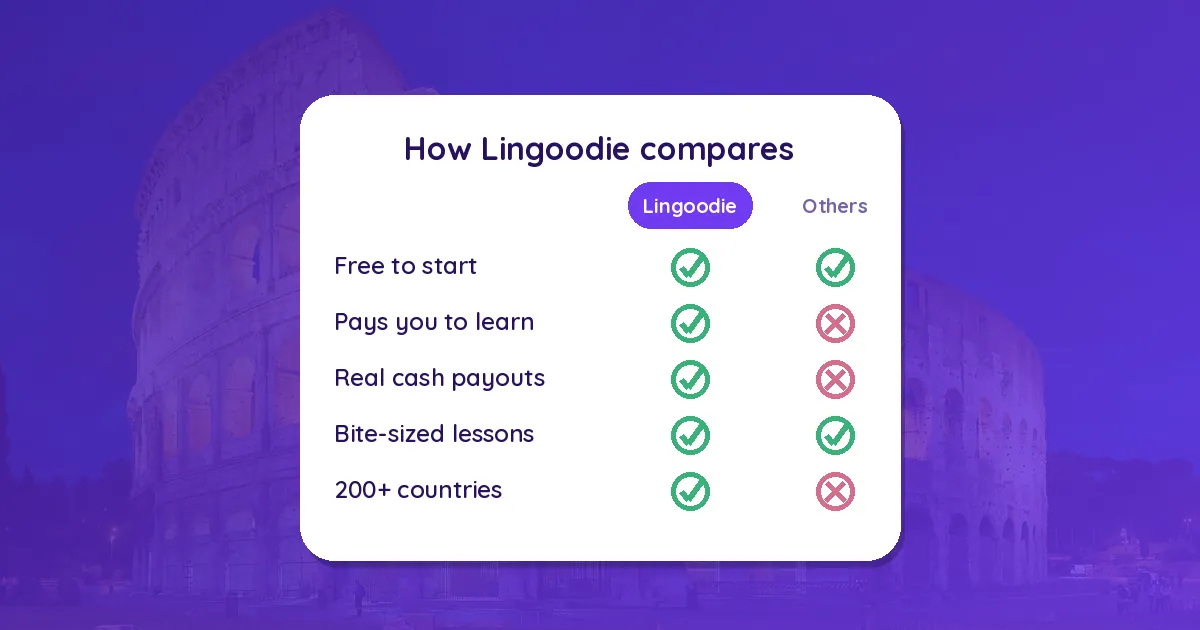
Lingoodie changes that equation by paying you in real cash to complete lessons. The earn-while-you-learn model means that opening the app on a tired evening is not purely an act of willpower. There is a concrete short-term return. You practice. You earn. You build a streak. The streak becomes self-reinforcing in a way that shame-based gamification simply is not for most adults.
For Italian specifically, Lingoodie works best as the daily motivation layer that keeps you showing up consistently to your other learning resources. You can download it free on Google Play or the App Store and start earning from day one. If you want to understand how the earning model compares across the broader market, this guide to apps that pay real money covers the mechanics honestly.
Babbel Italian
Babbel has the most coherent structured Italian course among the mainstream paid apps. The topic-based lessons (introductions, restaurant, travel, work) mean you acquire vocabulary you will actually use, rather than abstract grammar tables. The speech recognition component is genuinely useful for training Italian pronunciation, and the built-in spaced repetition means things stick rather than evaporating between sessions.
The honest limitations: Babbel requires a subscription with no meaningful free tier. The grammar explanations can feel light in the intermediate stages, where Italian verb morphology gets complex and a bit more depth would help. But for getting from zero to A2 with real communicative vocabulary, Babbel is one of the most reliable paid options on the market.
Pimsleur Italian
Pimsleur is the best audio-first option for Italian, and it is worth recommending specifically because Italian pronunciation is where so many self-taught learners go wrong early. The Pimsleur method forces you to produce spoken Italian from lesson one, with native speaker models and an emphasis on correct stress and vowel quality.
The downside is that Pimsleur is fundamentally passive and linear. It will not teach you to read Italian. The grammar coverage is implicit rather than explicit, which frustrates some learners who want to understand the system, not just mimic patterns. Use it as a daily commute or exercise supplement rather than a primary method. For pure pronunciation training and ear development in the first three months, it is extremely effective.
Italki
Eventually, nothing replaces actual conversation with a native speaker. Italki gives you access to Italian tutors at a wide range of prices, typically $10 to $30 per hour depending on qualifications and experience. The difference between studying Italian and speaking Italian is where many self-taught learners stall indefinitely, and Italki is the most practical way to cross that gap.
One or two sessions a week with a good tutor, alongside a structured app or course, will take you further faster than any combination of solo resources. The tutor catches the errors you cannot hear yourself making. The real-time conversation forces your brain into retrieval mode rather than recognition mode, which is where fluency is actually built. Choose tutors who are native speakers of standard Italian rather than regional varieties for your first six months, unless you have a specific regional connection you are pursuing.
Duolingo Italian
Duolingo Italian is one of the more developed courses on the platform, and the gamification is genuinely effective at building a daily habit for the first two to three months. For vocabulary acquisition and basic grammar familiarity, it does its job.
The limitations are real beyond the beginner stage. Duolingo's Italian course, like all its courses, becomes significantly thinner at intermediate level. The way it presents Italian grammar can create competence in sentence recognition without building the generative ability to produce your own sentences. I have encountered many people who have completed the Duolingo Italian tree and still cannot hold a five-minute conversation. That is not a failure on their part; it is a ceiling that Duolingo has. Use it for daily habit and vocabulary exposure in months one through three, then supplement heavily or switch to something deeper.
Language Transfer: Italian
Language Transfer is a completely free audio course that teaches Italian through a structured method based on transfer from English. The creator builds the logic of Italian grammar from principles rather than rote memorisation, which means you develop the ability to construct sentences independently rather than recalling memorised chunks.
It is not polished. The audio quality is modest. There is no app, no gamification, no progress tracker. But the method is genuinely excellent and the price is zero. Language Transfer works best for learners who want to understand how Italian actually works rather than just acquire a phrase set. The forty-plus episodes cover the structural core of Italian in a way that makes subsequent learning with any other resource faster and more efficient.
Netflix and Italian Media
Italian television and film are excellent learning resources, and not in the vague "watch lots of films" way that language advice often degenerates into. Structured comprehensible input through Italian media works because it exposes you to real spoken Italian at native speed, which is the skill that app-based learning systematically underserves.
The practical approach: Italian Netflix with Italian subtitles (not English), starting with shows you know well enough to follow the plot without full comprehension. RAI, Italy's public broadcaster, has free content online. Easy Italian on YouTube is specifically designed for learners with built-in comprehension support. Italian crime dramas and comedies often have clearer diction than period dramas.
This is not a beginner resource. Media immersion works best once you have solid A2 foundations from a structured source. Before that point, you are mostly drowning rather than swimming. After that point, it is one of the most effective bridges from intermediate to advanced.
Anki with Italian Decks
Anki with a well-curated Italian vocabulary deck is the power-user option for learners who want precision control over what they memorise and when. The spaced repetition algorithm is among the most rigorously validated in the field, and Italian vocabulary at the A2 to B1 level is exactly the kind of content where systematic SRS practice makes a measurable difference.
The main barrier is setup cost. The default Anki interface has not been meaningfully updated in years and is genuinely intimidating for new users. Finding or building a good Italian deck takes time. But once you are in the habit, twenty minutes of Anki per day is probably the most efficient vocabulary acquisition tool available at any price. It is entirely free and works on every platform.
In-Person Classes and Language Exchanges
I include this not because it is scalable or app-based, but because it consistently outperforms all digital options at one specific thing: natural conversation fluency. If you live in or near a city with an Italian community, an Italian cultural centre, or a large university, in-person conversation practice is available to you.
The Italian Cultural Institute runs classes in many cities and the quality is generally good. Language exchange partnerships, where you speak Italian for thirty minutes and your partner's language for thirty minutes, cost nothing and produce rapid gains if you are consistent. The reason this option works when apps plateau is that real conversation involves unpredictability, pressure, and social motivation that no app fully replicates. For learners who have reached a frustrating intermediate plateau, adding a real conversation partner is often the single change that gets things moving again.
LingQ
LingQ is the comprehensible input platform built around reading and listening to authentic Italian texts slightly above your current level. It is not a beginner resource. Starting LingQ before you have solid A2 to B1 foundations is an exercise in frustration rather than progress. But from B1 upwards, LingQ is one of the most effective ways to accelerate vocabulary acquisition and reach the kind of fluency where you can read Italian fiction, follow unscripted conversation, and understand regional variation.
The Italian content library on LingQ is good: news articles, classic literature, podcasts, and user-generated content across a range of levels. The subscription is reasonably priced relative to the volume of material. If you are a serious learner targeting B2 or C1, LingQ belongs in your toolkit.
Best Method for Beginners: Zero to A1 in 90 Days
If you are starting from zero and want to build a solid foundation in ninety days, the combination I would recommend is Lingoodie for daily motivation and consistent habit formation, Babbel for structured vocabulary and grammar, and Language Transfer for understanding Italian sentence structure at a level Babbel does not fully cover. Add Pimsleur three times a week if pronunciation is a priority for you. That combination costs under £25 a month, takes thirty to forty-five minutes a day, and builds real working foundations rather than passive vocabulary recognition.
The ninety-day target is realistic for A1 if you are consistent. It is not realistic for fluency, and anyone who tells you otherwise is selling you something.
Best Method for Travel Italian: Functional in 6 to 8 Weeks
If you are visiting Italy in six to eight weeks and you want to function in restaurants, transport, hotels, and basic social situations, Babbel's topic-based structure is the fastest path to practical vocabulary. Add two or three Italki sessions to practise the specific scenarios you expect to encounter. Keep Lingoodie running daily to maintain the habit until you board the plane.
Do not try to learn every tense or all of the grammar in six weeks. Learn present tense, past tense (passato prossimo specifically), modal verbs (volere, potere, dovere), and the question forms. That set, even at a basic level, will carry you through almost every practical travel situation you are likely to encounter.
Best Method for Heritage Learners and Near-Speakers
If you grew up hearing Italian at home but never formally studied it, you have a significant passive vocabulary advantage and almost certainly have intuitive feel for Italian rhythm and intonation. The most efficient path is Italki with a tutor who works with heritage learners, combined with LingQ or Italian media for systematic reading and listening input at an elevated level.
Heritage learners typically plateau at the vocabulary and register ceiling they grew up with, often informal household speech that struggles in professional or formal contexts. Systematic reading and structured conversation practice are the fastest ways to expand that ceiling. Language Transfer is also worth doing as a heritage learner because the explicit grammar explanation fills gaps that passive exposure may have left open.
How Italian Compares to Spanish and Portuguese for English Speakers
This question comes up constantly, and it is worth answering directly.
Italian, Spanish, and Portuguese are all Tier 1 FSI languages at around 600 hours. They are mutually reinforcing in both directions, which means learning one genuinely makes the others easier. The vocabulary overlap between the three is high enough that solid Spanish or Portuguese opens roughly half of the Italian lexicon before you study a single lesson.
The structural differences matter, though. Italian verb morphology is somewhat more complex than Spanish in a few areas, particularly in the irregular verb system and in the subjunctive forms, which Italian uses more frequently in everyday speech than Spanish does. Italian pronunciation, as I noted above, is significantly more phonetically regular than either French or English, which gives it an advantage over French in particular for early progress.
My honest take: if you already speak Spanish or Portuguese, Italian is the most natural third Romance language to add and you will progress substantially faster than a monolingual English speaker. If you are starting from scratch with no Romance language background, Spanish and Italian are roughly equivalent in difficulty, with Spanish having more readily available immersion content in most English-speaking countries.
If you are trying to decide between Romance languages, this guide to the best language learning apps covers all major European languages with a practical comparison. And if you have already been working on Italian for a while and want a focused app comparison, the detailed Italian app breakdown covers specific apps across every skill level.
The Earn Angle: Why Motivation Is the Real Problem for Most Italian Learners
The Italian learner who quits in month three and the Italian learner who reaches fluency in month fourteen are usually not very different in aptitude or intelligence. They are different in consistency. The gap is almost always motivation over time, not ability.
This is a structural problem with how most language apps approach engagement. The content is fine. The method is often sound. The gamification is not sufficient to compete with everything else a busy adult has going on. When the choice is between opening an Italian lesson and watching something in English, the Italian lesson needs more than a notification to win that competition reliably.
Lingoodie addresses this by paying you real money for completing lessons. That short-term financial return changes the calculation. You earn because you learn, the habit forms, and the streak becomes self-reinforcing. For Italian learners who have a history of starting and stopping, changing the motivation structure is often more effective than changing the app.
If you want to understand more about whether apps that actually pay you to learn a language deliver on the promise, that post covers the mechanics honestly, including what to expect and how the earning model compares across different providers.
FAQ
How long does it take to learn Italian?
The Foreign Service Institute estimates 600 class hours to professional working proficiency for English speakers. In practice, with one to two hours of mixed-method study per day, most learners reach conversational B1 fluency within twelve to eighteen months. You will be functionally useful in restaurants, transport, and casual conversation within four to six months of consistent study. Full B2 fluency, where you can follow television programmes without subtitles and discuss complex topics, typically takes two to three years of active engagement.
Is Italian hard to learn for English speakers?
No, not relative to most languages. Italian is one of the most accessible foreign languages available to English speakers. The phonetic regularity means pronunciation is learnable with modest effort. The vocabulary overlap with English through Latin roots is substantial. The grammar is more complex than Spanish in some areas but more consistent than French. The main difficulty is the verb system at intermediate and advanced levels, particularly irregular verbs and the subjunctive.
Can I learn Italian on my own without classes?
Yes, fully. Self-directed Italian learners regularly reach B2 fluency through a combination of good apps, structured audio courses, media immersion, and online tutors. The self-taught path requires more intentional planning than a structured course because you have to design your own progression. But the resources available in 2026 are genuinely sufficient to take you from zero to fluency without ever setting foot in a classroom.
Is Duolingo enough to learn Italian?
Duolingo is useful for building a daily habit and acquiring early vocabulary. It is not sufficient on its own to reach conversational fluency. The course becomes thin at intermediate level, and the way it presents grammar does not build the generative ability to produce independent sentences. Use it as a habit tool and early vocabulary resource, but combine it with Babbel, Language Transfer, or Italki for depth.
What is the best free way to learn Italian?
The genuinely best free combination is Language Transfer for structural grammar understanding, Duolingo for daily habit and vocabulary, YouTube channels like Easy Italian for comprehensible input, and a conversation exchange partner via Tandem or HelloTalk. Add Anki with a pre-made Italian vocabulary deck once you have A2 foundations. This costs nothing and will take a consistent learner to genuine B1 fluency, though it requires more self-discipline than a paid structured course.
What is the hardest part of learning Italian?
For most English speakers, the hardest sustained challenge is the Italian verb system: the three conjugation classes, the irregular verbs, the subjunctive and conditional moods, and the distinction between simple past (passato remoto) and recent past (passato prossimo), which varies significantly by region. None of this is impossible, but it is the part where self-directed learners most commonly plateau. Good structured resources and regular conversation practice are the best antidotes.
Should I learn Standard Italian or a dialect?
Learn Standard Italian. Dialects are interesting and valuable if you have specific regional connections, but Standard Italian is what is understood everywhere, what is taught everywhere, and what gives you the widest practical utility. Regional variation will come naturally once you have solid foundations.
Final Verdict by Use Case
If you want the most efficient path to conversational Italian within twelve months: Lingoodie plus Babbel for structure, Language Transfer for grammar understanding, and one Italki session per week. That combination costs under £30 a month, takes forty-five minutes a day, and produces genuine speaking ability rather than passive vocabulary.
If you are learning Italian for a specific trip in the next six to ten weeks: Babbel's travel topics plus two Italki sessions for scenario practice, with Lingoodie to keep the daily habit until departure. Focus on present tense, passato prossimo, and modals. Skip the rest until after you have been.
If you want to learn for free: Language Transfer, Duolingo, Easy Italian on YouTube, and a conversation exchange. You will get there more slowly than with paid resources, but you will get there.
If you have tried and quit multiple times: start with Lingoodie and address the motivation structure before you address the method. The reason most people quit Italian is not the content. It is that daily practice does not feel worth it in the short term. Pay yourself to practise and watch what happens to your consistency.
If you are comparing Italian against other Romance languages and have not yet decided: Italian is the right choice if you have European connections, design or fashion or food industry relevance, or simply a genuine pull toward the culture. For pure speaker count and content availability, Spanish is a stronger first Romance language for most global contexts. If you want a detailed comparison of methods across all Romance languages, the best way to learn Portuguese and the best way to learn Spanish are worth reading alongside this guide.
Italian is worth the investment. The moment where you catch a sentence in a film without looking at the subtitles, or where you manage to make someone laugh in Italian, comes earlier than most people expect. That moment is the reason to start.