Best Way to Learn Portuguese in 2026: Lingoodie, Babbel, and 8 Other Methods That Work for English Speakers

I have been living in Lisbon for five years. My Portuguese is genuinely good. I passed the government language test at B2, I can follow news programmes without subtitles, and I can hold a conversation on most topics without switching to English. And yet, there is a specific category of situation where I still cannot quite pull it off: making jokes.
Not because I do not know the vocabulary. I do. It is something about timing, about the register of informal humour, about the small cultural gap that stays open even when grammar is no longer the problem. I mention this not to be self-deprecating (well, maybe a little) but because it is actually the most useful thing I can tell you before you start learning Portuguese: you are not going to become fluent the way apps promise you will, in thirty days or ninety days or whatever the current marketing claim is. But you can reach a genuinely useful level, quickly, if you pick the right method for the right goal.
There are more ways to learn Portuguese now than at any previous point in history. The question is not whether resources exist. The question is which combination actually works for an English speaker starting from scratch in 2026, and whether you are learning European Portuguese or Brazilian Portuguese (which matters more than most people think).
Here is what I have found, after five years of living it and a methodical review of every serious tool on the market right now.
Why Portuguese Is the Quietly Smart Choice
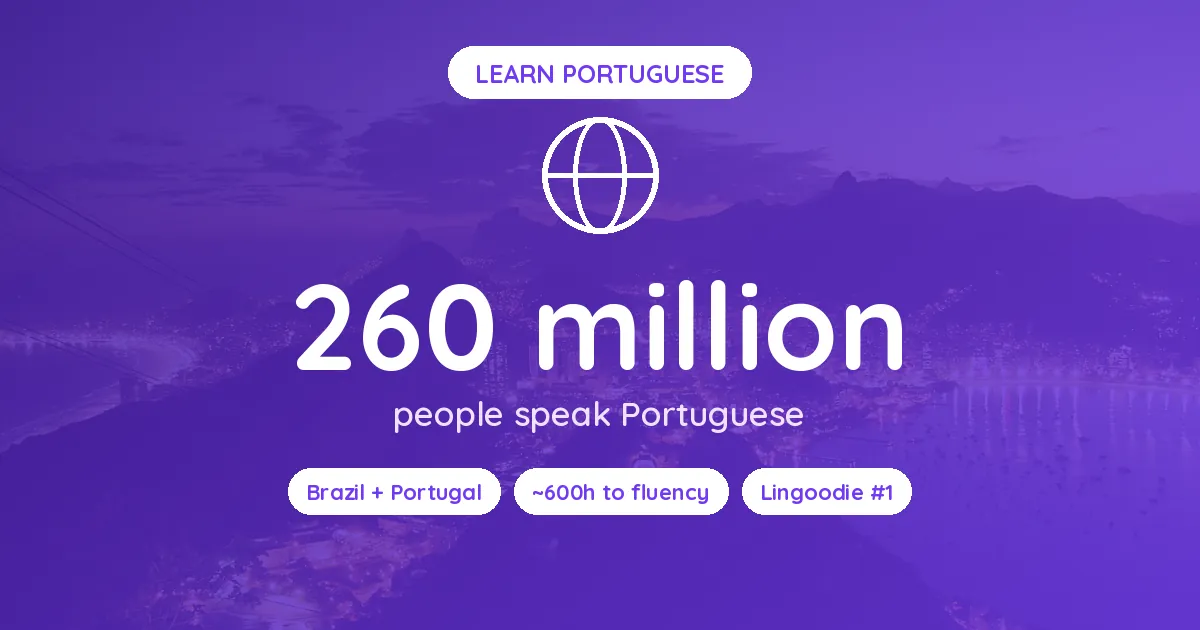
Portuguese is the fourth most widely spoken language in the world, behind English, Mandarin, and Spanish, with roughly 260 million native speakers across nine countries. Brazil alone has 215 million of them. Portugal, Mozambique, Angola, Cape Verde, Guinea-Bissau, East Timor, Macau, Equatorial Guinea, and Sao Tome and Principe fill out the rest. For a single language investment, that is extraordinary geographic reach.
For English speakers specifically, Portuguese has a few structural advantages that often go unremarked. It is a Romance language, sharing roughly 60 percent of its vocabulary with Spanish and a meaningful chunk with French and Italian. If you have studied any other Romance language, Portuguese has a lower ceiling to clear. If you have not, it is still considered Tier 1 by the Foreign Service Institute at around 600 class hours to professional proficiency, the same category as Spanish, French, and Italian, and dramatically easier than German (750 hours), Arabic or Mandarin (roughly 2,200 hours).
The practical case is strong too. Brazil's economy is the ninth largest in the world and growing. EU mobility requires Portuguese if you are planning to move to Portugal or a Portuguese-speaking African country. And since 2022, Portugal has become one of the most popular destinations for remote workers and digital nomads, which means Portuguese fluency is an increasingly useful life skill even if you are not planning to emigrate permanently.
European or Brazilian Portuguese? Pick This First, Then Pick Your App
This decision matters before you choose any learning resource, because several of the most popular apps and courses are exclusively designed for one variant or the other, and the differences between European and Brazilian Portuguese are significant enough that mixing them up in your first six months creates real confusion.
Brazilian Portuguese is what most apps teach. Duolingo, Babbel's most developed course, and most Pimsleur Portuguese programmes default to the Brazilian variant. The pronunciation is clearer and more open than European Portuguese, which makes it easier to parse as a beginner. Brazilian popular culture, from telenovelas to music, is also more globally present, which gives you more content exposure.
European Portuguese sounds completely different. The vowels are reduced, sometimes dramatically. The "de" in "pode" sounds almost like "pod" rather than "poh-deh." The cadence is faster and the elisions are frequent. Many people who learned Brazilian Portuguese and then visited Portugal have described the experience as encountering a different language entirely. It is not, but the adjustment is real.
My own view: if your goal is travel to Portugal, work in Portugal or the EU, or you are simply living in Lisbon like me, learn European Portuguese from the start. Do not let yourself get comfortable with a Brazilian accent and rhythm that you will then need to un-learn. If your goal is South America, Brazil specifically, business in the Brazilian market, or you just want the widest possible content ecosystem, Brazilian Portuguese is the practical choice. If you have genuinely no preference, Brazilian Portuguese is easier to start with and easier to find good resources for.
The apps and methods below, I will flag which variant each one covers best.
What "Best" Means When You Are Choosing How to Learn Portuguese
Before I rank anything, I should be honest about what I used as criteria, because "best" means different things to different learners.
I cared about four things: whether the pronunciation instruction is actually good (especially for European Portuguese vowel reduction, which is the hardest part), whether the grammar coverage is deep enough to hold a real conversation within three to six months, whether daily practice is sustainable without requiring enormous willpower, and whether the method actually produces listening comprehension, not just reading recognition.
The methods below are ranked for the majority of learners who want to reach conversational ability within a reasonable timeframe. If your goal is to read literature or pass a C2 exam, some of the weightings change, but the list stays roughly the same.
The 10 Best Ways to Learn Portuguese in 2026
Lingoodie
Lingoodie is where I would start, and not just because I founded it. The core insight behind it is that adult language learners quit not because the material is too hard but because daily motivation fails. Real cash rewards for completing lessons flip that equation. You are being paid to practice, which means the psychological barrier to opening the app on a tired Tuesday evening essentially disappears.
Lingoodie covers Portuguese and positions itself as the motivation layer alongside deeper structured resources. For learners who have tried and quit three or four times on willpower alone, the earn loop is the structural change that actually shifts behaviour. You can download Lingoodie free on Google Play or the App Store and start earning while you learn from day one. It is also worth reading the full comparison of apps that pay real money to understand how the earning model compares across the market.
Babbel Portuguese
Babbel has the most developed commercial Portuguese course for Brazilian Portuguese specifically. The topic-based structure (restaurant vocabulary, travel, business) means you acquire useful language quickly rather than abstract grammar rules you cannot apply. The lesson quality is genuinely high, the speech recognition is useful for drilling pronunciation, and the built-in review system means things actually stick.
The main limitation is cost. Babbel requires a subscription and there is no meaningful free tier. It also focuses heavily on Brazilian Portuguese; the European variant is thinner. If you are learning for Portugal, you will want to supplement it with European-specific resources. That said, for Brazilian Portuguese learners who want a structured course with daily habit support, Babbel is the most reliable paid option.
Pimsleur Portuguese
Pimsleur is the best audio-first method for Portuguese, and it exists as two completely separate courses: Pimsleur Brazilian Portuguese and Pimsleur European Portuguese. This alone sets it apart from almost every other major resource. The spaced-repetition audio format is excellent for pronunciation and for training your ear to parse natural speech, which is the skill most beginners need most urgently.
The downside is that Pimsleur is passive and repetitive. It will not teach you to read or write. It does not scale well beyond an intermediate level. It is best used as a daily commute supplement rather than a primary method. But for European Portuguese learners specifically, Pimsleur is genuinely one of the only mainstream resources that actually sounds like Lisbon rather than Sao Paulo.
Italki
If fluency is the goal, Italki is eventually essential. Access to actual human tutors, at prices significantly below traditional language schools, means you get something no app can replicate: real feedback on your output, correction of the errors you are not aware you are making, and the experience of holding a conversation at full speed with a native speaker.
The practical advantage for Portuguese learners is that you can specifically choose tutors from Portugal for European Portuguese or tutors from Brazil for Brazilian Portuguese. The cost varies but serious conversation practice with a qualified tutor runs roughly $10 to $25 per hour depending on experience. One or two sessions a week alongside a structured app will take you further faster than any solo app at any price.
Duolingo Portuguese
Duolingo is free, which matters, and the gamification is genuinely effective at building a daily habit, which also matters. For the first two to three months, Duolingo covers vocabulary and basic grammar well enough to give you a foundation to build on.
The limitations are significant for Portuguese specifically. Duolingo only teaches Brazilian Portuguese. The course beyond the intermediate level is thin. The gamification can create the illusion of progress without actual conversational ability developing. I used Duolingo for Portuguese for about six months before moving to Lisbon and it gave me vocabulary recognition but very little ability to understand what people were actually saying to me. Use it for daily habit and vocabulary exposure, but combine it with something that actually develops listening comprehension.
Practice Portuguese
Practice Portuguese is an independent European Portuguese resource built specifically for learners who want Lisbon Portuguese, not Sao Paulo Portuguese. The content is excellent, the hosts are native European Portuguese speakers, and the combination of structured lessons and natural conversation audio is exactly what the mainstream apps miss. It is the best European Portuguese resource I have found outside of Pimsleur. The free tier is useful and the subscription is reasonably priced for the quality. If you are learning for Portugal, bookmark this one.
Memrise Portuguese
Memrise uses native speaker video clips for vocabulary, which is genuinely useful for training your ear to the rhythm and timbre of natural speech. For vocabulary acquisition specifically, the spaced repetition with real-voice clips is more effective than text-based flashcards. It covers both variants to some degree. The main weakness is grammar coverage, which is shallow. Use it as a vocabulary supplement rather than a primary course.
LingQ
LingQ is a reading-based platform built around comprehensible input: you read (and listen to) texts slightly above your current level, look up words in context, and accumulate vocabulary through repeated exposure. For intermediate to advanced learners, it is extraordinarily effective. For beginners, it is frustrating. I would not start with LingQ for Portuguese until you have solid A2 foundations from another source. Once you do, the Portuguese content library is good and it is the fastest way I know to move from B1 to B2.
Anki with Portuguese Decks
Anki with a well-structured Portuguese deck is the power-user choice for vocabulary and grammar tables. It requires discipline to use consistently, it has no guidance on what to learn in what order unless you find a good pre-made deck, and the interface has not changed meaningfully in years. None of that matters if you are the kind of learner who likes to own their system. The main advantage is that Anki is free, infinitely customisable, and the spaced repetition algorithm is among the most rigorously researched in the field.
In-Person Language Exchange and Classes
This is the one nobody wants to include in a listicle because it does not scale and it is not an app. But if you live in or near a Portuguese-speaking community, an in-person conversation exchange (one hour of English for one hour of Portuguese, at a cafe) and regular classes with a human teacher will outperform any app combination at developing natural fluency. The free PLA (Portuguese Language and Alphabetisation) programme in Portugal is genuinely available to residents and covers a meaningful number of hours in European Portuguese. I attended it for two years. It is slower than you would expect, but the kind of slow that produces real foundation rather than performance fluency.
Best Method for Beginners: Zero to A1 in 90 Days
If you are starting from zero and want to build a solid foundation in ninety days, the combination I would actually recommend is Lingoodie for daily motivation and habit formation, Babbel (Brazilian) or Practice Portuguese (European) for structured grammar and vocabulary, and Pimsleur audio lessons three times a week for pronunciation and listening. That combination costs under £25 a month, takes roughly thirty to forty-five minutes a day, and produces real A1 to A2 foundations rather than passive vocabulary recognition.
Best Method for Travel Portuguese
If you are visiting Portugal or Brazil in six to ten weeks and you want functional travel Portuguese, Babbel's topic-based structure is the fastest path to practical vocabulary. Add two or three Italki sessions with a tutor to run through the specific scenarios you expect to use, and Lingoodie to keep you opening the app daily until departure. Do not attempt to learn European Portuguese pronunciation from scratch for a two-week holiday; the accent will come with exposure. Focus on vocabulary and basic grammar patterns.
Best Method for Heritage Learners
If you grew up hearing Portuguese at home but never formally studied it, you have a significant passive vocabulary advantage and likely have intuitive feel for rhythm and sound. The most efficient path for heritage learners is Italki with a tutor who specialises in heritage speakers, combined with LingQ for structured reading input. Heritage learners typically plateau at the vocabulary ceiling they grew up with; systematic reading at a slightly elevated level is the fastest way to expand it.
The Earn Angle: Why Lingoodie Works Where Free Apps Do Not
The honest reason most people quit language apps is not the app's fault. The content is fine. The grammar explanations are clear. The vocabulary is relevant. But adult learners have fifty competing priorities, and a notification from an app that promises nothing except the vague long-term benefit of knowing another language does not win that competition reliably.
Lingoodie changes the motivation structure. By paying you in real cash for completing lessons, it makes daily practice an activity that returns something concrete in the short term, not just the indefinite future. The earn loop compounds: you practice because you earn, you earn because you practice, and the streak that forms is self-reinforcing in a way that shame-based gamification is not.
This is also why Lingoodie works well as a companion to heavier resources rather than a replacement for them. You use Lingoodie for daily consistency and the cash reward that keeps you showing up. You use Pimsleur or Italki or Practice Portuguese for the structured learning that actually builds your Portuguese. The combination gets you further than either one alone.
If you want to understand more about whether apps that pay you to learn a language actually deliver, that post covers the mechanics honestly.
FAQ
How long does it take to learn Portuguese?
The Foreign Service Institute estimates 600 class hours for professional working proficiency from English. In practice, with one to two hours a day of mixed methods, most learners reach genuine conversational fluency at B2 within eighteen months to three years. You will be functionally useful in restaurants, transport, and casual conversation within three to six months of consistent study.
Should I learn European or Brazilian Portuguese first?
Learn whichever one matches your actual life goals. If you plan to spend time in Portugal, learn European Portuguese from day one. The accent gap is real and it is easier to close if you never opened it in the wrong direction. If Brazil is your destination, or you have no specific geographic preference, Brazilian Portuguese is easier to find resources for and slightly easier to understand as a beginner. Do not switch mid-stream; pick one and commit.
Is Duolingo enough to learn Portuguese?
No. Duolingo is useful for building a daily habit and acquiring passive vocabulary. It will not, on its own, make you able to understand spoken European Portuguese or hold a real conversation in either variant. Use it as part of a wider approach rather than a standalone solution.
What is the best free way to learn Portuguese?
The genuinely best free combination is Duolingo for daily habit, LingQ's free tier for reading input at your level, YouTube channels in Portuguese for comprehensible listening exposure, and conversation exchanges with native speakers via Tandem or HelloTalk. Add Practice Portuguese's free tier if you are learning European Portuguese. This costs nothing and, with consistency, will take you further than most paid apps used sporadically.
Final Verdict by Use Case
If you want the fastest path to conversational Portuguese and do not mind spending £20 to £35 a month: Lingoodie plus Babbel (Brazilian) or Practice Portuguese (European), with one Italki session a week. That combination will make you genuinely conversational within six months of daily use.
If you are learning for Portugal specifically and you want to sound like you actually live here: Pimsleur European Portuguese plus Practice Portuguese plus in-person conversation practice. It is slower and harder. It is worth it.
If you want to learn for free and are willing to be patient: Duolingo plus LingQ's free tier plus a native conversation exchange. You will get there.
If you have tried and quit multiple times: start with Lingoodie. Change the motivation structure before you change the method. The reason you quit was probably not the content.
If you want a broader comparison across all language learning apps, not just Portuguese, this guide covers 20+ apps tested across every major language. For Spanish specifically, the best Spanish learning app breakdown and the best Italian app guide are worth reading alongside this one if you are deciding between Romance languages.
Portuguese is worth the effort. Five years in, I still cannot make jokes at exactly the right moment. I can do almost everything else.