Half the Internet Is in English. The World Isn't.
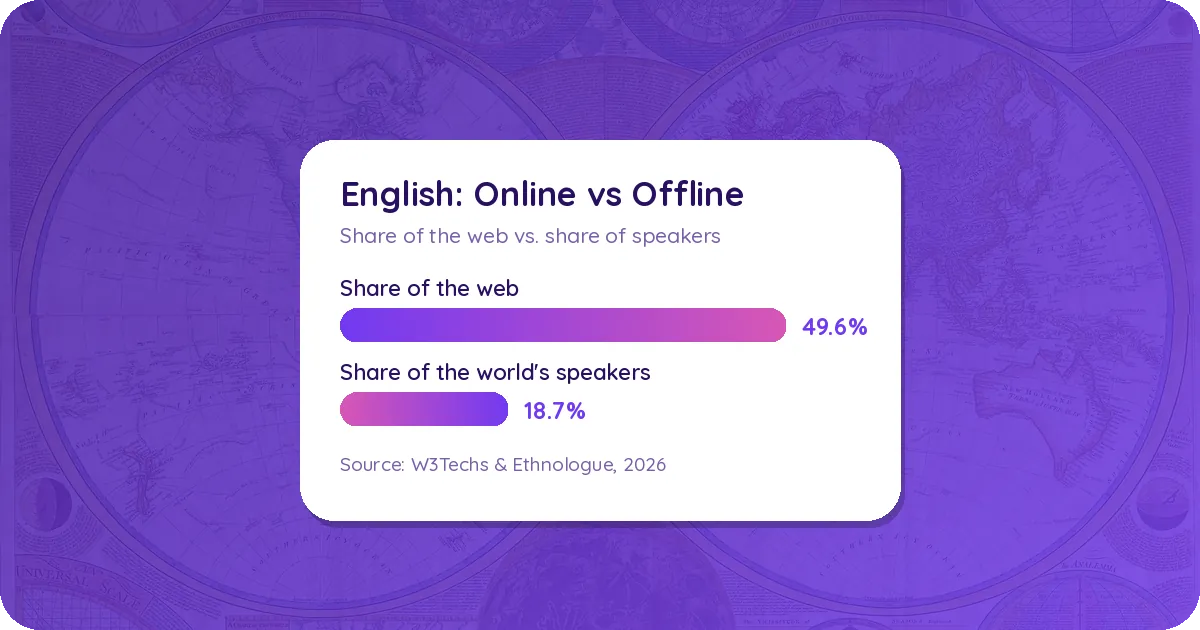
Here is a fact that should be stranger than it feels. Nearly half of every website on the internet is written in English. As of July 2026, W3Techs puts English at 49.6 percent of all websites whose content language it can identify. No other language cracks 7 percent.
Now hold that next to the real world. English is the native language of maybe one person in twenty. Even counting everyone who speaks it as a second, third, or workplace language, Ethnologue puts the global English-speaking population at roughly 1.53 billion, which is a lot of people, but still under a fifth of humanity.
So a language that most of the planet does not speak accounts for half of what the planet has written down online. The internet, it turns out, does not sound like the world. It sounds like a business meeting in English. This gap has a name, the digital language divide, and once you see it you cannot unsee it. Here is what it actually looks like in 2026, where the numbers come from, and why it matters even in an age of instant machine translation.
What the Web Speaks
Start with the internet's own voice. This is the share of the world's websites written primarily in each language, as measured by W3Techs in July 2026.
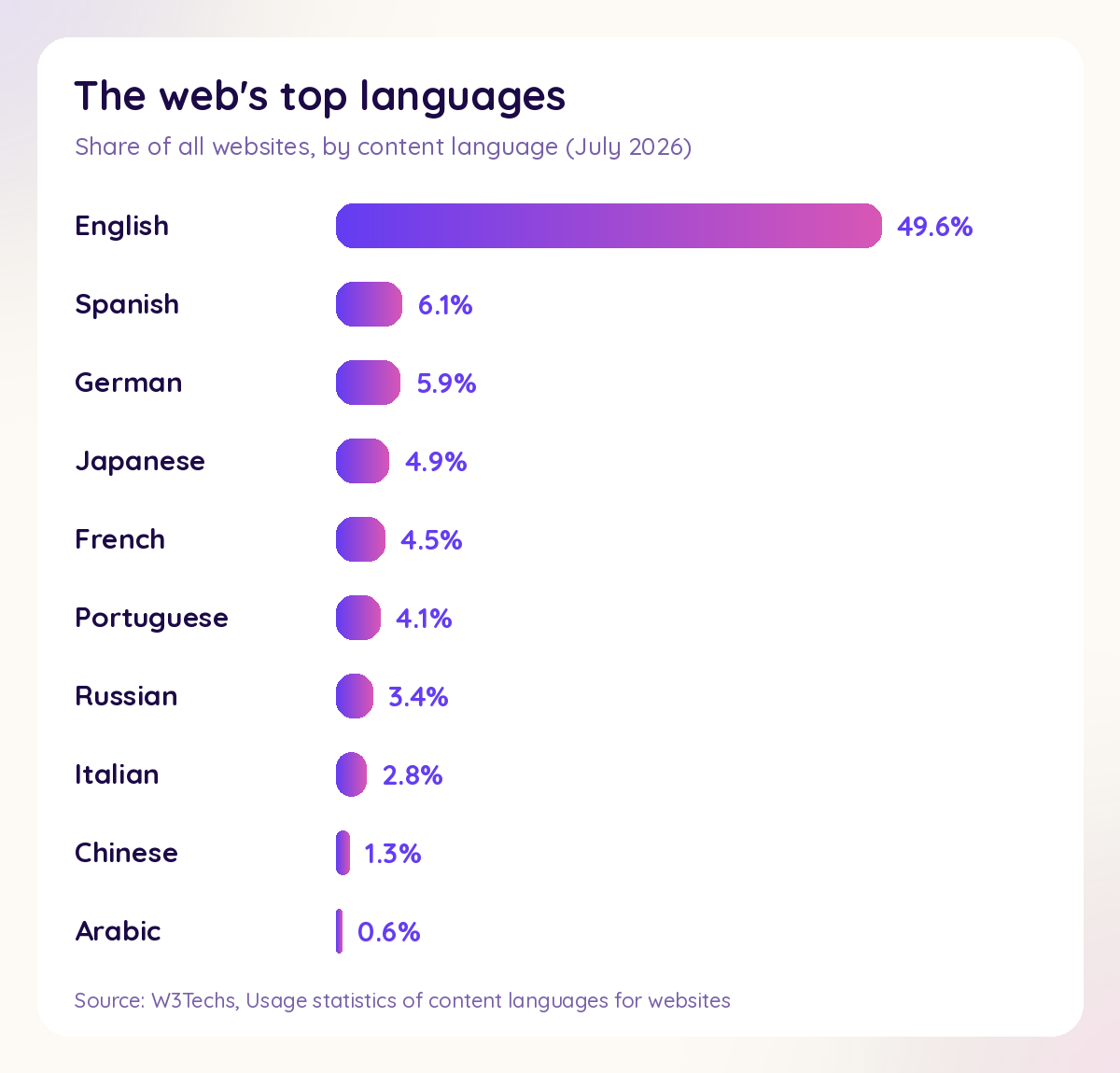
Look at that chart and something jumps out. It is mostly European. Spanish, German, French, Portuguese, Russian, and Italian together take up more of the web than the next fifty languages combined. Japanese is the one non-European heavyweight near the top. And the two languages spoken by the largest number of humans after English, Chinese and Hindi, are almost missing. Chinese sits at 1.3 percent. Hindi does not even clear a tenth of a percent, tucked into the long tail below Bengali.
What the World Speaks
Now flip to the real world. This is the ranking by total number of speakers, first language plus second, from Ethnologue's 2025 data as visualized by Visual Capitalist.
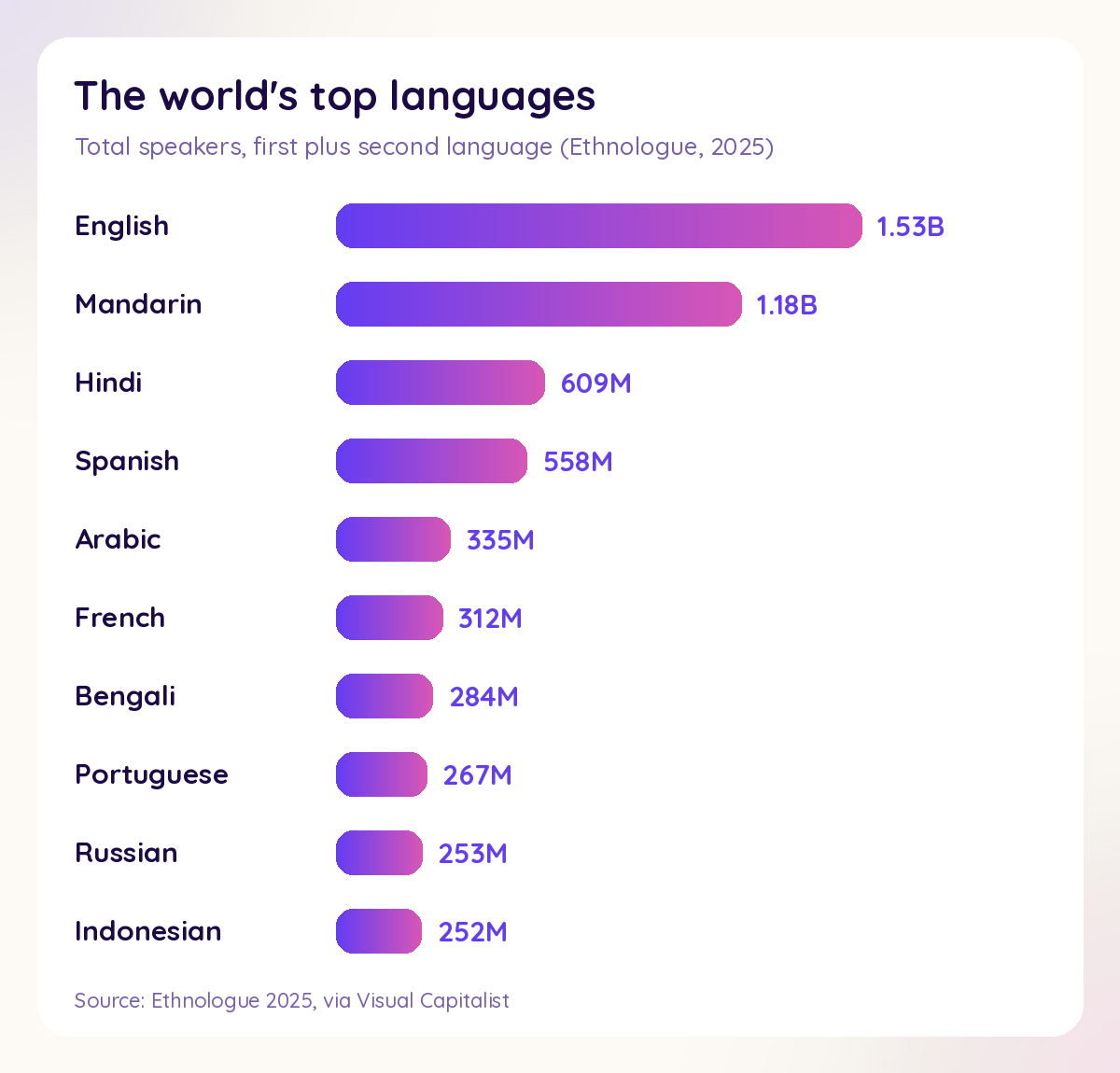
This is a completely different planet. Mandarin Chinese has nearly as many speakers as English and more native speakers than any language on Earth, yet it holds barely 1.3 percent of websites. Hindi is the third most spoken language in the world, with more than 600 million speakers, and it is a rounding error online. Bengali has 284 million speakers and about a tenth of a percent of the web. Arabic, spoken across more than twenty countries by over 300 million people, sits at 0.6 percent.
Put the two side by side and the mismatch is almost comic.
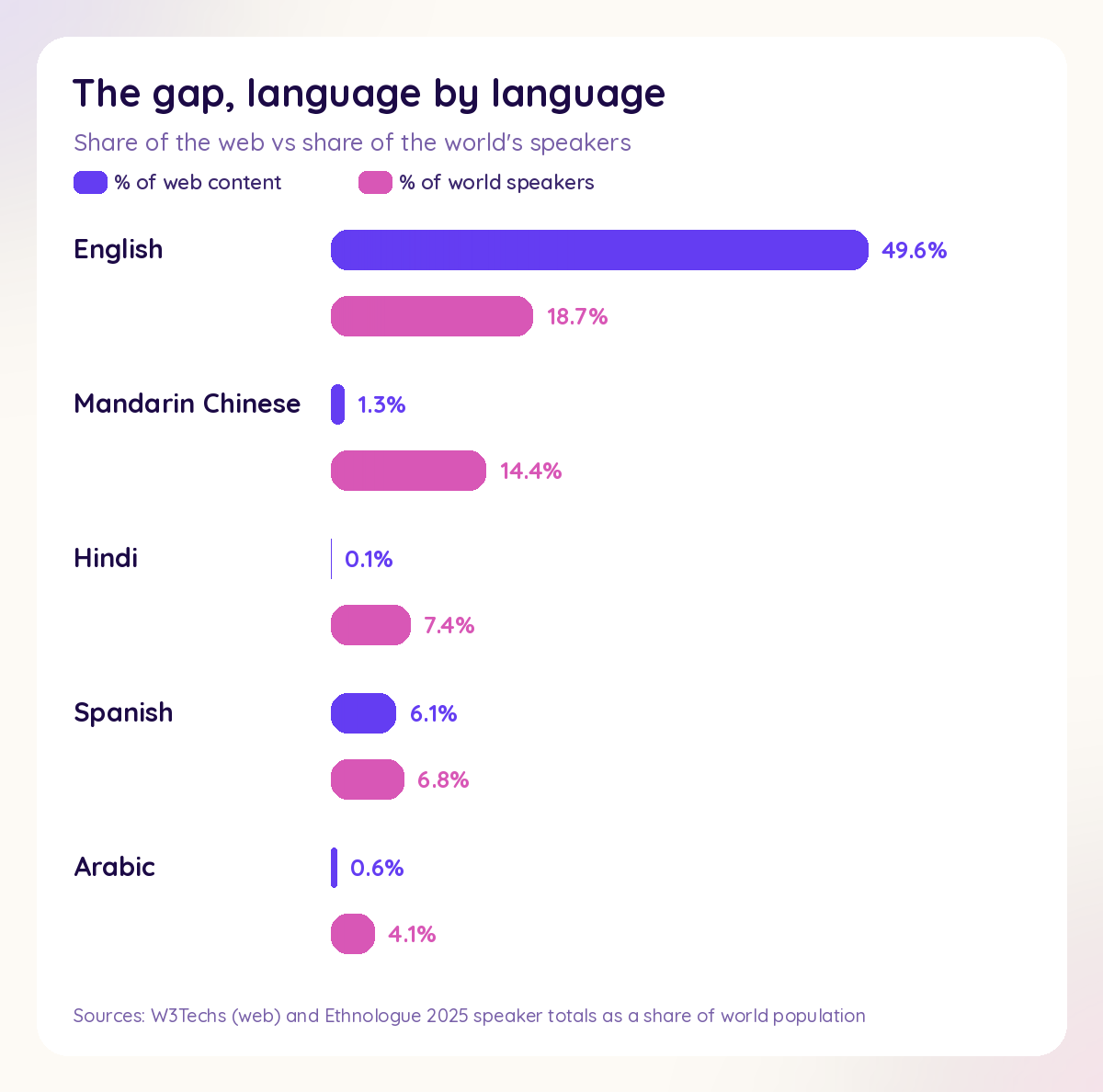
The web massively over-represents English and a handful of European languages, and it massively under-represents the languages of Asia and the Arabic-speaking world. The Statista chart that first put this side by side made the point in a single image: the bars for online presence and offline speakers barely line up for anyone.
Why the Gap Exists (It Is Not What You Think)
The easy explanation is that English "won" the internet because the internet was born in English-speaking countries. That is part of it, but it is not the whole story, and the real reasons are more interesting.
First, W3Techs measures websites, not people, and not usage. It looks at the content language of the world's most-visited sites. That is a real and useful measurement, but it captures the open, indexed, published web, the part that search engines crawl. It is a count of pages, not of human activity, and English is the default for a huge share of business, academic, and technical sites regardless of where they are. A German company will often publish in English to reach the world. A scientist in Seoul frequently writes in English to be cited. The published web leans toward whatever language reaches the most readers, and for now that remains English.
Second, and this is the big one, an enormous amount of the world's non-English internet does not live on indexed websites at all. It lives inside apps. China's internet runs largely through walled ecosystems like WeChat and Weibo, closed platforms that W3Techs cannot crawl and that the open web never sees, which is a large part of why Chinese looks tiny in the website data and enormous in real life. India's extraordinary online growth has been overwhelmingly mobile-first and increasingly voice and video first, happening on YouTube, WhatsApp, and short-video apps rather than on Hindi or Tamil web pages. The Internet Society Foundation has pointed out that hundreds of millions of people have come online in the last few years whose first language is not English, and most of them are talking, watching, and messaging, not building websites.
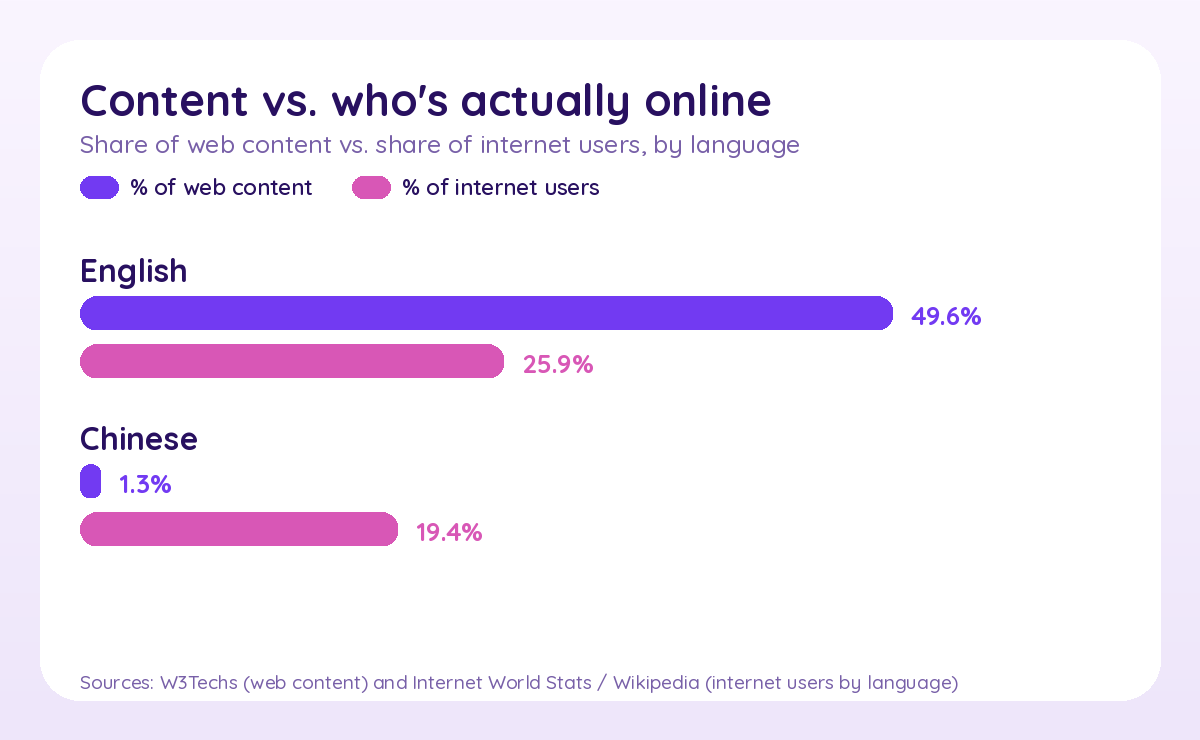
Third, look at the internet by users rather than by content and the picture already looks less lopsided. Where English is around half of web content, it is only roughly a quarter of internet users, with Chinese close behind, according to figures compiled on Wikipedia's overview of languages used on the internet. In other words, the gap is not really about who is online. It is about who gets to publish the durable, searchable, machine-readable record of human knowledge. And that record is still being written mostly in English.
The Long Tail, Where Most Languages Live
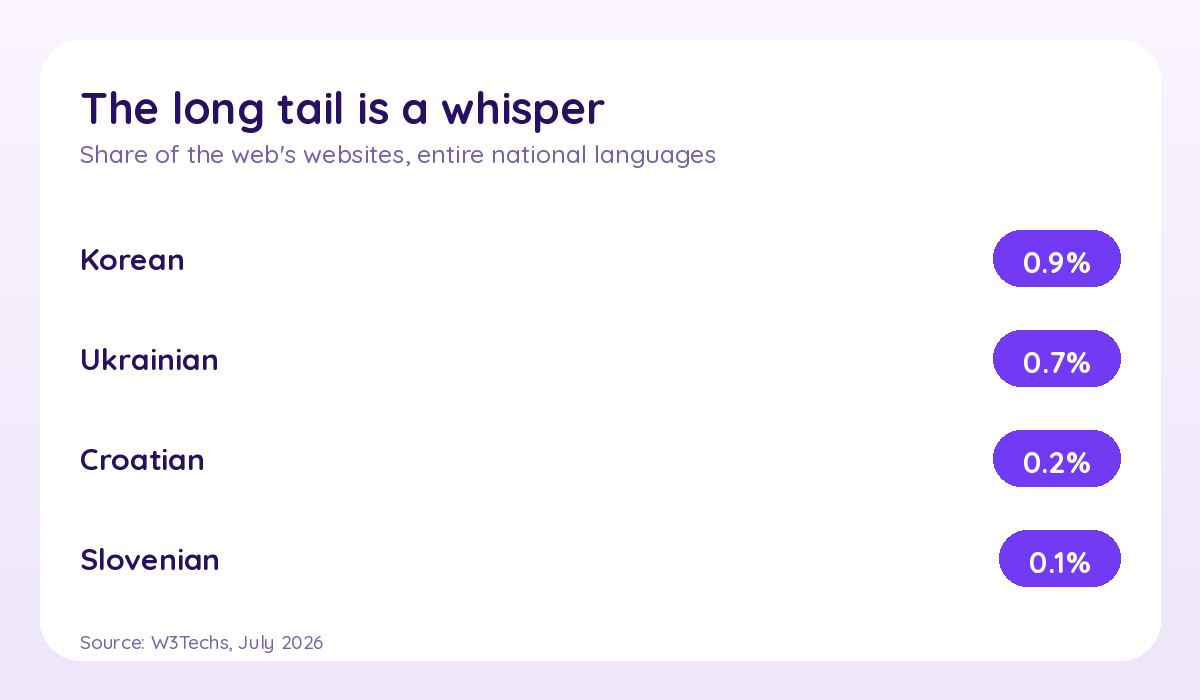
Here is the part that does not make the headlines. Below the top ten, the web thins out fast. Korean and Ukrainian each sit under 1 percent of websites. Croatian is around 0.2 percent. Slovenian is around 0.1 percent. These are national languages of entire countries, the languages of governments, newspapers, and literature, and online they are a whisper.
Multiply that across the roughly 7,000 languages humans actually speak and the scale of the divide becomes clear. The overwhelming majority of the world's languages have almost no meaningful presence on the open web at all. For the people who speak them, the internet is a place you visit in someone else's language. That has real consequences for what knowledge is accessible, whose culture gets preserved, and who feels at home online.
Does This Still Matter in the Age of Translation?
A fair question in 2026: if your phone can translate anything instantly, who cares what language the web is written in? Just point the camera and read.
Machine translation is genuinely miraculous and it has flattened a lot of these walls. But it has not made language irrelevant, for a few stubborn reasons. Translation is lossy, especially for humor, idiom, tone, poetry, law, and anything where the exact words carry the meaning. Translation depends on training data, which means it works beautifully for high-resource languages like Spanish and German and far worse for the hundreds of under-resourced languages that barely exist online in the first place, quietly reinforcing the very divide it promises to erase. And reading a translation is not the same as understanding. You can machine-translate a French menu, but you cannot machine-translate a conversation with your partner's grandmother, or the feeling of finally getting a joke in the original.
The internet's language gap is a reminder that the world is far more multilingual than your browser makes it look, and that knowing a language yourself is still the only way to actually belong in it rather than tour it through a filter.
Learning Your Way In
The most direct way to stop seeing the internet through an English-shaped keyhole is to learn one of the languages on the other side of the gap. That holds whether you pick a giant like Spanish or Mandarin or a smaller language the web barely acknowledges.
If you want the practice to actually stick, Lingoodie teaches ten languages that sit on both sides of this divide: Spanish, French, German, Italian, and Portuguese from the web's crowded top tier, and Slovenian, Croatian, Ukrainian, Russian, and Korean from further down the long tail. It also pays you a little for the time you put in, with cash out via Revolut or PayPal, which for a lot of people is the difference between starting a language and finishing one. You can download it free on Google Play or the App Store.
If you enjoy this kind of thing, our roundup of interesting language facts is full of the same sort of surprises, and if the earning angle caught your eye, here is how you can get paid to learn a language while you close your own personal language gap.
The Takeaway
The internet is not a mirror of the world. It is a mirror of who has published the most searchable pages, and for now that is a fairly small, fairly English-speaking, fairly European slice of humanity. English is 49.6 percent of websites and under a fifth of speakers. Mandarin is nearly a fifth of humanity and barely more than 1 percent of the web. Hindi has 609 million speakers and almost no web at all.
None of that is destiny. Every year the internet gets a little more multilingual as the next billion people come online in their own languages. But the fastest way to stop seeing the world through an English-shaped keyhole is not to wait for the web to catch up. It is to learn a language, and step through.