Spanish from Spain: 5 key features every learner should know

Learn Spanish in Spain for a while and you'll start noticing something: it doesn't quite sound like the Spanish you might have picked up from Mexico, Colombia, Argentina, or anywhere else in Latin America.
That catches a lot of people off guard, especially if they've already put in serious study time. Don't panic. You haven't accidentally learned a different language.
Spanish is spoken across dozens of countries, and every region has its own rhythm, pronunciation, vocabulary and little turns of phrase. Move to Spain, and those differences suddenly become impossible to ignore.
Below are five features I always flag for my students, the ones most worth knowing if you're planning to live, study, travel, or just get by more naturally once you're in Spain.
"Vosotros" isn't optional, it's everyday speech
For a lot of learners, "vosotros" is the first grammatical curveball Spain throws at them.
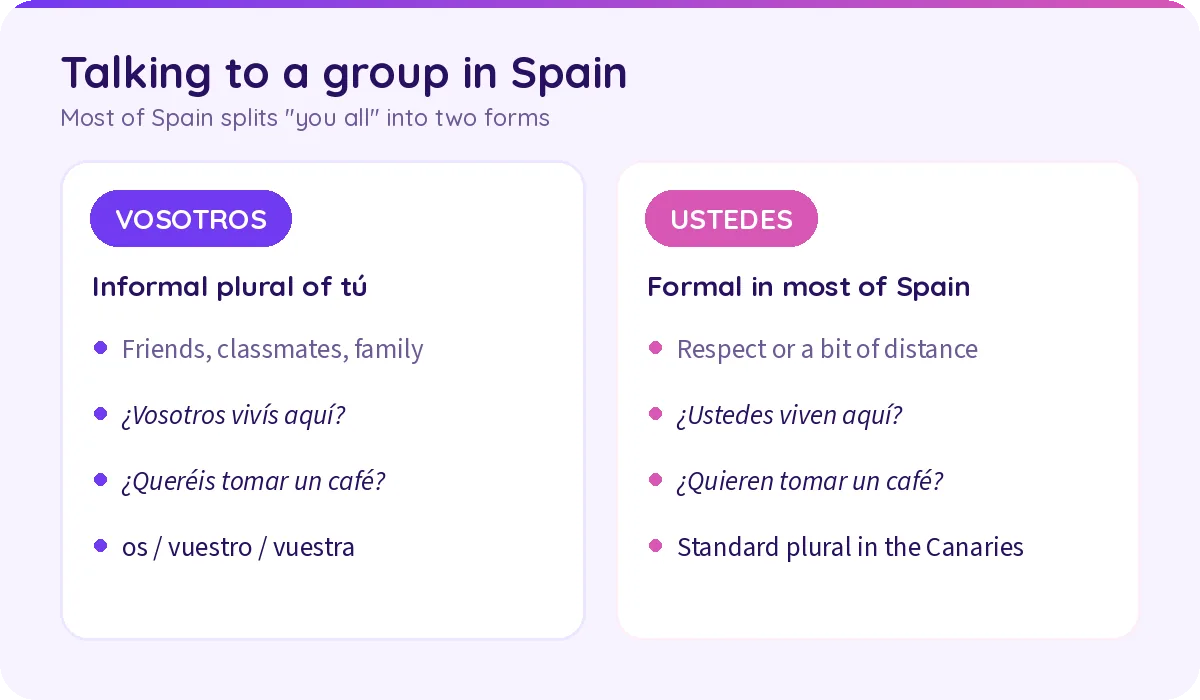
Across most of the country, "vosotros" works as the informal plural of "tú". Talking to a group of friends, classmates, or family? That's your form.
A few examples:
- "¿Vosotros vivís aquí?" (Do you guys live here?)
- "¿Qué vais a hacer este fin de semana?" (What are you doing this weekend?)
- "¿Queréis tomar un café?" (Want to grab a coffee?)
- "¿Habéis visto esta película?" (Have you seen this movie?)
It looks intimidating laid out in a grammar table, but it stops feeling that way once you've heard it enough times.
"Ustedes", on the other hand, is mostly reserved for formal situations in Spain, moments where you want to signal respect or keep a bit of distance.
Here's a small detail that always makes students laugh: use "usted" with someone who doesn't think the moment calls for it, and they might tease you with "No soy tan mayor" (I'm not that old!).
It's usually a joke, but it says something real about how pronoun choice shapes the tone between two people.
And Spain isn't uniform here either. In parts of Andalusia, "ustedes" gets used informally, and in the Canary Islands it's simply the standard plural, so "vosotros" barely comes up.
You'll also run into the related forms "os" and "vuestro/vuestra", as in:
- "Os llamo mañana" (I'll call you tomorrow.)
- "¿Esta es vuestra casa?" (Is this your house?)
My advice? Learn these through sentences you'd actually say, not by memorising a conjugation table top to bottom.
Yes, the "th" sound is real, but it's not "the" Spanish accent
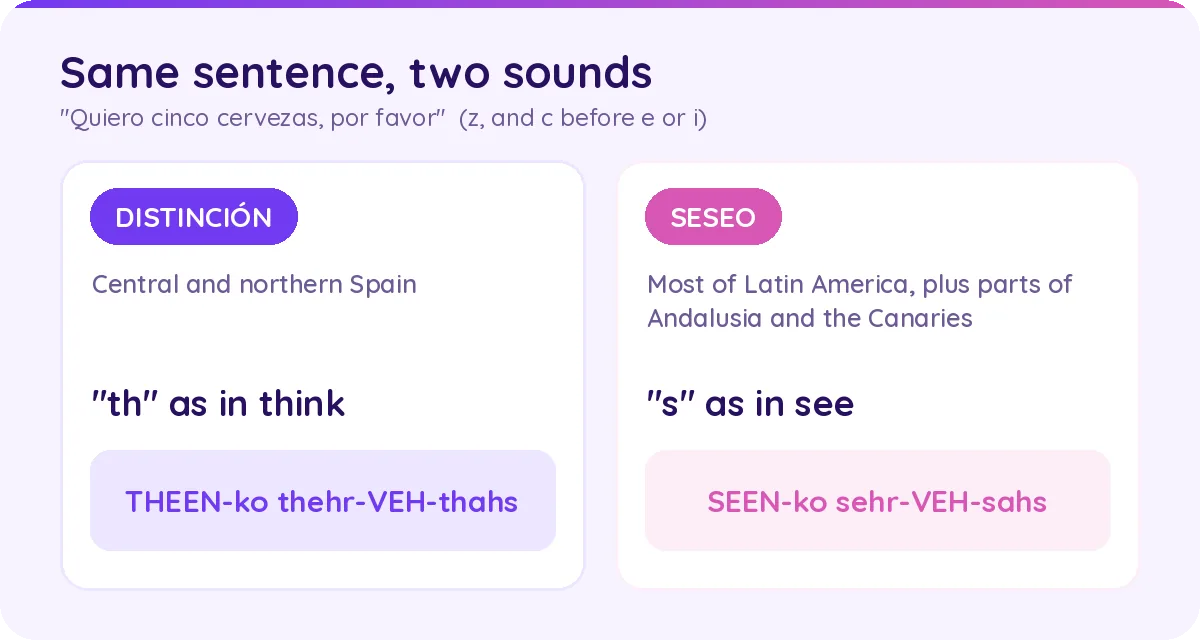
Time for a difference related to pronunciation. And this is how "z" and "c" (before "e" or "i") get pronounced.
In much of central and northern Spain, these come out as /θ/, the same sound English speakers make in "think". Linguists call this "distinción", since /θ/ and /s/ stay separate sounds. Across most of Latin America, both collapse into /s/, a pattern known as "seseo".
Rather than getting tangled in terminology, I always recommend just practising it in full sentences, such as:
- "Quiero cinco cervezas, por favor" (I'd like five beers, please.)
- "Gracias por la información" (Thanks for the information.)
And one more thing worth remembering: Spain doesn't have a single accent. You'll hear "seseo" in parts of Andalusia and the Canary Islands too, right alongside other regional pronunciations.
Everyday words will trip you up before grammar ever does
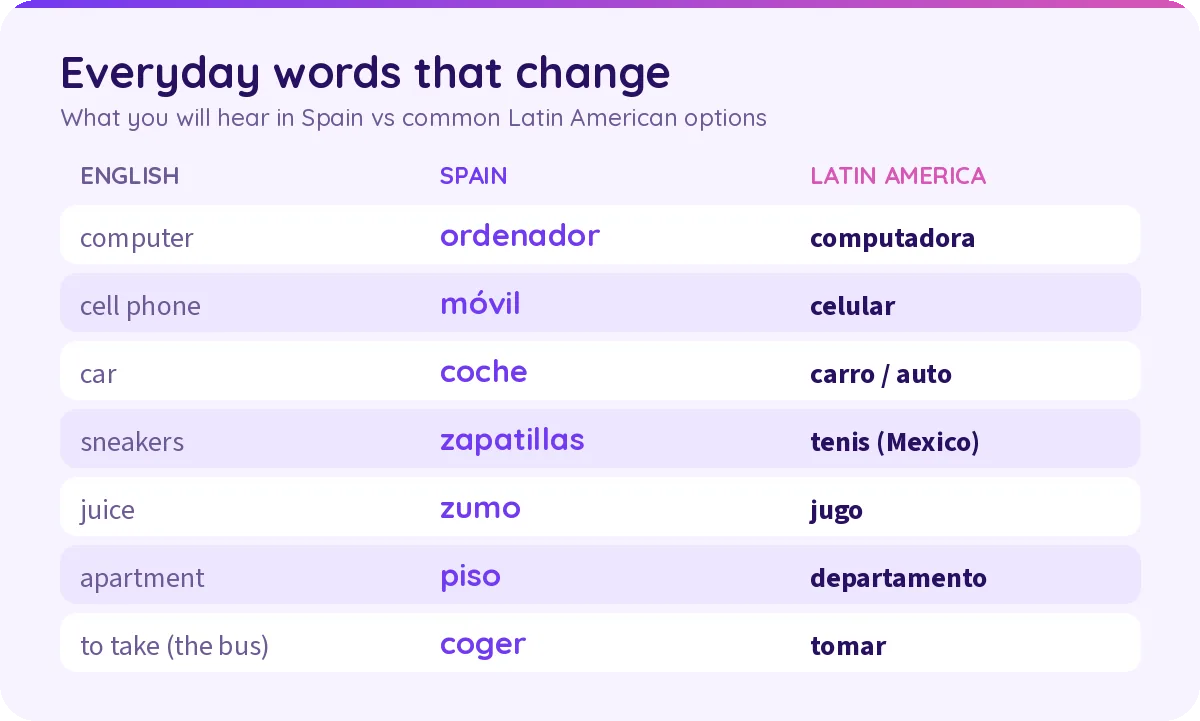
You can have rock-solid grammar and still get lost in a totally mundane conversation in Spain. Vocabulary is usually the culprit. Spanish shares a massive common core across countries, but the everyday, unglamorous words shift a lot from place to place.
In Spain, people say "ordenador" for "computer", "móvil" for "cell phone", "coche" for "car", "zapatillas" for "sneakers", "zumo" for "juice" and "piso" is the standard word for "apartment".
Then there's "coger", a word that trips up almost every student at some point. Why? Because in Spain it's a completely ordinary verb meaning "to take", "to catch", or "to get", depending on context.
For example:
- "Voy a coger el autobús" (I'm going to take the bus.)
- "¿Puedes coger el teléfono?" (Can you get the phone?)
In several Latin American countries, though, "coger" carries a vulgar sexual meaning, so people tend to steer clear of it in daily conversation.
"Vale" and "venga" are everywhere
Students tend to focus on grammar and vocabulary, but it's usually the small everyday expressions that will make you feel like you have actually landed in Spain.
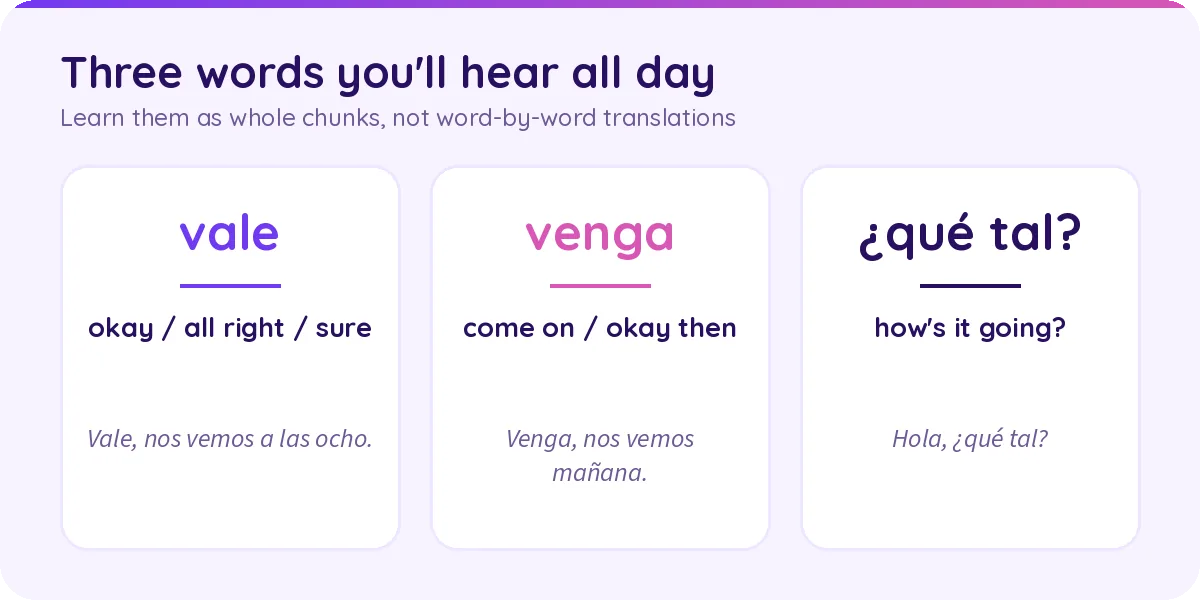
Take "vale". You'll hear it nonstop. Depending on the moment, it can mean "okay", "all right", or "sure".
Then there's "venga", trickier because its meaning shifts with context and tone of voice:
- "Venga, vamos." (Come on, let's go.)
- "Venga, nos vemos mañana." (Okay, see you tomorrow.)
You'll also hear "¿Qué tal?" as a quick, casual greeting or a way of checking in.
My suggestion here is to learn phrases like these as whole chunks. Try to translate "vale" fresh every time you hear it and you'll wear yourself out for no reason. Pay attention to how it's being used instead.
Real Spanish sounds nothing like your textbook
This last one isn't a grammar point. It's more of a rite of passage every learner goes through eventually.
You study for months. You feel good in class. Then you land in Spain, overhear two people chatting at normal speed, and suddenly you're following maybe 30 percent of it.
I hear some version of this constantly: "I understand Spanish, but when people here talk, I understand nothing."
Usually, nothing's actually gone wrong. Their Spanish hasn't vanished, they're just hearing natural, unscripted speech for the first time.
In Spain, native speech moves fast. Sounds blend together. People use filler words, shifting intonation, and expressions your textbook never covered. Sometimes you'll recognise every single word in a sentence and still need a beat to piece the whole thing together.

Photo: Pablomfa via Wikimedia Commons, Free Art License.
That's completely normal, and honestly, it tells you exactly what to work on next. If you're learning Spanish in Spain, don't limit yourself to slow, carefully enunciated textbook dialogues. Get into interviews, podcasts, videos, real conversations between native speakers.
You don't need to catch every word. Your brain just needs time to adjust to what Spanish sounds like when nobody's slowing down for you.
Spanish from Spain or Latin American Spanish: which one should you learn?
If you're heading to Spain to live, study, work, or spend real time here, it makes sense to learn the variety you'll actually be surrounded by. That means getting comfortable with "vosotros," local vocabulary, the pronunciation, and the everyday expressions that come with it.
If you've already been learning a different variety, though, you don't need to start over. Every version of Spanish shares the same core. They just diverge in pronunciation, vocabulary, grammar, and everyday usage.
Early on, it's tempting to hunt for the "correct" version of Spanish. The more you learn, though, the more you realise the better question is: who says this, where, and in what kind of situation?
So if you're heading to Spain, don't be intimidated by "vosotros". Get your ear used to the pronunciation, pay attention to the small everyday words, and pick up the little expressions that keep coming back around.
And when you eventually hit a sentence you can't follow, don't read it as failure. It's not a sign your Spanish is slipping. It's just one more part of learning how the language actually gets spoken.