Por vs Para: The One Little Swap That Changes Everything

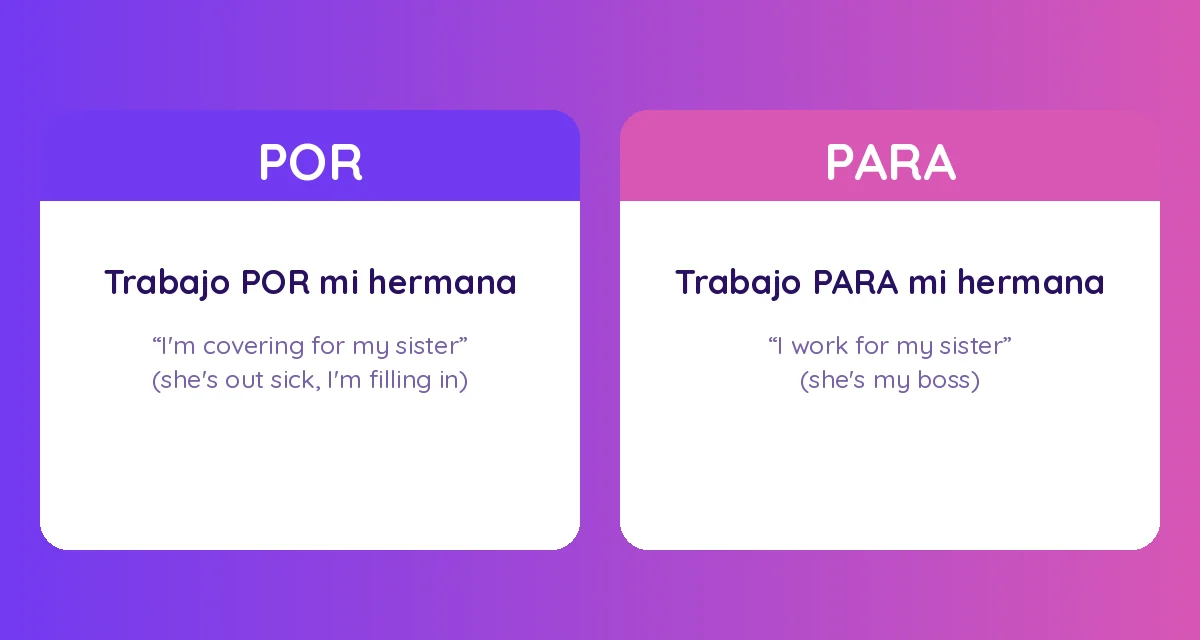
Say this out loud: "Trabajo por mi hermana." Now swap one word and say: "Trabajo para mi hermana."
The first one means you are working in place of your sister, covering her shift because she is out sick. The second means you work for your sister, as in she signs your paycheck and she is your boss. Same five words, same friendly family situation on the surface, and yet one version has you doing a favor and the other has you reporting to a relative every Monday morning. That is the trouble with por and para. They both get translated as "for" in a beginner phrasebook, so English speakers treat them as interchangeable, and Spanish quietly lets the meaning slide out from under them.
The good news is that this is not a memorization slog with fifty exceptions. Underneath the two hundred textbook rules there is one honest distinction, and once it clicks, most sentences sort themselves out. This guide gives you a cheat sheet to skim now, a simple mental trick to carry with you, the mistakes English speakers actually make, and a short quiz to prove it stuck.
The Two-Question Trick
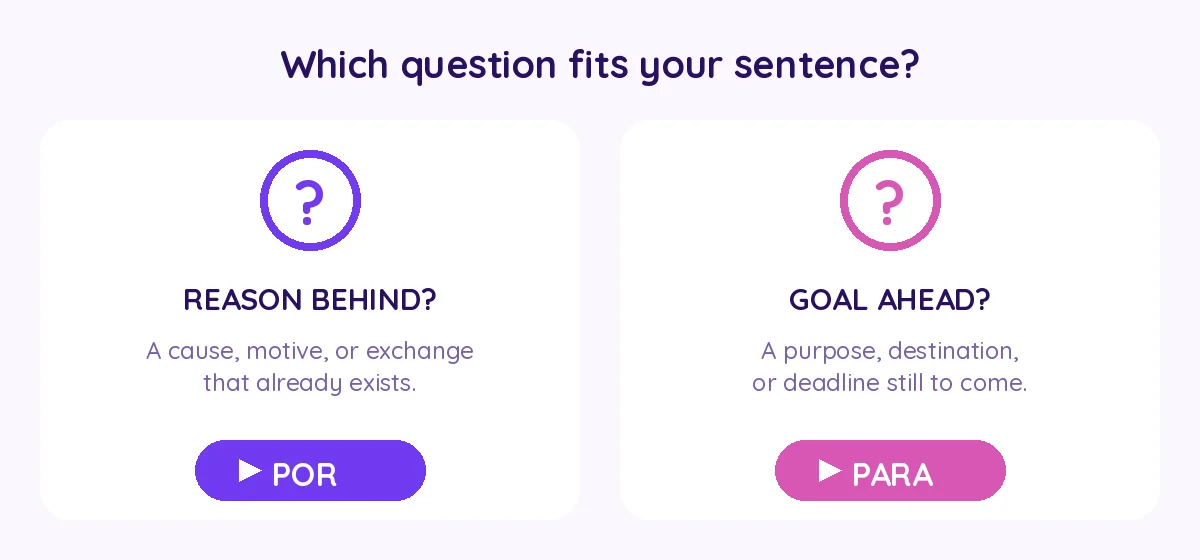
Forget arrows pointing backward and forward in time. When you hit a spot in a sentence where "for" wants to go, ask yourself one of two questions:
Question 1: is this about a reason that already exists? A cause, a motive, an exchange, a thing that made the action happen. If yes, reach for por. Think of por as the "because of / by way of / in exchange for" word. The reason is already sitting there behind the action.
Question 2: is this about a goal that is still ahead? A purpose, a destination, a recipient, a deadline you are aiming at. If yes, reach for para. Think of para as the "aiming at / headed toward / meant for" word. There is a target out in front of the action.
Reason behind, or goal ahead. That is the whole engine. "Trabajo por mi hermana" answers why you are working (because of her, in her place). "Trabajo para mi hermana" points at who the work is aimed at serving (her, your employer). Keep those two questions in your pocket and you will resolve the large majority of por and para decisions without ever opening a grammar table.
The Cheat Sheet
Here is the quick-reference version. Skim it now, then read the fuller explanation below when you want the reasoning.
| Use POR for... | Example | Use PARA for... | Example |
|---|---|---|---|
| Cause or reason (because of) | Llegué tarde por el tráfico | Purpose or goal (in order to) | Estudio para aprobar el examen |
| Exchange or price | Lo compré por diez euros | Recipient (meant for someone) | Este regalo es para ti |
| Duration (how long) | Viajamos por dos semanas | Deadline (by when) | Lo necesito para el viernes |
| Movement through a place | Caminamos por el parque | Destination (headed toward) | Salgo para Madrid |
| Means or method | Te llamo por teléfono | Opinion (in the view of) | Para mí, es la mejor |
| The doer in passive voice (by) | Escrito por García Márquez | Comparison or standard | Para un niño, cocina muy bien |
| On behalf of / in place of | Firma por mí | Employment (works for) | Trabaja para una empresa grande |
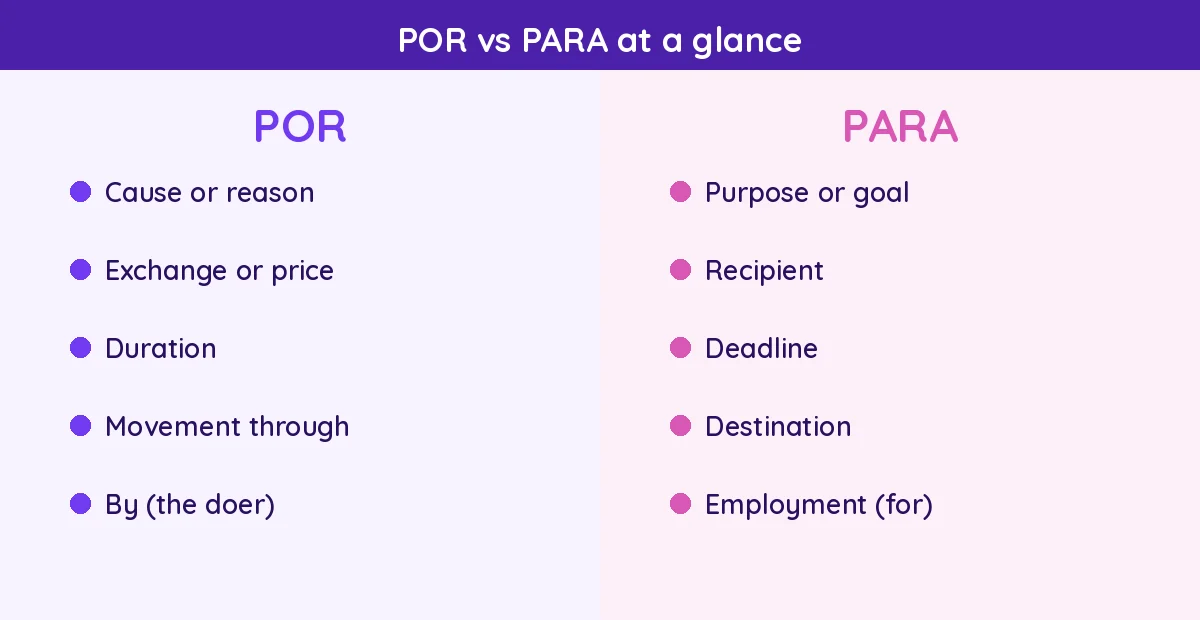
Notice how many of the por rows are about something that already happened or already exists (the traffic, the price, the author who wrote the book), while the para rows keep pointing at something out ahead (the exam you want to pass, the person the gift is going to, Friday). Reason behind, goal ahead.
Why It Feels So Hard for English Speakers
English hands you a single word, "for," and lets it cover a startling range of jobs. "I did it for you," "I paid ten dollars for it," "I studied for three hours," "I am leaving for Madrid," "for a beginner, that is impressive." English does not make you stop and sort those into two buckets. Spanish does. So the difficulty is not really about Spanish being complicated. It is that Spanish forces a distinction your native language lets you ignore, and your brain has no habit for it yet.
That is also why translating word by word fails you. If you start from the English "for" and try to pick, you will guess wrong constantly, because "for" is doing at least six unrelated jobs. Start from the meaning instead. Ask the two questions. Is there a reason already behind this, or a goal still ahead? The moment you think in terms of cause versus purpose rather than hunting for the "right translation of for," the fog lifts. If you are building a broader Spanish habit, our guide on how to learn Spanish fast walks through this "think in meaning, not translation" mindset in more depth.
Common Mistakes English Speakers Make
These are the swaps that trip people up most often. Wrong on the left, right on the right.
Reason for doing something.
- Wrong: Estudio español para mi trabajo. (This says you study Spanish in order to create a job, which is not what you mean.)
- Right: Estudio español por mi trabajo. Your existing job is the reason, the cause sitting behind the studying. Reason behind, so por.
- But watch: Estudio español para conseguir un trabajo mejor is correct, because now a better job is the goal ahead. The English "for" hides which one you mean; Spanish does not.
Thanking someone.
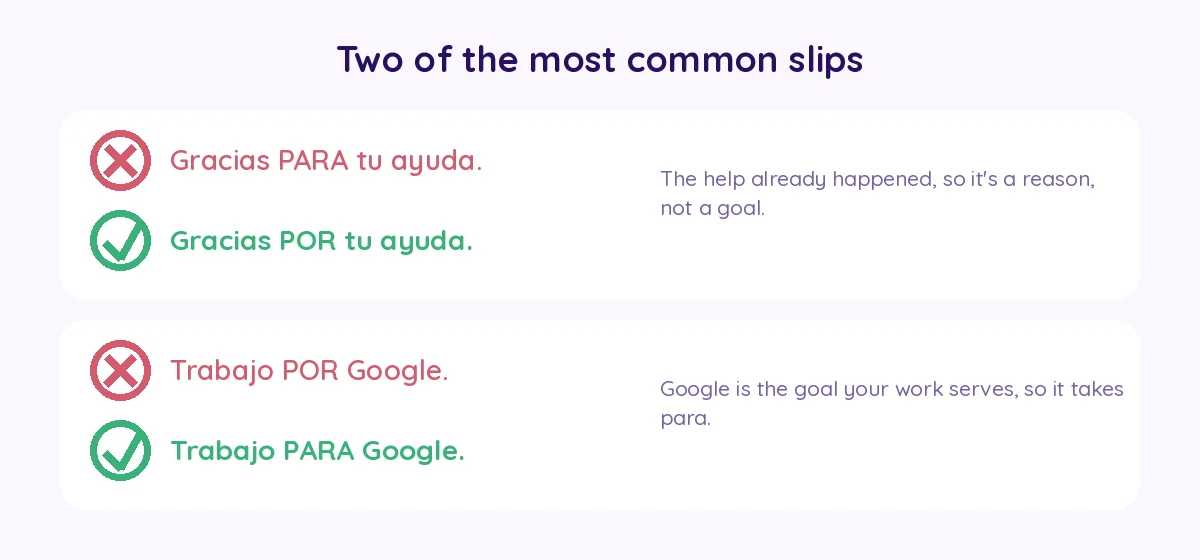
- Wrong: Gracias para tu ayuda.
- Right: Gracias por tu ayuda. You are thankful because of the help that was already given. The help is the reason. Almost every "thanks for..." in Spanish takes por.
Deadlines.
- Wrong: Termínalo por el lunes.
- Right: Termínalo para el lunes. Monday is the target you are aiming at, the goal ahead. Deadlines are para, even though English says "by."
Duration, in casual speech.
- Textbook: Estudié por dos horas.
- What natives often say: Estudié dos horas (no preposition at all). Spanish frequently drops the word entirely for plain durations. Using por here is not wrong, but do not be surprised when a native speaker just leaves it out.
Being someone's employee.
- Wrong: Trabajo por Google. (This says you are covering someone's shift at Google, or doing it on their behalf.)
- Right: Trabajo para Google. Google is who your work is aimed at serving, your employer, the goal ahead. This is exactly the sister trap from the opening.
The Nuance Almost Nobody Explains: Por Qué, Porque, Porqué
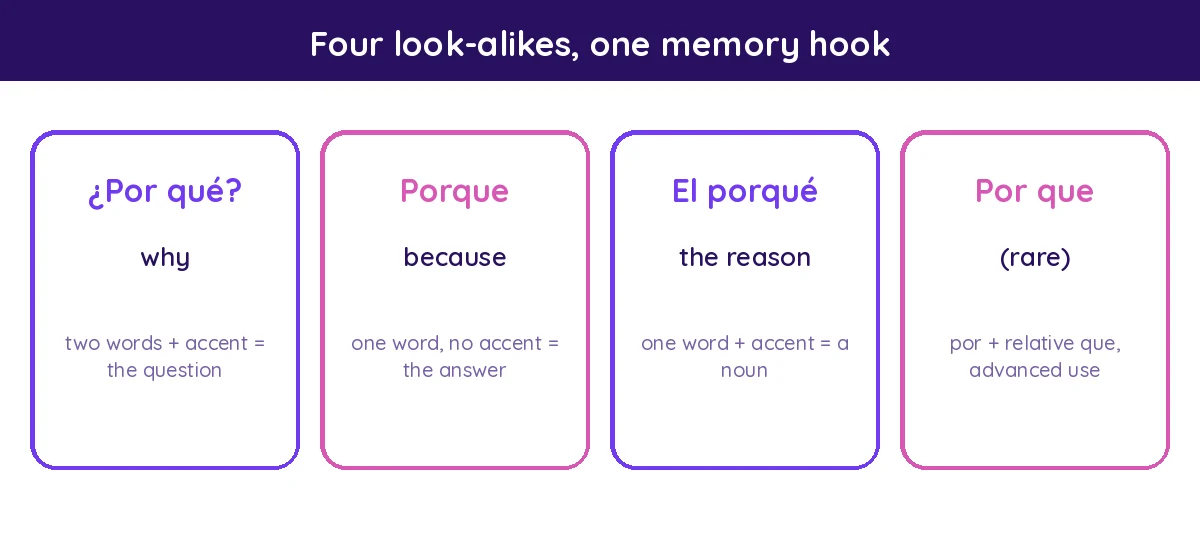
While you are sorting out por, one more thing quietly ruins written Spanish for learners, and most guides skip right past it. There are actually four look-alikes, and native speakers themselves mix them up in text messages:
- Por qué (two words, accent) is the question word "why." ¿Por qué estudias español?
- Porque (one word, no accent) is the answer "because." Porque me gusta.
- Porqué (one word, accent) is a noun meaning "the reason." No entiendo el porqué de su decisión.
- Por que (two words, no accent) is rare and shows up when por and a relative que happen to land next to each other. You can mostly ignore this one until much later.
A quick memory hook: the version with the space and the accent asks the question; the version squished together answers it. Get just those first two right and your written Spanish will already look far more careful than most.
Bonus: A Few Everyday Expressions
Some phrases you simply learn as fixed units, because the choice is baked in and native speakers do not stop to reason about it:
- Por favor (please). The single most common por phrase you will ever say.
- Por fin (finally, at last). ¡Por fin llegó el fin de semana!
- Por si acaso (just in case). Lleva un paraguas por si acaso.
- Para siempre (forever). Notice the goal-ahead flavor: aimed at all of future time.
- Para nada (not at all). No me molesta para nada.
You will absorb these by hearing them, not by parsing them. That is genuinely how fluency in prepositions arrives: enough correct examples pass through you that the right one starts to sound right before you can explain why.
Practice: Por or Para?
Here is where it locks in. Fill in each blank with por or para, then check the key below. This is exactly the kind of quick-decision sentence that Lingoodie's Spanish grammar drills quiz you on, and getting them right earns points you can cash out, so it is worth actually doing rather than just reading.
- Compré este libro ____ mi madre. (the book is a gift for her)
- Gracias ____ venir a la fiesta.
- Salimos ____ la playa a las ocho.
- Caminamos ____ el centro histórico.
- Necesito el informe ____ el miércoles.
- Pagué cincuenta euros ____ los zapatos.
- ____ mí, esta es la mejor decisión.
- Estudio mucho ____ sacar buenas notas.
- La carta fue escrita ____ un poeta famoso.
- Estuvimos en Lisboa ____ tres días.
Answer key:
- para (recipient, the gift is aimed at her)
- por (reason, thanks because of the action)
- para (destination, headed toward the beach)
- por (movement through a place)
- para (deadline, aiming at Wednesday)
- por (exchange, price paid)
- Para (opinion, in my view)
- para (purpose, the goal is good grades)
- por (the doer in passive voice)
- por (duration, how long it lasted)
If you missed a few, look at which question you skipped. Almost every miss is a moment where "for" felt neutral and you forgot to ask whether the meaning was a reason behind or a goal ahead.
Make It Stick, and Get Paid to Practice
Prepositions are not learned in an afternoon. They are learned in small, repeated doses until the correct one arrives faster than you can explain it, and the only thing that gets you there is showing up regularly. That is the whole idea behind Lingoodie. You complete short Spanish lessons, drill exactly these kinds of por and para choices, earn points, and cash out real money via Revolut or PayPal, available in 200+ countries. Revolut is instant, has a low minimum, and Lingoodie takes no fee on it. PayPal is also available with a higher 100,000-point minimum and 1 to 3 business day processing, where PayPal (not Lingoodie) takes its own cut. The rewards are small on purpose, just enough of a nudge to get you back for tomorrow's five minutes, which is where the real progress hides. Lingoodie teaches 10 languages including Spanish, Italian, German, French, and Portuguese.
If Spanish is your target, it helps to have the right tool in your pocket. Here is our honest rundown of the best Spanish learning app options so you can pick what fits.
Download Lingoodie free on Google Play or the App Store, and turn your daily por-versus-para practice into real cash.