Ser vs Estar: The Only Guide You Actually Need
Here is a sentence that has quietly humbled thousands of Spanish learners. You want to say a friend is bored at a party, so you reach for the word you learned on day one and say, "Es aburrido." You have just told the room that your friend is boring. Not tired of the party. Boring as a person. The word you wanted was está, and the gap between the two is the single most common stumbling block in beginner Spanish.
The reason is simple and slightly unfair. English gets by with one verb for "to be." Spanish uses two, ser and estar, and they are not interchangeable. Choose the wrong one and you do not just sound off, you sometimes say something completely different from what you meant. The good news is that the rules behind them are consistent, learnable, and built on one clean idea. Once that idea clicks, ser and estar stop feeling like a coin flip and start feeling obvious.
Why Ser and Estar Both Mean "To Be" (And Why That Trips Everyone Up)
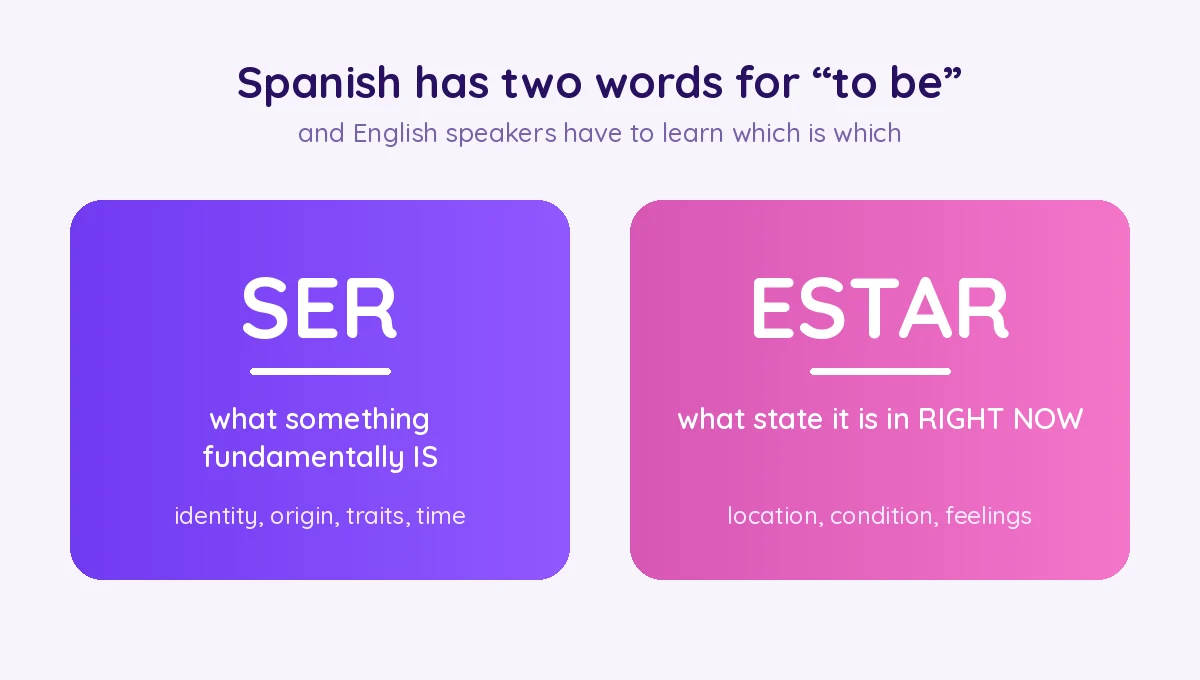
Think of the difference this way. Ser describes what something fundamentally is. Estar describes what state something is in right now. Ser is the permanent, defining layer: identity, the stuff that does not change from one afternoon to the next. Estar is the temporary, situational layer: how things happen to be at this moment, where they are, how they feel.
Water is a helpful picture. Water is always water, that is its identity, so you would use ser for that. But water can be hot or cold, frozen or boiling, and those are passing states, so you would use estar. Same substance, two different kinds of truth about it. One is about essence, the other is about condition.
English speakers struggle because their brain has only ever needed one bucket. "I am tired," "I am tall," "I am a teacher," "I am in Madrid" all use the same little word, so the differences between those statements feel invisible. Spanish forces you to sort them. Being tall is identity, so it is ser. Being tired is a passing condition, so it is estar. Being a teacher is your role, so it is ser. Being in Madrid is your current location, so it is estar. The sorting feels like extra work at first, and then it becomes automatic.
Use SER For: Identity, Characteristics, Origin, and Time
Ser handles the things that make something what it is. A well-worn memory trick spells out its main jobs with the word DOCTOR, and it covers almost every everyday use you will meet.
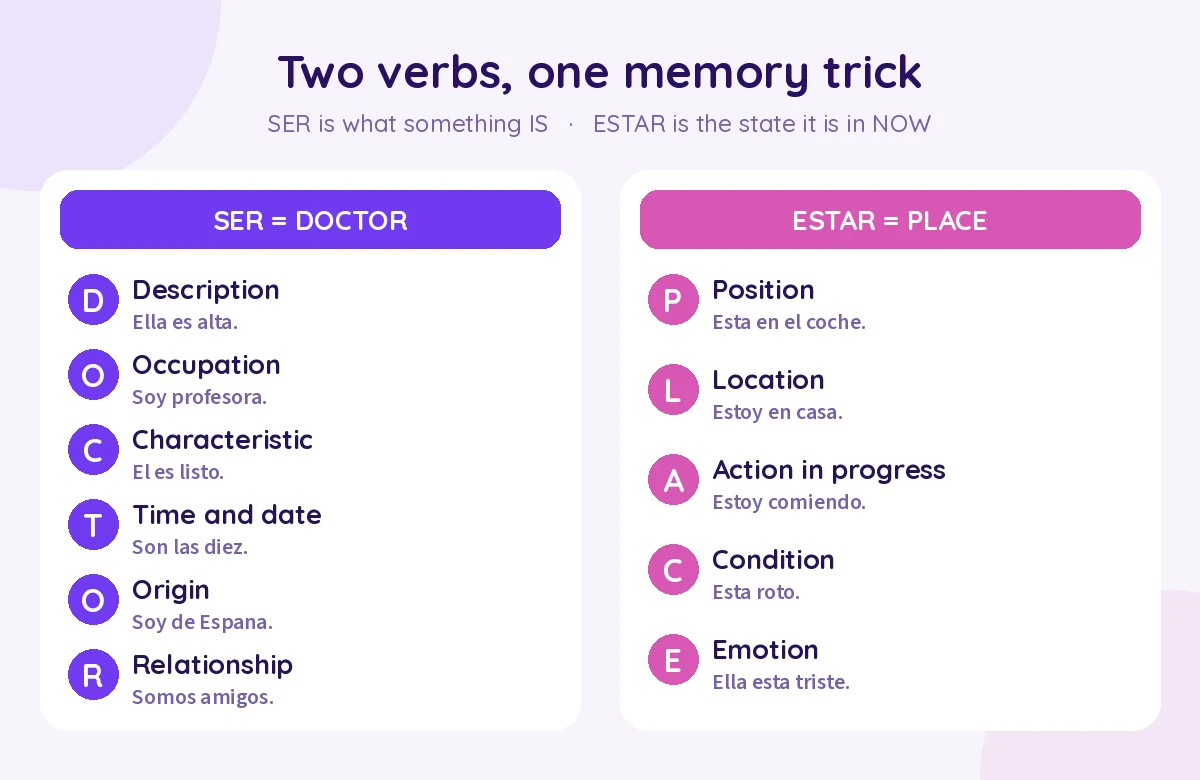
D is for Description, the lasting traits of a person or thing. Ella es alta. She is tall. El coche es rojo. The car is red. O is for Occupation, what someone does. Soy profesor. I am a teacher. C is for Characteristic, personality and inherent qualities. Mi hermano es simpático. My brother is nice. T is for Time and dates, the clock, the day, the year. Son las tres. It is three o'clock. Hoy es martes. Today is Tuesday. O is for Origin, where someone or something is from and what it is made of. Somos de Portugal. We are from Portugal. La mesa es de madera. The table is made of wood. R is for Relationship, how people connect. Ella es mi madre. She is my mother.
Notice the thread running through all six. None of them change based on the moment. Your nationality, your job, your mother, the time on the clock as a fact of the day, these are stable. That is ser's whole territory: the defining, the categorical, the things that answer the question "what is this?"
Use ESTAR For: Location, Condition, and Ongoing Actions
Estar handles the here and now. Its memory trick is the word PLACE, and it captures the states and situations that ser leaves alone.
P is for Position, the physical posture of something. El vaso está en la mesa. The glass is on the table. L is for Location, where something is right now. Estamos en casa. We are at home. Even a permanent-seeming location uses estar: Madrid está en España. Madrid is in Spain. A is for Action in progress, paired with a verb ending in -ando or -iendo. Estoy comiendo. I am eating. C is for Condition, the passing physical or health states. Estoy cansado. I am tired. La sopa está caliente. The soup is hot. E is for Emotion, how someone feels at the moment. Ella está feliz. She is happy. Estamos nerviosos. We are nervous.
The common thread here is impermanence. Where you are standing, what you are doing this second, whether you feel happy or nervous, whether the soup is still hot, all of it can change within the hour. Location trips people up because a city sitting in a country feels permanent, but Spanish treats all physical location, fixed or not, as estar's job. Learn that one exception early and the rest of PLACE falls into place.
Side by Side: Same Sentence, Different Meaning
This is where the two verbs stop being a grammar rule and start being genuinely useful. Because ser and estar carry different meanings, swapping one for the other can flip a sentence entirely. These are not mistakes so much as different statements.
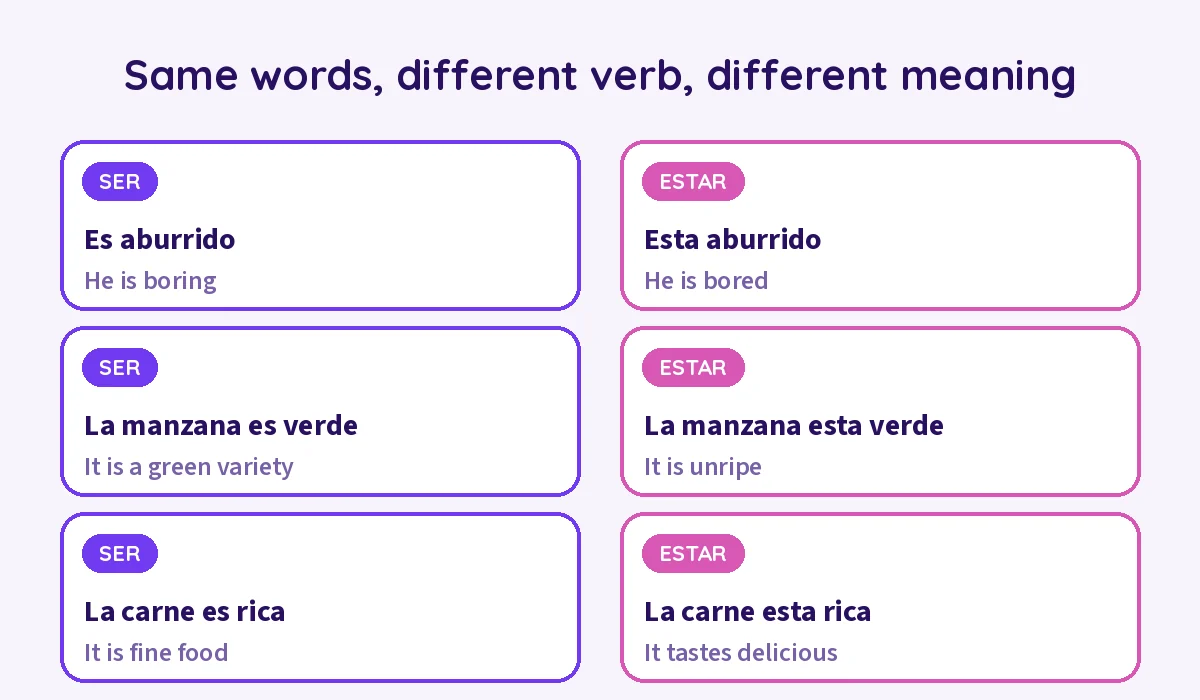
Él es aburrido means he is a boring person, a lasting trait. Él está aburrido means he is bored right now, a passing mood. La manzana es verde means the apple is a green variety, its identity. La manzana está verde means the apple is unripe, its current condition. Ella es lista means she is clever. Ella está lista means she is ready. La carne es rica means the meat is a rich or high-quality food. La carne está rica means the meat tastes delicious right now.
Read those again and the underlying logic holds every time. Ser reaches for the essence, estar reaches for the state. Once you feel that pull, you can predict what a swap will do to almost any sentence, which is a far more powerful place to be than memorizing pairs.
The Adjectives That Flip Meaning
A handful of adjectives lead a double life. They mean one thing with ser and something else with estar, and they are worth knowing on their own because the shift can be dramatic.
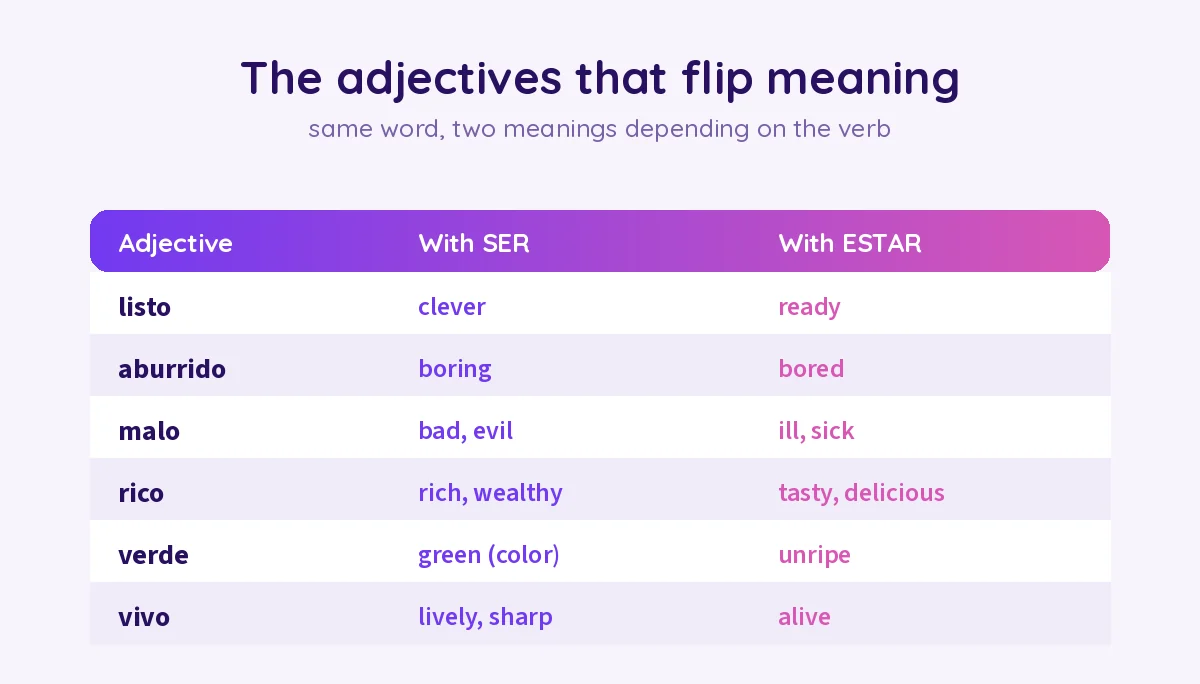
| Adjective | With SER | With ESTAR |
|---|---|---|
| listo | clever | ready |
| aburrido | boring | bored |
| malo | bad (evil) | ill, sick |
| rico | rich, wealthy | tasty, delicious |
| verde | green (color) | unripe |
| vivo | lively, sharp | alive |
| orgulloso | proud (arrogant) | proud (of something) |
| seguro | safe, reliable | sure, certain |
The pattern is the same one you already know. With ser, the adjective describes a defining quality: a clever person, a wealthy family, a lively character. With estar, it describes a current state: ready to leave, feeling sick, tasting good, being alive. Es rico is a comment on someone's bank account. Está rico is a compliment to the cook. Getting these backward is how you accidentally tell someone their grandmother is delicious instead of well.
Common Mistakes English Speakers Make
Most ser and estar errors come from a small set of habits, and naming them makes them easy to catch.
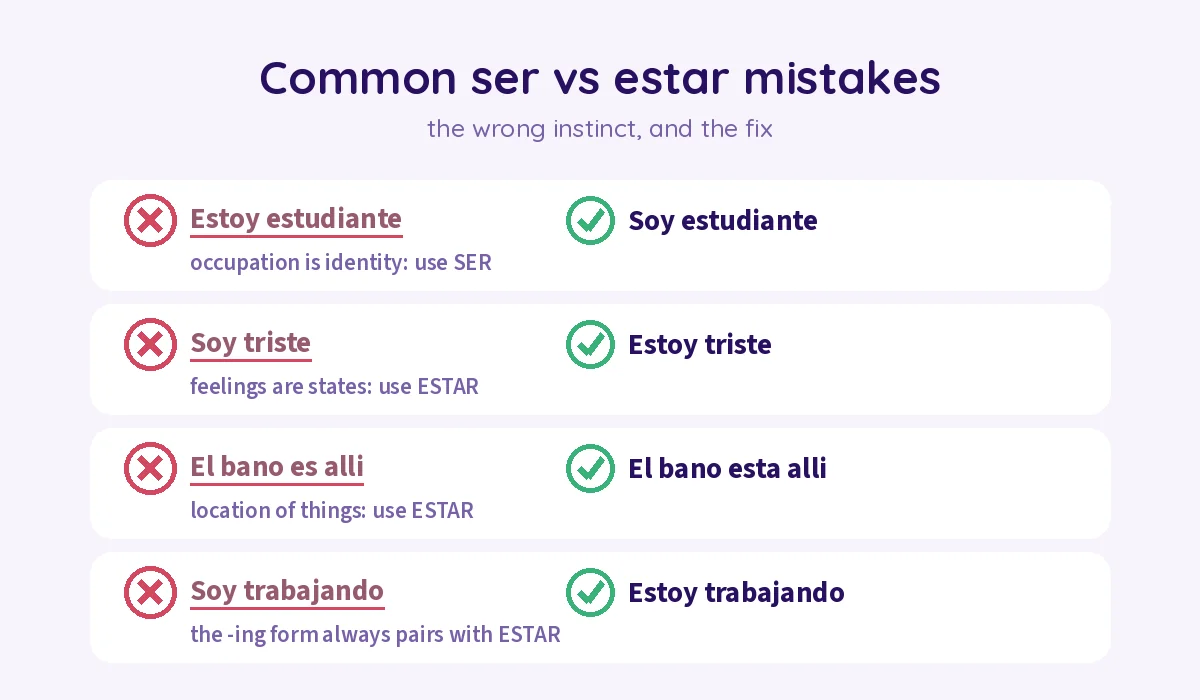
The first is using ser for location. Because English says "the party is at my house" with the same "is" as everything else, learners reach for ser. But physical location is estar's job: La fiesta está en mi casa is wrong actually, because events are the one exception and take ser, while the house itself uses estar. Keep it simple: things and people are located with estar, el baño está allí, the bathroom is there.
The second is using estar for professions. "I am a student" feels like a current status, so learners say estoy estudiante. Your occupation is identity, so it is ser: soy estudiante. The third is defaulting to ser for feelings because they seem important or lasting. Emotions are states, so estoy triste, I am sad, not soy triste, which would claim sadness as your permanent character. The last common slip is forgetting that the progressive tense, the "I am doing" form, always pairs with estar: estoy trabajando, never soy trabajando. If you want to earn a quick internal shortcut, the how to learn Spanish fast guide covers how to drill patterns like these until they are automatic rather than deliberate.
Quick Practice: Test Yourself With 10 Sentences
Cover the answers and fill in ser or estar in the right form. Then check yourself.
- Nosotros ___ de Brasil. (We are from Brazil.)
- La ventana ___ abierta. (The window is open.)
- Mi padre ___ médico. (My father is a doctor.)
- Los niños ___ cansados. (The children are tired.)
- Hoy ___ jueves. (Today is Thursday.)
- El restaurante ___ cerca del parque. (The restaurant is near the park.)
- Ella ___ muy inteligente. (She is very intelligent.)
- Yo ___ estudiando ahora. (I am studying now.)
- La nieve ___ blanca. (Snow is white.)
- ¿Cómo ___ tú hoy? (How are you today?)
Answer key:
- somos (origin, ser)
- está (condition, estar)
- es (occupation, ser)
- están (condition, estar)
- es (day and date, ser)
- está (location, estar)
- es (characteristic, ser)
- estoy (action in progress, estar)
- es (defining description, ser)
- estás (current state, estar)
If you missed a few, look at which ones. Almost every miss lands on the same fault line: a passing state that felt permanent, or a defining trait that felt momentary. Sort the sentence into "what it is" versus "how it is right now" and the verb chooses itself.
Turn Grammar Drills Into Points You Can Cash Out
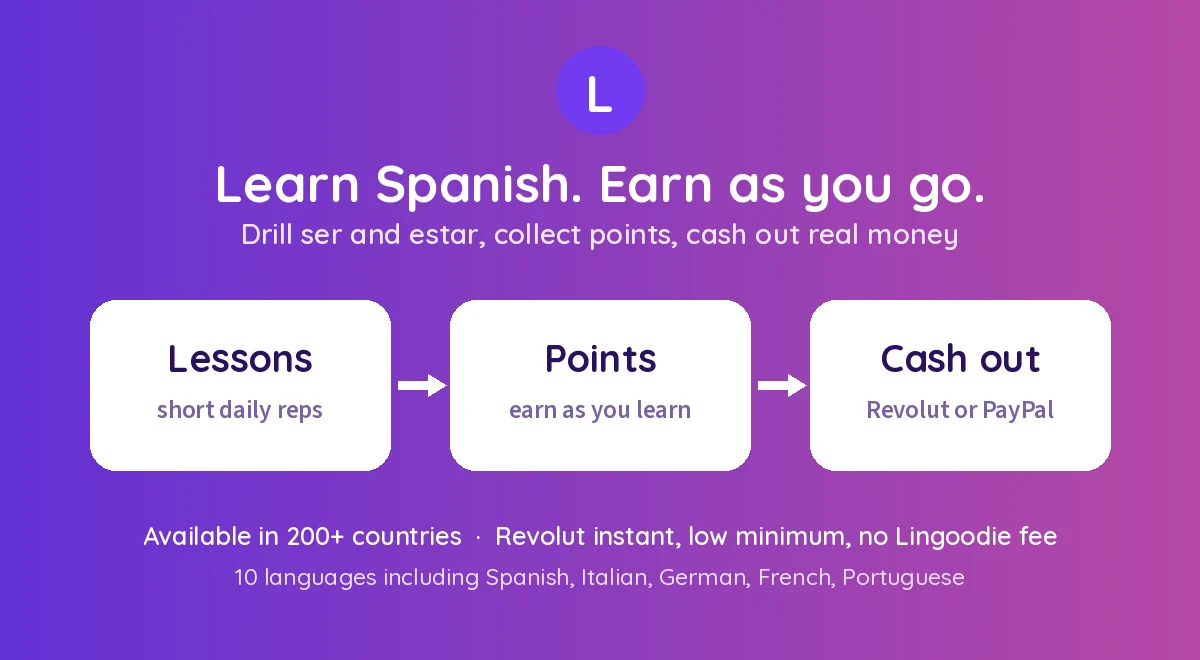
Ser and estar are not learned by reading a rule once. They are learned in short, repeated reps until the correct verb arrives before you have time to think about it, and the only thing that gets you there is showing up regularly. That is exactly what Lingoodie is built around. You complete short Spanish lessons, drill precisely these kinds of ser and estar choices, earn points as you go, and cash out real money via Revolut or PayPal, available in 200+ countries. Revolut is instant, has a low minimum, and Lingoodie takes no fee on it. PayPal is also available with a higher 100,000-point minimum and 1 to 3 business day processing. The rewards are small on purpose, just enough of a nudge to bring you back for tomorrow's five minutes, which is where the fluency quietly builds. Lingoodie teaches 10 languages including Spanish, Italian, German, French, and Portuguese.
If you are still choosing where to study, it helps to pick the right tool first. Here is an honest rundown of the best Spanish learning app options so you can find the one that fits how you actually practice.
Download Lingoodie free on Google Play or the App Store, and turn every ser and estar you get right into real cash.