How Long Does It Really Take to Learn a Language?
Ask this question anywhere and you get the same shrug of an answer: it depends. Which is true, and completely useless. It is the reply you give when you do not want to be pinned down, and it leaves you exactly where you started, with no finish line and no way to tell whether you are on track or drifting.
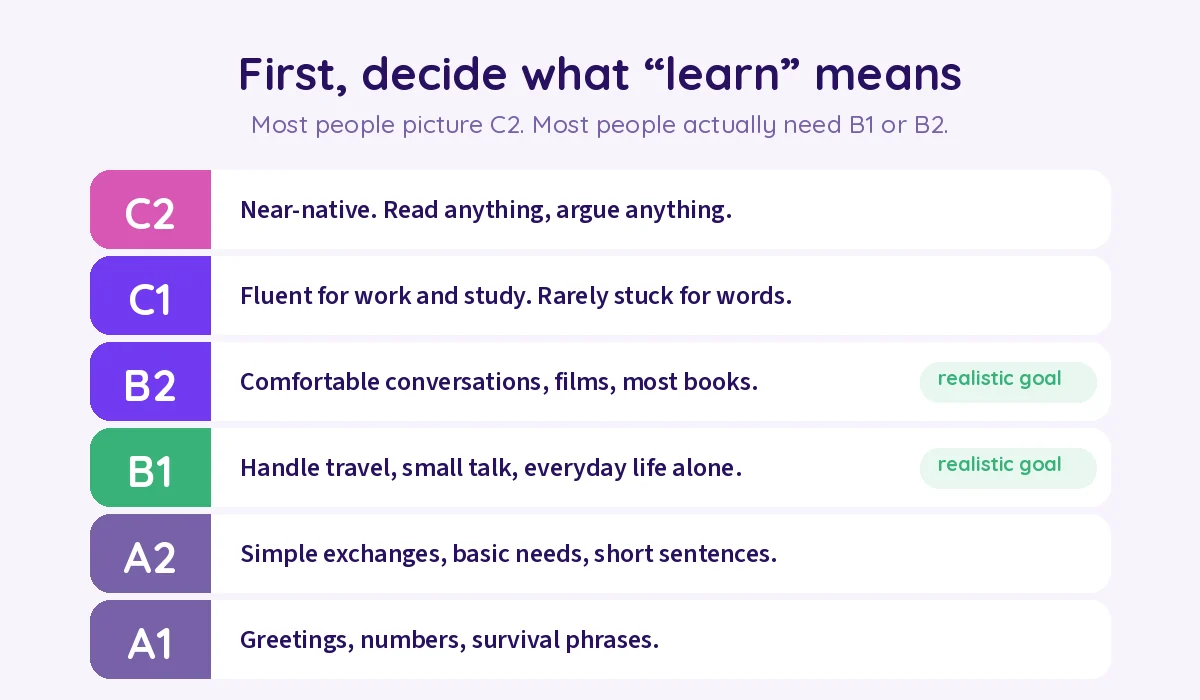
So let us pin it down. The honest answer is not a single number, because "learn a language" can mean ordering coffee in Lisbon or defending a thesis in Berlin, and those are years apart. But it is not a mystery either. It is a short piece of arithmetic with three inputs: how many hours your goal actually costs, how far your target language sits from English, and how many minutes a day you are willing to put in. Fix those three and a real date falls out.
The good news hiding in that formula is that two of the three inputs are yours to set. You choose the level you are aiming for, and you choose your daily pace. Only the language distance is fixed. That is why two people learning the same language can finish a year apart, and why the "it depends" is technically correct but quietly hands you all the control.
First, Decide What "Learn" Actually Means
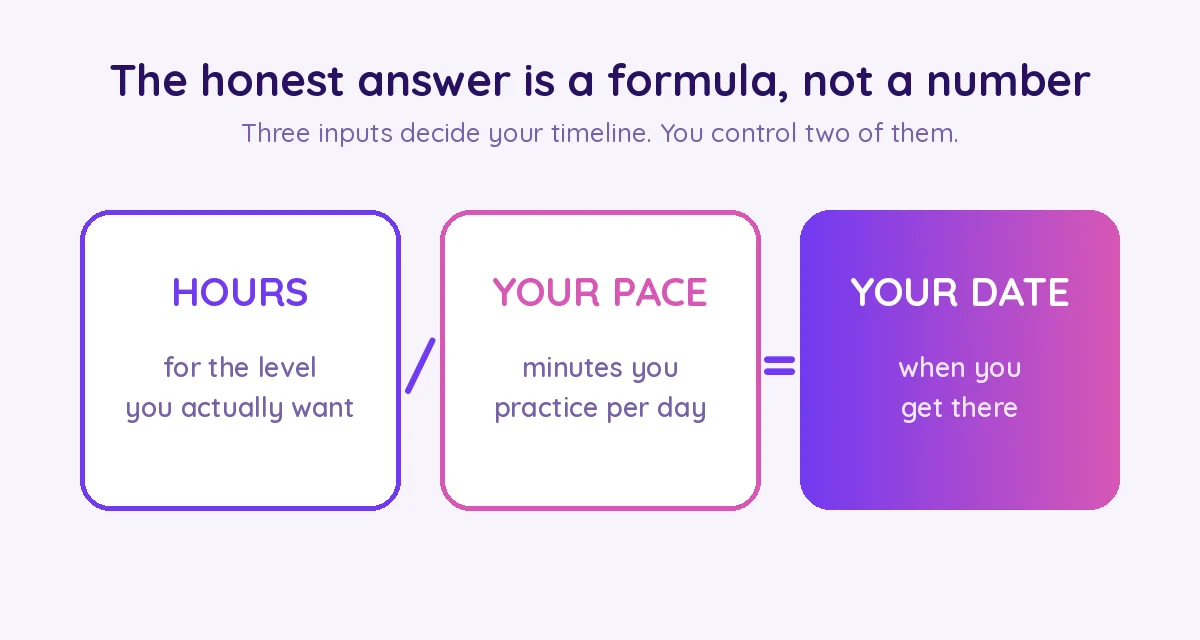
Before any timeline makes sense, you have to say where the finish line is, and this is where most people accidentally sign up for a decade of work. When someone imagines being able to "speak Spanish," they often picture a native-level command: cracking jokes, following fast films, reading novels without a dictionary. That is real, and it is also the top of a long staircase.
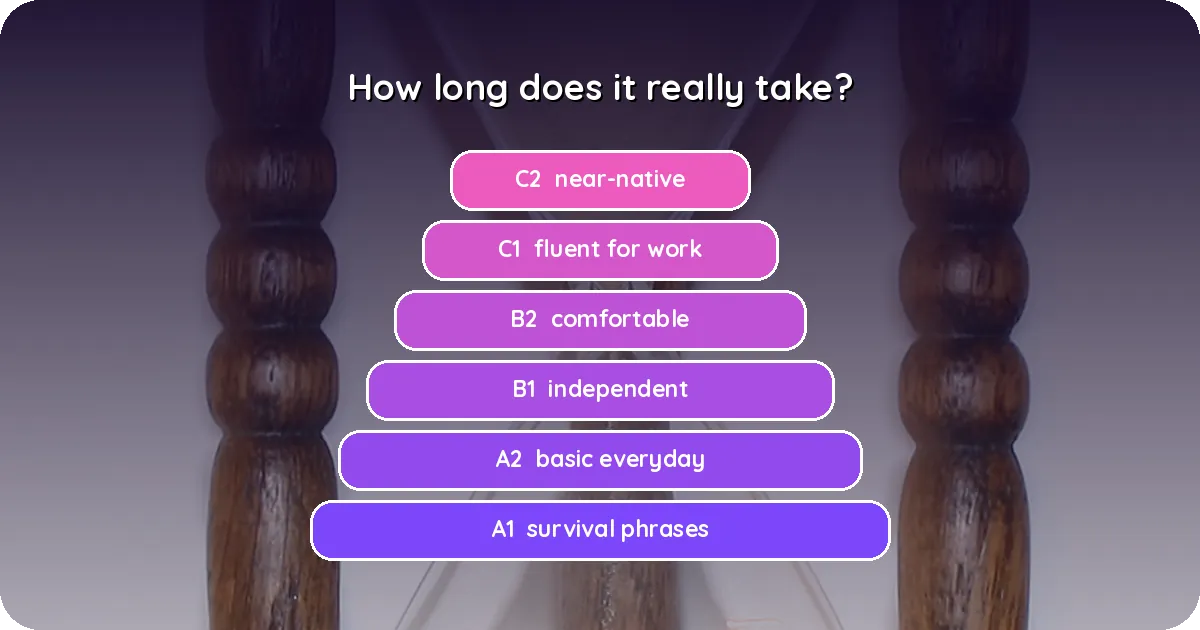
The staircase has a name. The Common European Framework of Reference, or CEFR, sorts ability into six levels, from A1 at the bottom to C2 at the top. A1 is greetings and survival phrases. B1 is the point where you can travel, handle everyday life, and hold a simple conversation on your own. B2 is comfortable: real conversations, most films, most books. C1 and C2 are the fluent-for-work and near-native tiers that take the longest by far.
Here is the quietly liberating part. You almost never need C2. For travel, for talking to family, for enjoying a country, for most jobs that are not translation or diplomacy, B1 or B2 is the goal that actually changes your life. Aiming there instead of at some vague idea of perfection can cut your timeline in half before you have studied a single word.
The Hour Cost of Each Level
Once you have a target level, you can attach a rough number of study hours to it. These are estimates, not promises, and they assume focused practice rather than half-watching a video with the sound down. But they are grounded in how language schools and exam boards plan their courses, so they are a fair starting point.
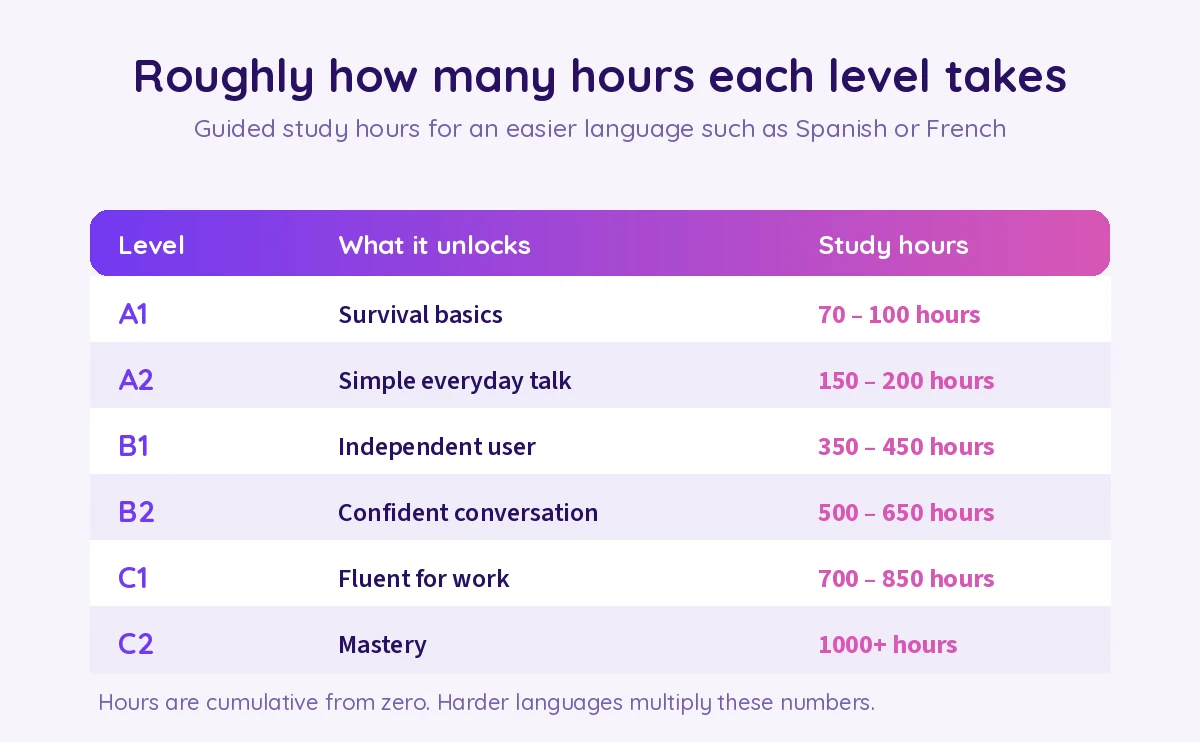
For a language that is relatively close to English, the guided hours climb roughly like this: about 70 to 100 hours to reach A1, around 150 to 200 to reach A2, somewhere near 350 to 450 for B1, and 500 to 650 for a confident B2. C1 and C2 keep going, into the high hundreds and past a thousand. The numbers are cumulative, so B1 already includes the A1 and A2 hours underneath it.
Notice the shape of that staircase. The early levels are cheap and the later ones are expensive, which is why beginners feel fast progress and intermediate learners feel stuck. You are not slowing down. The steps are simply getting taller. Knowing that in advance is worth a lot, because the plateau that makes people quit at B1 is not a failure, it is just the price of the next level printed in hours.
The One Input You Cannot Change
Those hour figures assume an easier language. Pick a harder one and every number in the table stretches. This is the single input the formula does not let you negotiate, and the best guide to it comes from the United States Foreign Service Institute, which has spent decades training diplomats and sorting languages by how long they take an English speaker to reach working fluency.
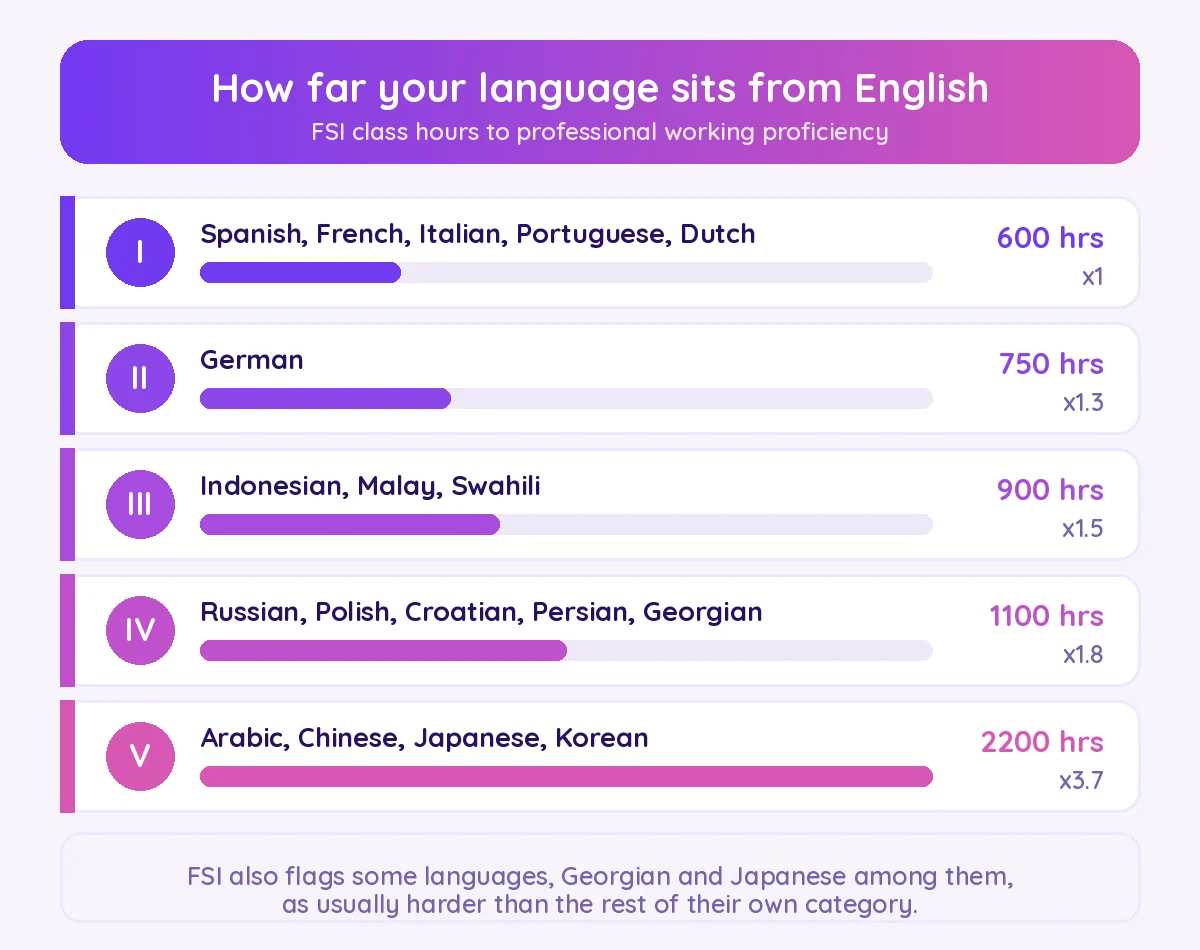
The Institute groups languages into five categories. Category I holds the closest cousins of English, such as Spanish, French, Italian, and Portuguese, at roughly 600 class hours to working fluency. German sits on its own in Category II at 750. Category III, at 900, is a small group including Indonesian, Malay, and Swahili. Category IV is the crowded one at around 1100 hours, and it covers most of the rest of the world, including Russian, Polish, Croatian, Ukrainian, Greek, Hindi, Persian, and Georgian. At the far end, Category V covers Arabic, Chinese, Japanese, and Korean at roughly 2200 hours, close to four times Category I, because you are learning a new writing system and sound world at the same time as the grammar. The Institute also flags a handful of languages, Georgian and Japanese among them, as usually harder than the rest of their own category.
Treat this as a multiplier on your level estimate rather than a separate table to memorize. If B1 in Spanish is around 400 hours, the same level in a Category V language is a much larger commitment, and planning as if they were equal is how people burn out. If you want the full ranking of which languages cost the most, our guide to the hardest languages to learn breaks it down, and if you would rather start somewhere gentle, the easiest languages to learn is the other side of the same coin.
Now Do the Division
Here is where the vague question becomes a real date. Take the hours your goal costs and divide by the hours you practice per day. That is the whole calculation. Hours divided by your daily pace gives you a calendar, not a maybe.
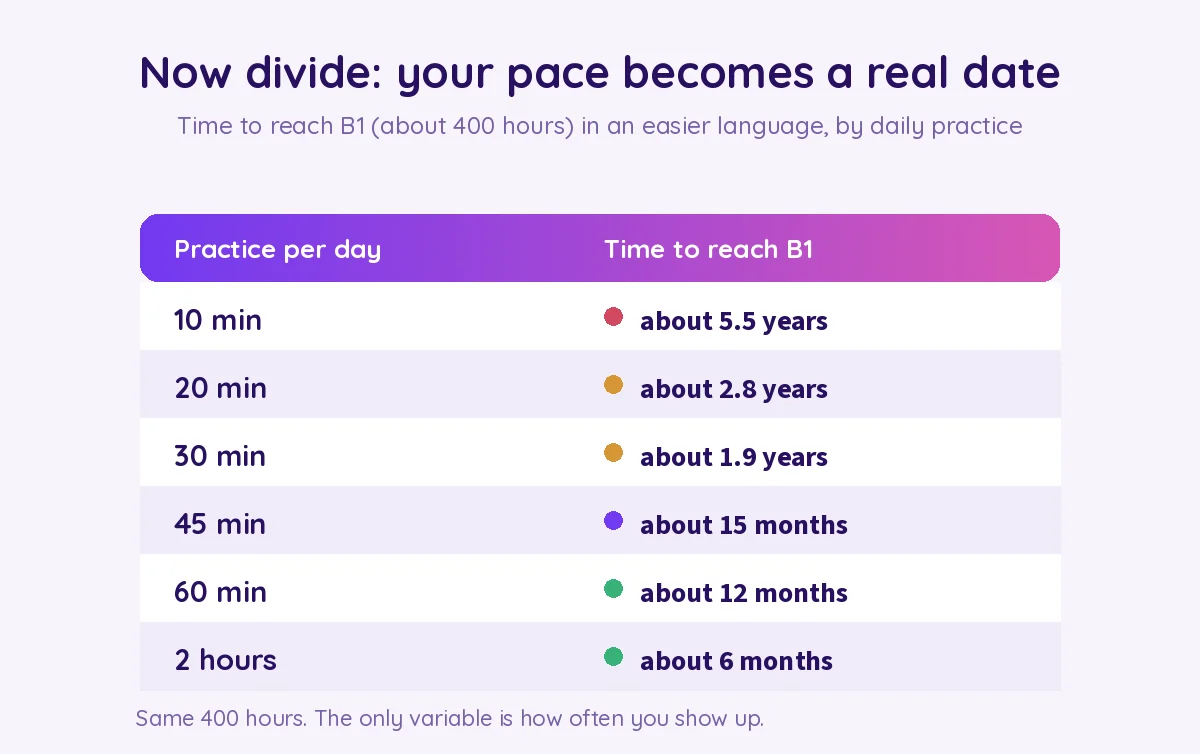
Say you are aiming at B1 in an easier language, roughly 400 hours. At a gentle ten minutes a day, that works out to well over five years, because ten minutes is only about sixty hours of study a year. Bump it to twenty minutes and you are near three years. At forty-five minutes a day you reach B1 in a little over a year, and at an hour a day you get there in around twelve months. Push to two focused hours and B1 arrives in roughly six.
The striking thing about that table is that the goal never moved. It is the same 400 hours in every row. The only thing that changed is how often you showed up, and it swings the finish line from six months to six years. That is the real lesson buried inside "how long does it take." The language does not decide your timeline nearly as much as your calendar does.
About Those "Fluent in Three Weeks" Promises
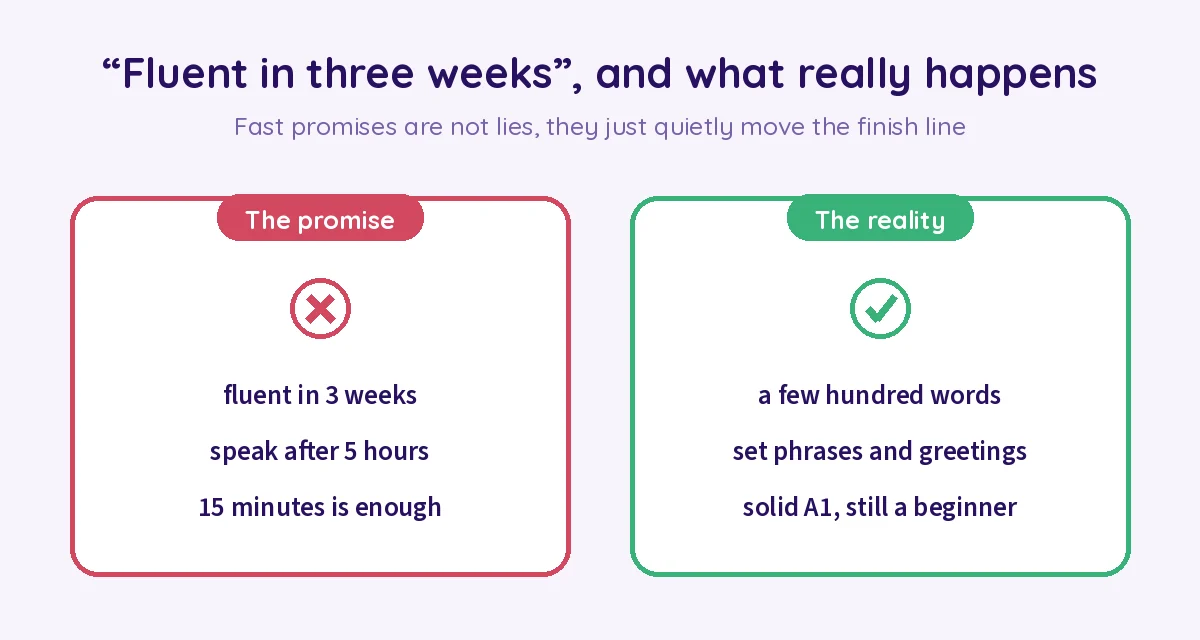
If you have shopped around for a course, you have seen the fast claims: fluent in three weeks, speaking after five hours, fifteen minutes a day is all you need. These are not quite lies, but they lean hard on a trick. They quietly redefine the finish line and hope you do not notice.
Look back at the hours table and the math gives them away instantly. Three weeks of daily practice is a handful of hours, not the hundreds a real conversational level requires. What three focused weeks genuinely buys you is a stack of useful phrases, some greetings, a first grip on the sound of the language, and a solid A1. That is a great start, and it is worth being excited about. It is simply not fluency, and calling it fluency sets you up to feel like a failure at exactly the moment you should feel encouraged.
The fifteen-minutes-a-day promise is more honest, with one piece of fine print. Fifteen minutes is a fantastic habit and a terrible sprint. It will absolutely get you there, on the multi-year timeline the calculator showed, not the multi-week one the ad implied. Keep the habit, drop the fantasy, and you will out-last every learner who bought the fantasy instead.
Five Things That Actually Move Your Number
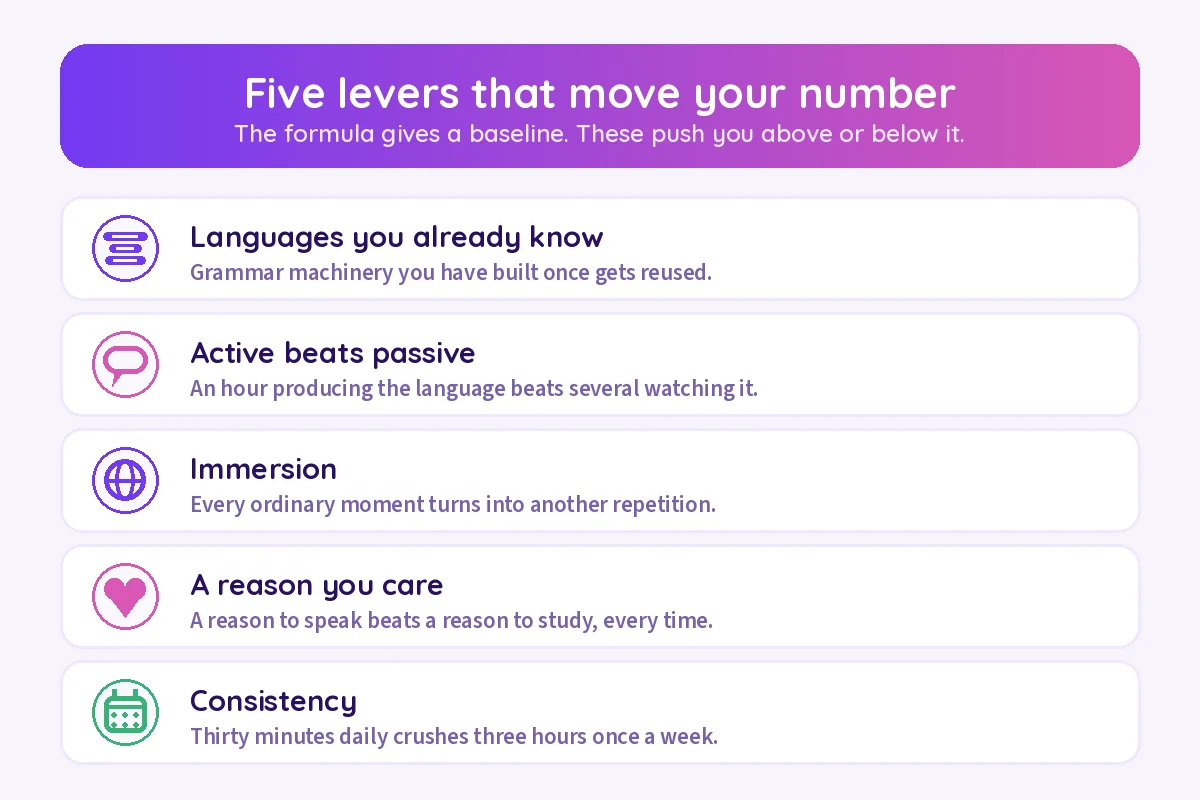
The formula gives a baseline. These are the levers that push you above or below it in real life, and none of them are secrets.
The first is the languages you already know. A second language you learned before, especially one related to your target, shaves real time off because you are reusing grammar machinery your brain already built. The second is active versus passive practice. An hour spent speaking, writing, and recalling is worth several hours of watching a lesson roll by, because struggling to produce the language is what moves it into long-term memory.
The third is immersion. Living where the language is spoken, or flooding your day with its music, shows, and conversation, compresses the calendar dramatically because every ordinary moment becomes a repetition. The fourth is using it for something you care about, since a reason to speak beats a reason to study every single time. And the fifth, the one that quietly beats all the others, is consistency. Thirty minutes every day crushes three hours once a week, because a language is a memory that fades without contact. The only input that is fully yours, day after day, is whether you show up.
The Real Bottleneck, and How to Beat It
Put all of it together and the answer to "how long does it take to learn a language" is refreshingly concrete. Pick your level, look up the hours, apply the distance multiplier for your language, and divide by the minutes you can honestly commit each day. Aim at B1 or B2 rather than some perfect ideal, keep your practice active, and above all keep it daily.
That last part is the whole game, and it is also the hardest, because motivation is generous on day one and stingy on day forty. The learners who win are not the fastest or the most gifted. They are the ones who kept the daily habit alive long after the novelty wore off. If you want a wider look at the tools that help you do that, here is our honest rundown of the best language learning apps, and if Spanish is your target, our guide to learning Spanish fast picks up where this leaves off.
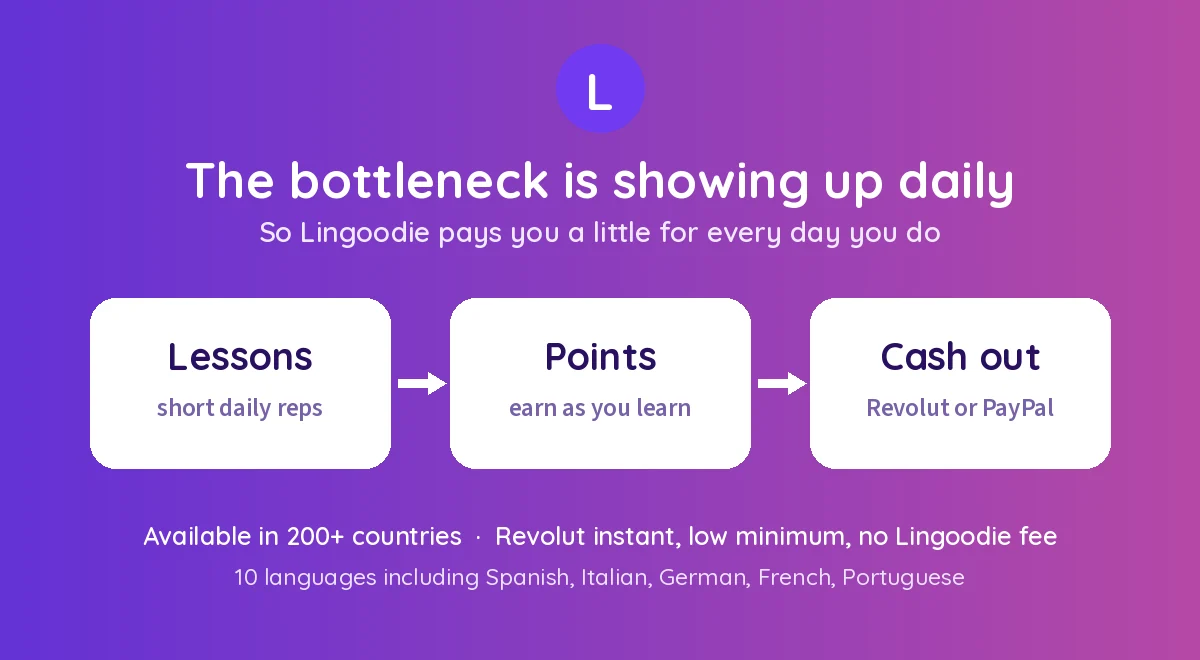
This habit problem is exactly the one Lingoodie is built to solve. You complete short daily lessons, earn points as you learn, and cash out real money via Revolut or PayPal, available in 200+ countries. Revolut is instant, has a low minimum, and Lingoodie takes no fee on it. PayPal is also available, with a higher 100,000-point minimum and 1 to 3 business day processing, where PayPal, not Lingoodie, takes its own cut. The rewards are small on purpose, just enough of a nudge to get you back for tomorrow's five minutes, which is where the multi-year math quietly turns in your favor. Lingoodie teaches 10 languages including Spanish, Italian, German, French, Portuguese, Korean, Russian, Ukrainian, Croatian, and Slovenian.
The timeline was never really about talent. It was about how many days in a row you can keep showing up. Download Lingoodie free on Google Play or the App Store, and turn the daily minutes that decide your finish line into real cash along the way.