Best Gig Economy Apps in 2026: Ranked by Real Pay and Flexibility
The gig economy made a simple promise: work when you want, as much as you want, on your phone. A decade in, that promise is mostly real, with two large caveats that the breathless app reviews skip. The first is that the headline hourly rates rarely survive contact with expenses, fees, and dead time. The second is that flexibility and pay usually pull in opposite directions, the most flexible gigs pay least per hour, and the best-paying ones demand a real skill or schedule.
This guide ranks the best gig economy apps in 2026 by what they actually pay after the costs nobody mentions, and by how much flexibility you give up to earn it. We have grouped them by type, because a food-delivery app and a freelance marketplace are barely the same category, and the right choice depends entirely on what you have to offer: a car and spare evenings, a marketable skill, or just a few unpredictable minutes here and there.
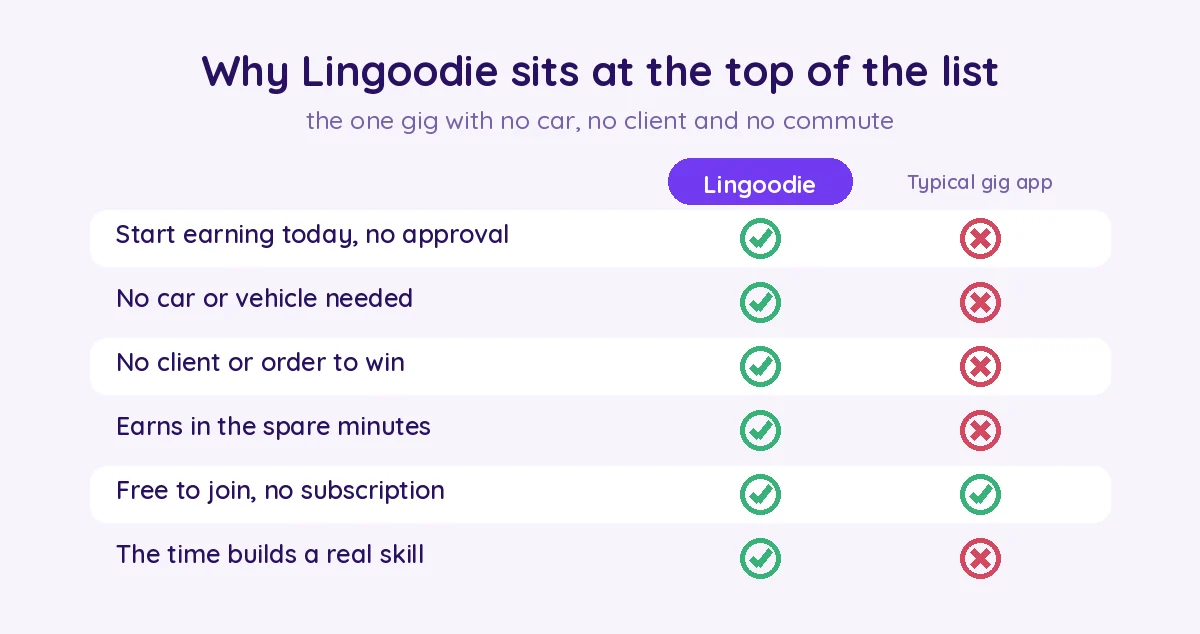
Lingoodie is listed first, not because it competes with driving for an hourly rate, but because it represents the one corner of this market with zero barriers to entry, no car, no client, no commute, and a payout for time most gig apps cannot touch, the small dead minutes between everything else.
How to Read Gig Economy Earnings Honestly
Before the list, three numbers worth internalising. Most part-time gig workers in 2026 earn somewhere between $500 and $1,500 a month working 10 to 20 hours a week. Full-time workers stacking multiple platforms report $3,000 to $7,000 or more a month, but that is genuine full-time work with no benefits attached. And the gap between gross and net is large in the driving and delivery category, where fuel, vehicle wear, and self-employment taxes can take a serious bite out of the advertised rate.
The framing that keeps people sane: gig apps are a way to convert time, and sometimes a vehicle or a skill, into flexible income with no boss and no fixed schedule. They are excellent for filling gaps and topping up income. They are demanding and unprotected as a sole livelihood. Choose based on what you actually have to trade.
Flexible Micro-Earning, No Barriers
Lingoodie
Lingoodie is the gig app for the time no other gig app can use: the five minutes in a queue, the wait for a kettle to boil, the gap between two other tasks. You complete short language learning sessions, earn cash rewards, and cash out weekly via Revolut or PayPal. There is no car to maintain, no client to win, no order to wait for, and no commute to swallow your margin. It is free, with no subscription.
It will not match a busy delivery shift for raw hourly output, and it does not pretend to. What it offers instead is the lowest barrier to entry on this entire list and a return on time that would otherwise earn nothing, with the added benefit that the minutes build a real language rather than simply passing. For gig workers, it is the natural companion to the apps below: something to earn from in the dead time when you are waiting for the next ride, delivery, or task to come in. Available on Android and iOS, with cashout in the EEA, UK, Australia, Brazil, and the United States. The get paid to learn a language guide explains the model in full.
Food and Grocery Delivery
DoorDash
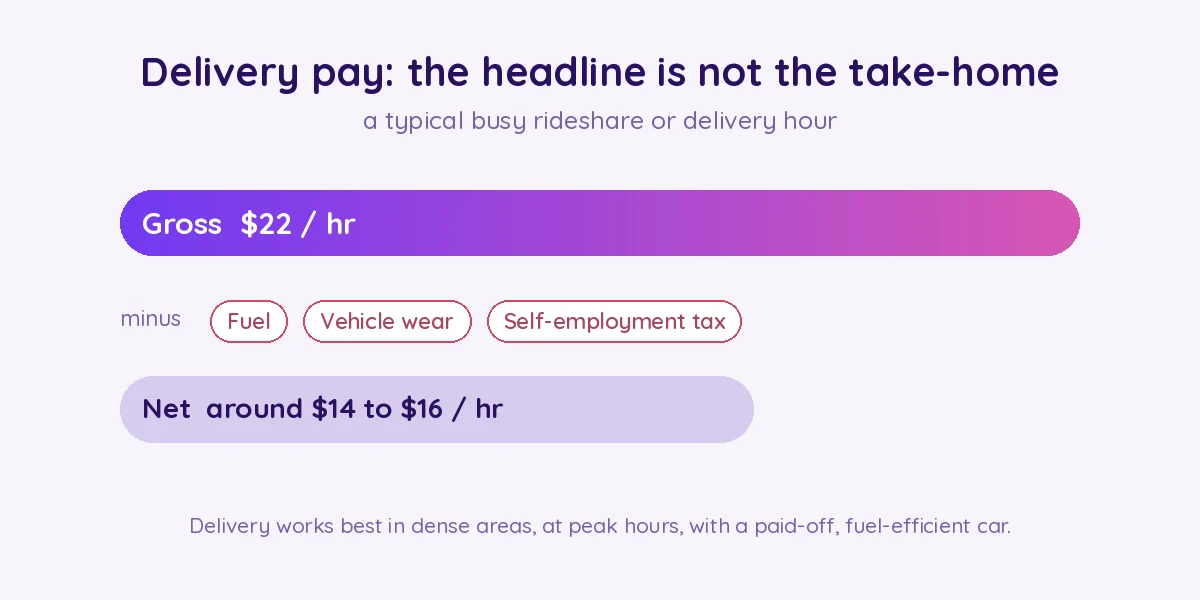
DoorDash is the largest food-delivery platform and the default entry point into delivery gig work. The schedule is fully flexible, the customer base is huge, and the DasherDirect card pays you instantly rather than weekly. Real earnings tend to land around $15 to $30 an hour before expenses, with the higher end during busy meal-time surges.
The honest caveat is expenses. After fuel and vehicle wear, net earnings on a typical run come in noticeably below the gross, and that is before you set aside anything for tax. DoorDash works best in dense urban areas during peak hours and for people who already have a paid-off, fuel-efficient vehicle.
Uber and Uber Eats
Uber covers both rideshare and food delivery, which gives you two earning modes in one app and the ability to switch based on demand. Peak rideshare earnings tend to edge out the delivery apps, roughly $20 to $25 an hour in busy periods, helped by surge pricing, and the Instant Pay feature lets you cash out several times a day. The same expense and tax caveats apply, and rideshare adds more vehicle wear than delivery because of the mileage. For drivers in a busy market, Uber's dual mode is one of the more reliable ways to keep earning through quiet stretches.
Instacart
Instacart pays you to shop for and deliver groceries, and it rewards larger orders with higher pay, which can push the effective rate above the food-delivery apps on a good batch. It suits people who do not mind the in-store shopping component and can handle bulkier deliveries. As with all delivery work, the advertised figures are gross, and your real rate depends on order size, tips, and how much driving sits between batches. Amazon Flex is a similar option for those who prefer package delivery in scheduled blocks rather than on-demand orders.
Skilled Tasks and Local Work
TaskRabbit
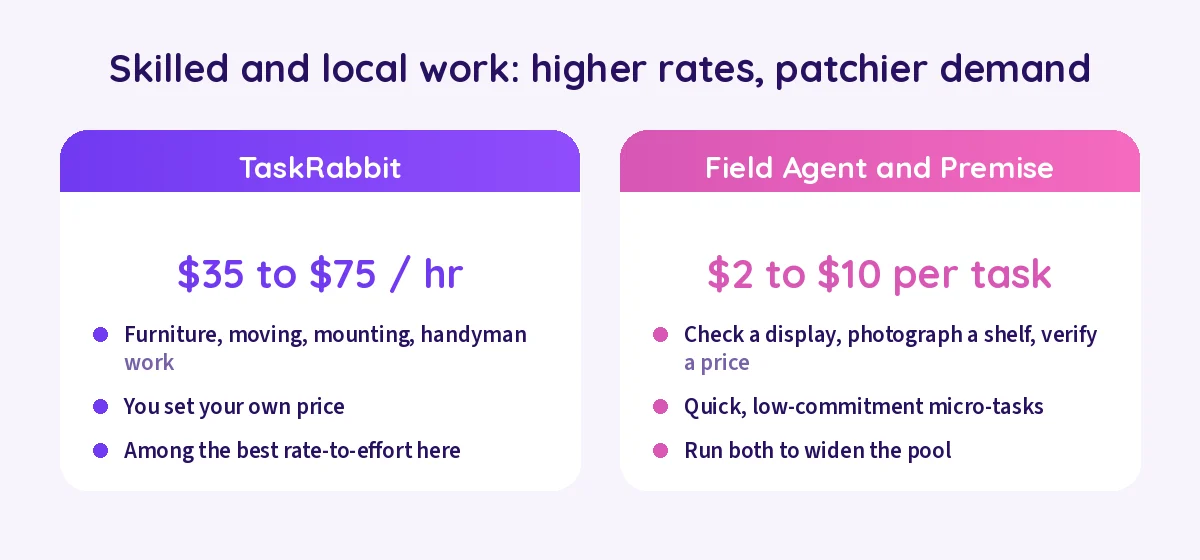
TaskRabbit connects you with people who need local tasks done, furniture assembly, moving help, mounting, cleaning, handyman work, and it pays among the highest hourly rates on this list, roughly $35 to $75 an hour for skilled tasks, with the platform charging clients rather than taking a cut of your rate. You set your own price, which is the real advantage.
The trade-off is consistency. Demand is less steady than delivery, and you only earn when tasks near you are available, so it works best as a higher-rate supplement rather than a guaranteed income stream. For anyone handy with tools or willing to do physical local work, it is one of the best rate-to-effort options in the gig economy.
Field Agent and Premise
Field Agent and Premise pay you for small real-world tasks: checking a product display, photographing a shelf, verifying a price, completing a quick mystery shop. Individual tasks pay from a couple of dollars up to ten or more, and the work is genuinely flexible and low-commitment. Availability is geographic, so urban users see far more tasks than rural ones. Run both to widen the pool when tasks are scarce.
Freelance Skills, the Highest Ceiling
Upwork
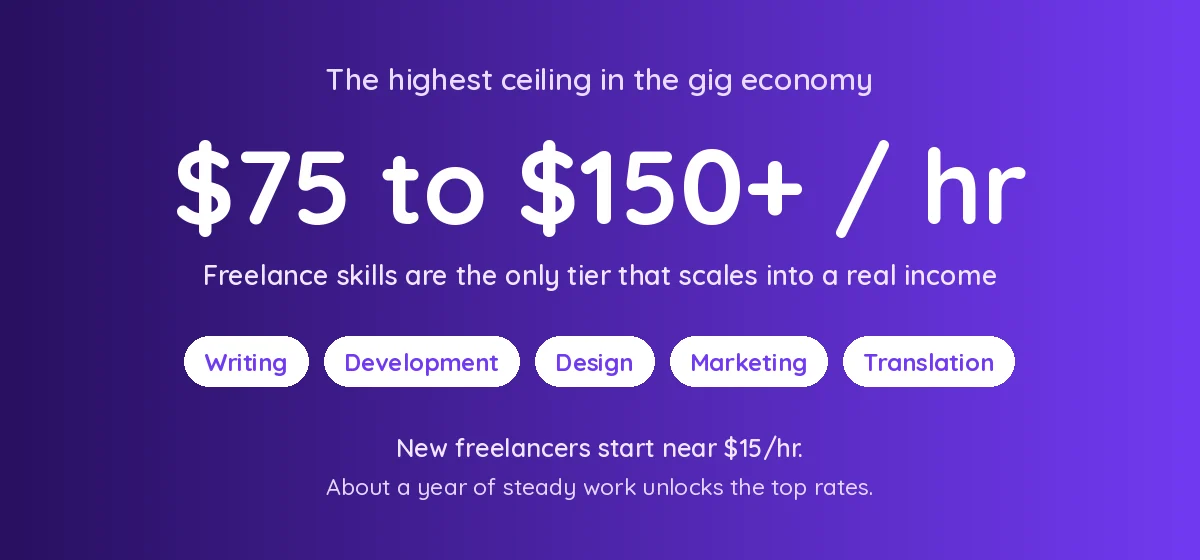
Upwork is the largest freelance marketplace, and it is where the real money in the gig economy lives. Skills in demand, writing, web and software development, design, marketing, translation, AI work, and cybersecurity, command $75 to $150 an hour and more once you are established, far above anything in the delivery category. You manage clients and projects largely from your phone, and long-term contracts can turn gig work into something closer to a remote career.
The honest catch is that you start at the bottom. A new freelancer with no reviews competes near the floor of the market, and it typically takes about a year of steady work to build the reputation, ratings, and portfolio that let you charge much above 15 dollars an hour. There is a learning curve to win your first clients, platform fees are taken from your earnings, and this is real skilled work rather than something you can start cold this afternoon. But for anyone willing to put in that first year, Upwork is the only category here that scales into a genuine income rather than pocket money.
Fiverr
Fiverr works on the opposite model to Upwork: instead of bidding on client jobs, you list fixed-price services, gigs, that buyers purchase directly. It suits repeatable, well-defined work, a logo design, a voiceover, an article, a quick edit, and rewards sellers who can productise a skill into a clear offer. Fiverr takes a commission on earnings, heavier on lower tiers, but for the right skill it generates steady inbound work with less ongoing pitching than Upwork. Toptal is a third option worth knowing for elite, vetted freelancers in development, design, and finance, with rates to match.
Renting Out Time, Space, and Skills
Rover
Rover connects pet owners with sitters and dog walkers, and for animal lovers it is a rare gig that barely feels like work. Earnings vary by service and location, and Rover takes a commission of roughly 20 to 25 percent of each booking. It is flexible, pleasant, and a genuine earner in pet-heavy areas, though like TaskRabbit the demand depends on where you live. The broader category, renting out a skill, a spare room, a driveway, or equipment, is worth exploring for anyone with an underused asset and a few spare hours.
How Much Can You Realistically Earn?
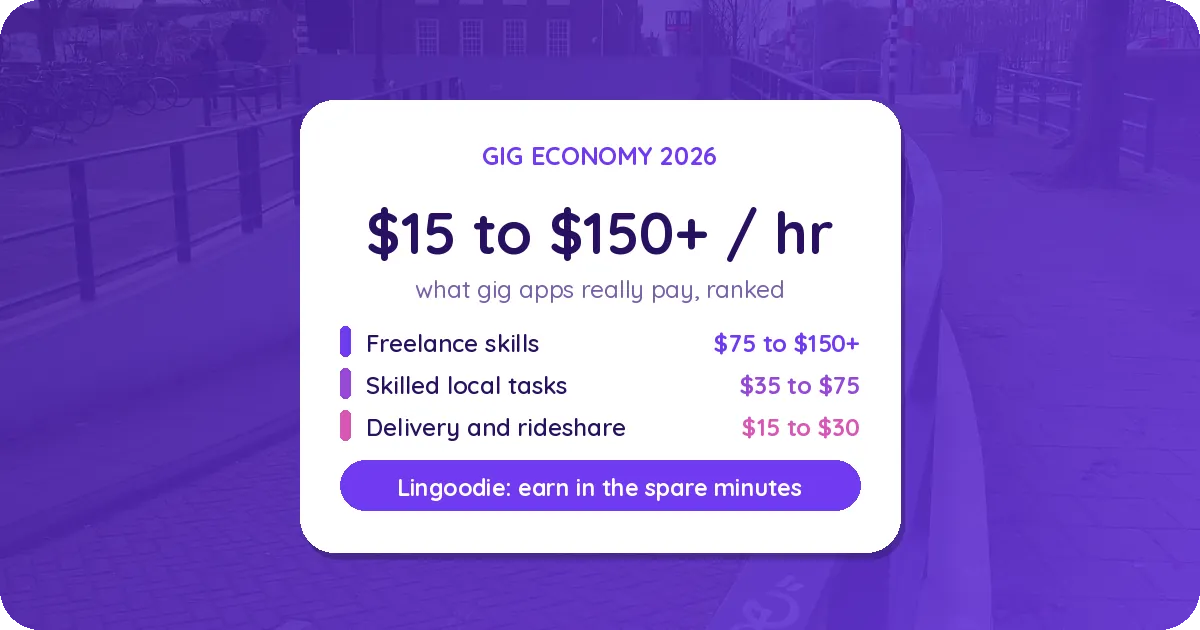
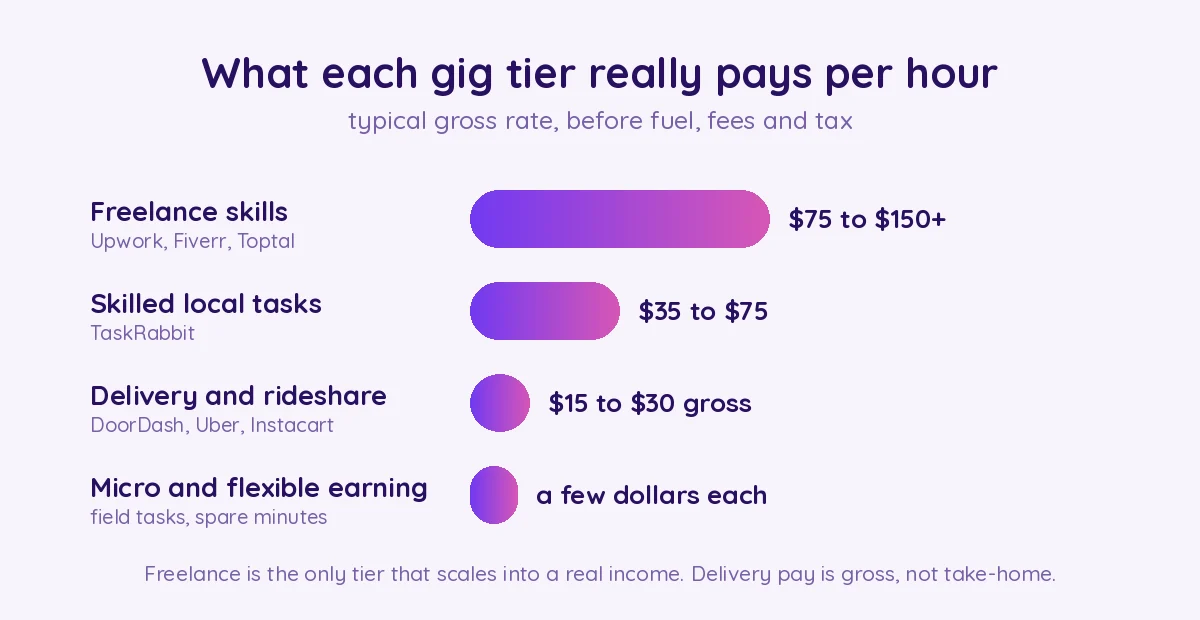
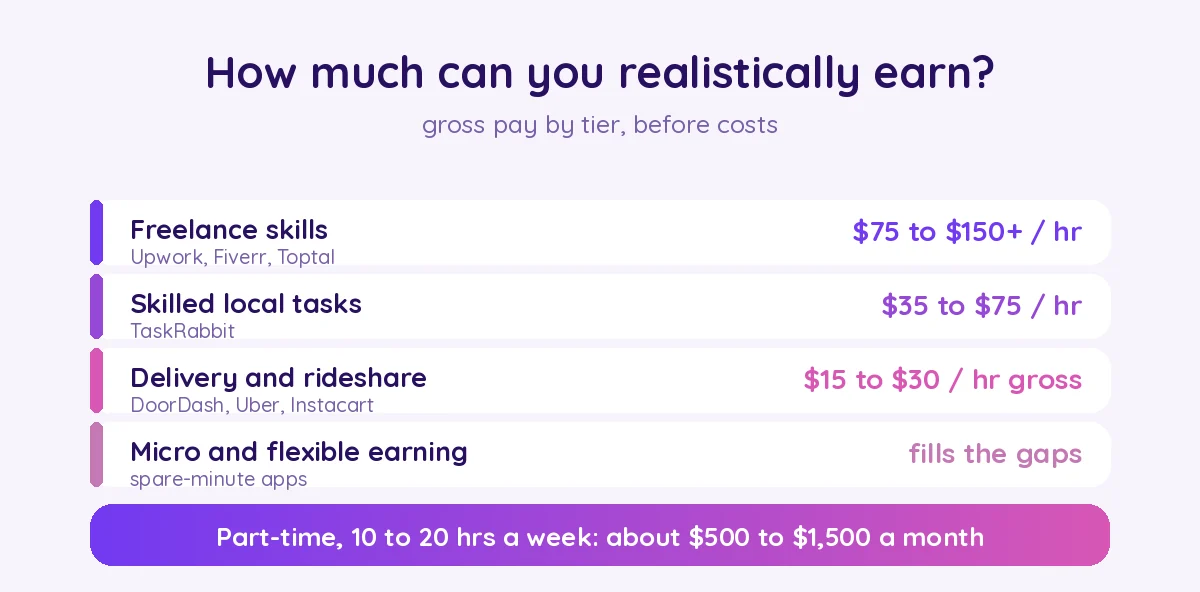
The honest picture by tier. Delivery and rideshare pay $15 to $30 an hour gross, meaningfully less after fuel, vehicle wear, and tax, and reward dense areas and peak hours. Skilled local work on TaskRabbit pays $35 to $75 an hour but with less consistent demand. Freelance work on Upwork, Fiverr, or Toptal tops the list at $75 to $150 an hour and more, and is the only category that scales into a real income, but it requires a genuine skill. Micro-task and flexible-earning apps fill the gaps with smaller, lower-commitment amounts.
A realistic part-time gig worker earns $500 to $1,500 a month at 10 to 20 hours a week. The single biggest lever on your real rate is matching the app to what you have: a car and peak-hour availability for delivery, a trade skill for TaskRabbit, a professional skill for Upwork, and the dead minutes in between for something like Lingoodie.
The Costs and Catches Nobody Advertises
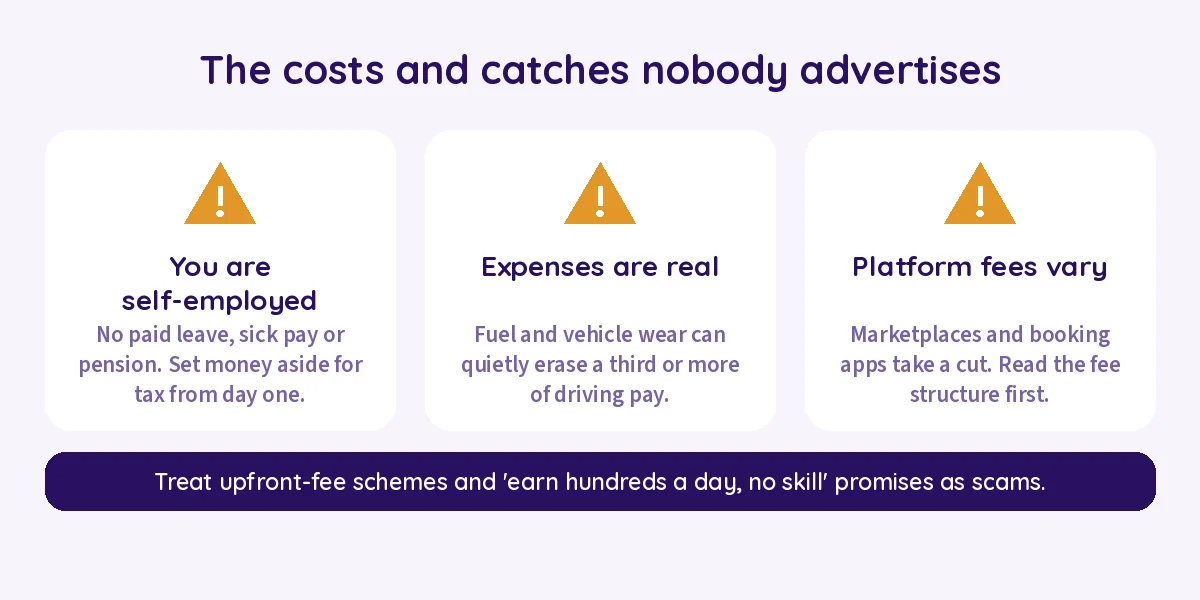
Three things to go in with eyes open. First, you are self-employed, which means no paid leave, no sick pay, and no employer pension, and you are responsible for setting aside money for tax. None of this guide is tax advice, but budgeting for it from day one prevents an unpleasant surprise. Second, expenses are real, especially in driving and delivery, where fuel and vehicle wear can quietly erase a third or more of the headline rate. Third, platform fees vary, freelance marketplaces take a percentage of your earnings, and pet and task platforms take a cut of bookings, so read the fee structure before you commit.
And as in any earning category, treat upfront-fee schemes and "earn hundreds a day with no skill or effort" promises as scams. Legitimate gig apps are free to join and honest that the money tracks the work.
The Bottom Line
The best gig economy app in 2026 is simply the one that matches what you have to trade. A car and spare evenings point to DoorDash, Uber, or Instacart. A trade or handy skill points to TaskRabbit. A professional skill points to Upwork or Fiverr, the only route that scales into real income. And the unpredictable dead minutes between all of it point to a zero-barrier earner that asks for nothing but a few spare moments.
That is the niche Lingoodie fills, and why it sits at the top of this list despite not competing on raw hourly rate. It is the gig with no car, no client, and no commute, the one you can do while waiting for the next order to come in, and the only one where the time itself compounds into a skill you keep. The payout is modest and honest, like everything worth recommending here, but it earns from the minutes every other gig app leaves on the table.
For more ways to earn from your phone, see the apps that pay real money, earn money from your phone, and passive income apps guides. If you would rather your phone time built a language, start with the best language learning apps guide.
Download Lingoodie free on Google Play or the App Store.