Best Passive Income Apps in 2026: 10 That Actually Pay (Tested)
The phrase passive income apps promises something that is half true. Yes, there are apps that pay you with little or no ongoing effort. No, they will not make you rich, and the ones that claim they will are almost always a scam. The honest version of passive income from your phone is modest, reliable, and genuinely useful as a supplement, provided you go in with the right expectations.
True passivity has a low ceiling by definition. If an app pays you to do nothing, then everyone can do it, which means the per-user payout has to be small. The apps that pay more always ask for more in return, attention, spending, or actual work, at which point they stop being passive. The smart approach is to stack a few genuinely passive apps for a small automatic baseline, and to be honest with yourself about where passive ends and effort begins.
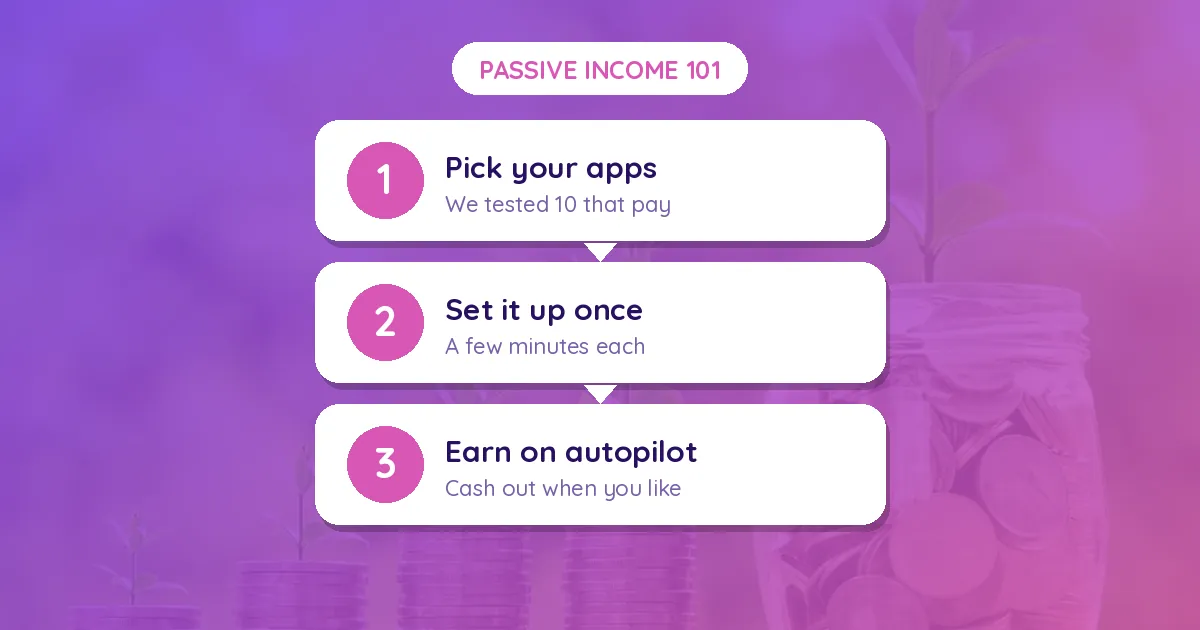
We tested the most popular passive income apps in 2026 and sorted the legitimate from the noise. Below are ten that actually pay, with honest numbers and a clear section on the scams to avoid. Lingoodie is listed first because it is the one where the small daily effort leaves you with something lasting, a language, but every app here clears the only bar that matters: real money or value you can actually withdraw.
A Quick Reality Check on "Passive"
Set the expectation before the list. The realistic range for genuinely passive apps is roughly $5 to $30 per month each, and combining several can add $50 to $200 a month without changing your routine much. Bandwidth-sharing apps pay a few dollars a month. Cashback returns a percentage of spending you were doing anyway. Round-up investing apps quietly build a small balance over time. None of these is a wage, and the ones promising hundreds of dollars a day for doing nothing are selling a fantasy.
The framing that works: passive income apps are a way to put a small automatic return on things you already do, browsing, spending, walking, and to fund a specific modest goal rather than to replace income.
Learn and Earn
Lingoodie
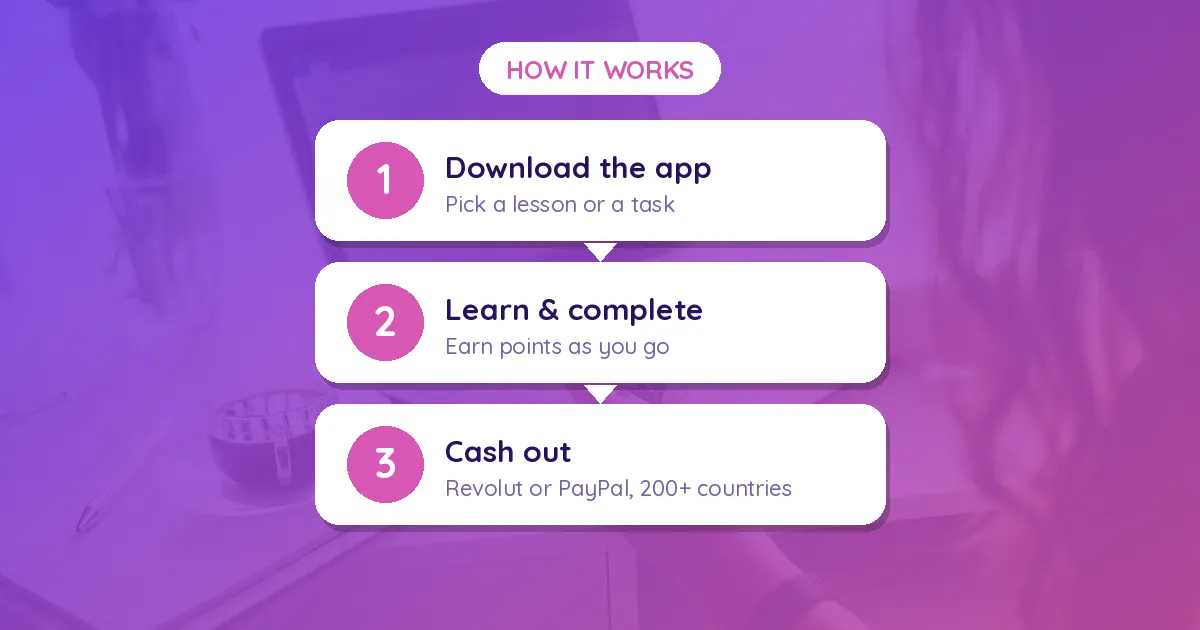
Lingoodie is the one app on this list where the small daily effort compounds into something you keep. It is not purely passive, you complete short language learning sessions, but it sits at the top of this list because the time is the most productive on the page. You earn cash rewards for completing vocabulary and comprehension exercises, and you cash out weekly via Revolut or PayPal.
Most passive income apps give you a few dollars and nothing else. Lingoodie gives you a few dollars and a language. The cash reward keeps you consistent through the weeks when motivation dips, and the skill you build, in Spanish, French, Portuguese, German, Korean, and more, lasts long after any month's payout is spent. It is free to download, carries no subscription, and the earnings are modest by design. If you are going to spend a few minutes a day earning, this is the version where the minutes are not wasted.
Available on Android. Cashout via Revolut or PayPal, now available in 200+ countries. For more on this model, the get paid to learn a language guide goes deeper.
Share Your Unused Internet
Honeygain
Honeygain is the most genuinely passive app on this list. It runs quietly in the background and earns you a small amount for sharing your unused internet bandwidth, which is used for things like price comparison and web monitoring. You earn roughly ten cents per gigabyte shared, and most users earn somewhere between $5 and $20 a month depending on location, connection speed, and how many devices they run it on.
It is as close to set-and-forget as phone earning gets: install it, let it run, and a small balance accumulates. The trade-offs to understand are that it uses your data allowance, so it suits unlimited home broadband rather than a capped mobile plan, and you should read what the app does with your connection before installing, as with any bandwidth-sharing tool. Payout is via PayPal or crypto once you clear a low threshold.
Cashback on Spending You Already Do
Rakuten
Rakuten is passive income in the truest everyday sense: it pays you a percentage back on shopping you were going to do regardless. Activate it before buying through participating retailers and a slice of the price comes back to you, paid reliably by PayPal or cheque. During major sale events the rates climb. The one rule is to never let cashback tempt you into buying things you would not otherwise buy, because the moment that happens the app is costing you money rather than making it.
Fetch Rewards
Fetch Rewards is the lowest-effort cashback app: scan any shopping receipt and earn points that convert to gift cards, with no need to clip offers in advance. Because it works on receipts you already have from almost any shop, it stacks effortlessly on top of Rakuten, each covering a different slice of your spending. The per-receipt value is small but the effort is close to zero.
Round-Up Investing
Acorns
Acorns automates investing by rounding up your card purchases to the nearest dollar and investing the spare change into a diversified portfolio of exchange-traded funds, some of which hold dividend-paying stocks. The appeal is that the money accumulates from spending you barely notice, and over time a balance builds without active effort.
A clear note here: this is investing, not guaranteed income, and nothing in this guide is financial advice. The value of investments can go down as well as up, and Acorns charges a monthly fee that can be significant relative to small balances. Round-up investing apps suit people who want to build a saving and investing habit painlessly, not people looking for a predictable monthly payout. Understand the fees and the risk before you start, and treat any returns as long-term rather than spending money.
Get Paid to Walk
Sweatcoin
Sweatcoin tracks the steps you were already taking and converts them into its own currency, redeemable for products, gift cards, or occasionally cash. The earnings are small and the redemption options narrower than a straight payout, but the effort is genuinely zero. Treat it as a tiny bonus layer rather than a real earner. It costs nothing to run, so there is little reason not to let it accumulate in the background.
Two More Worth Knowing
High-interest savings and rewards accounts. Some digital banks and fintech apps pay meaningful interest on cash you hold anyway, or round-the-clock cashback on a linked card. Revolut, which Lingoodie uses for payouts, is one example of a fintech account that bundles spending rewards and savings features. Parking your everyday balance somewhere that pays interest is among the most genuinely passive returns available, with no app-grinding required. As with any financial product, compare the terms and any fees before switching.
Peer-to-peer bandwidth alternatives. Apps like Pawns.app work on the same principle as Honeygain, paying for shared bandwidth. Running one alongside Honeygain can modestly increase passive bandwidth earnings, though the same data-use and privacy considerations apply, so install only what you are comfortable with.
How Much Can You Realistically Earn?
Stacking sensibly, a bandwidth app might return $5 to $20 a month, cashback apps another $10 to $30 depending on your spending, and walking or bonus apps a few dollars more. A consistent user combining several genuinely passive apps lands somewhere around $30 to $80 a month for almost no ongoing effort, with cashback scaling up if you spend more, which is not a reason to spend more.
Add a learn-and-earn app like Lingoodie and a round-up investing habit and the total climbs further, but those involve either a few minutes of daily effort or money you are setting aside rather than receiving. The honest headline is that purely passive phone income tops out in the tens of dollars a month per app. It is a useful supplement, not a salary.
Red Flags: How to Spot a Scam
The passive income category attracts scams precisely because the promise is so appealing. The tells are consistent.
Never pay an upfront fee. A legitimate passive income app pays you, not the other way around. Any app or platform that asks for money to start earning, or to access a higher earning tier, is a scam.
Be suspicious of large daily promises. Real passive income is measured in single or low double-digit dollars per month per app. The "earn $200 a day passively" framing is the most reliable marker of a scam.
Avoid apps that pay only in credits you can never withdraw, or in obscure crypto tokens with no clear way to convert them to money. If the value is locked inside the app's ecosystem forever, the earning is an illusion designed to keep you engaged.
Read what bandwidth and data apps actually do with your connection, and treat anything that wants deep device permissions for a vague reward with caution. The same scrutiny applies to popular tools backed by big names: a recognisable brand is not a guarantee that its incentives are aligned with yours.
The legitimate apps in this guide share one honest trait: they are transparent about being small. They pay real money or value, they let you withdraw or use it, and they never pretend to be a fortune.
The Bottom Line
Passive income apps in 2026 are real and worth using, as long as you treat them as a small automatic supplement rather than a path to wealth. Stack a bandwidth app, a cashback app or two, and a walking app for a genuinely passive baseline, add a round-up investing habit if you understand the fees and risk, and you can earn a useful sum for almost no effort.
The version we keep recommending first is the one where the effort leaves you better off in more than cash. That is why Lingoodie tops this list: the few minutes you spend earning also build a language you keep for life. The payout is modest and honest, like everything worth recommending here, but it is the only one where the time itself compounds into a skill.
For more ways to earn from your phone, see the apps that pay real money and earn money from your phone guides. If you would rather your phone time built a language, start with the get paid to learn a language guide.