Slavic Languages: How Similar Are They, and Which One Should You Learn?
If you have ever wondered whether a Russian speaker can chat with a Pole, whether Serbian and Croatian are really different languages, or which Slavic language is the easiest place to start, this guide is for you. Around 300 million people speak a Slavic language, spread from the Adriatic to the Pacific, and the family is far less uniform than the map makes it look. Some neighbours understand each other almost perfectly. Others share an ancestor but barely a conversation.
This is the honest version, without the myth that "all Slavs understand each other." We will walk through the family tree, look at how similar the languages actually are, sort out the famous cases (Russian and Ukrainian, Serbian and Croatian), and finish with the practical question: if you want to learn one, which should it be? Lingoodie teaches four of them, so we have skin in this game, but the goal here is to give you the real picture first.
The Slavic Language Family, in Plain Terms
The Slavic languages are a branch of the larger Indo-European family, which means they are distant cousins of English, Spanish, Hindi, and Greek. They all descend from a single ancestor, Proto-Slavic, spoken somewhere in Eastern Europe well over a thousand years ago. As Slavic-speaking peoples spread out, that one language split into the roughly twenty you find today.
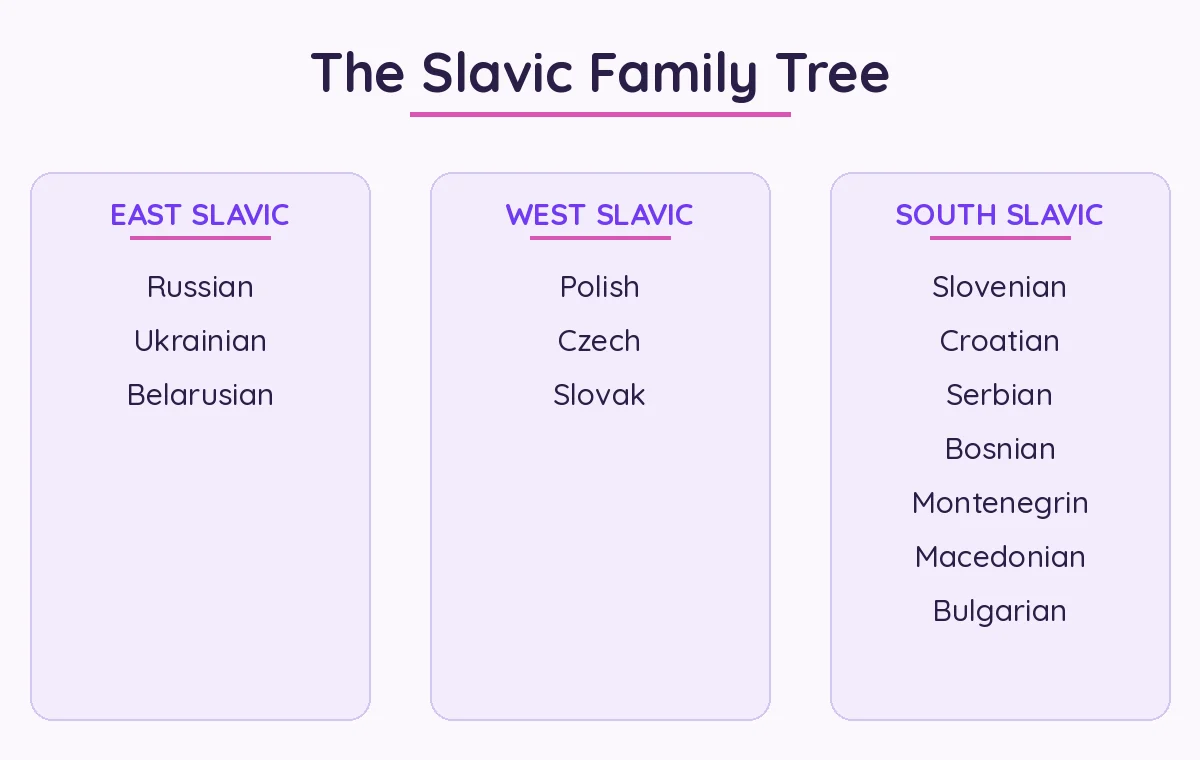
Linguists sort those languages into three branches, and the branch matters more than almost anything else for how similar two languages will be:
- East Slavic: Russian, Ukrainian, and Belarusian.
- West Slavic: Polish, Czech, and Slovak (plus smaller languages like Sorbian).
- South Slavic: Slovenian, Croatian, Serbian, Bosnian, Montenegrin, Macedonian, and Bulgarian.
Two languages in the same branch tend to be close. Two languages in different branches share deep roots but often need real effort, or a lot of guessing, to understand each other.
There is one more split that trips people up: the alphabet. Slavic languages are written in either the Latin or the Cyrillic script, and it does not line up neatly with the branches. Polish, Czech, Slovak, Slovenian, and Croatian use the Latin alphabet. Russian, Ukrainian, Belarusian, Bulgarian, and Macedonian use Cyrillic. Serbian famously uses both, switching between Latin and Cyrillic depending on context. So two languages can sound quite similar and still look completely different on the page.
How Similar Are the Slavic Languages, Really?
Here is our approximate lexical-similarity chart. Read a row against a column: the number is roughly how much of the vocabulary overlaps.
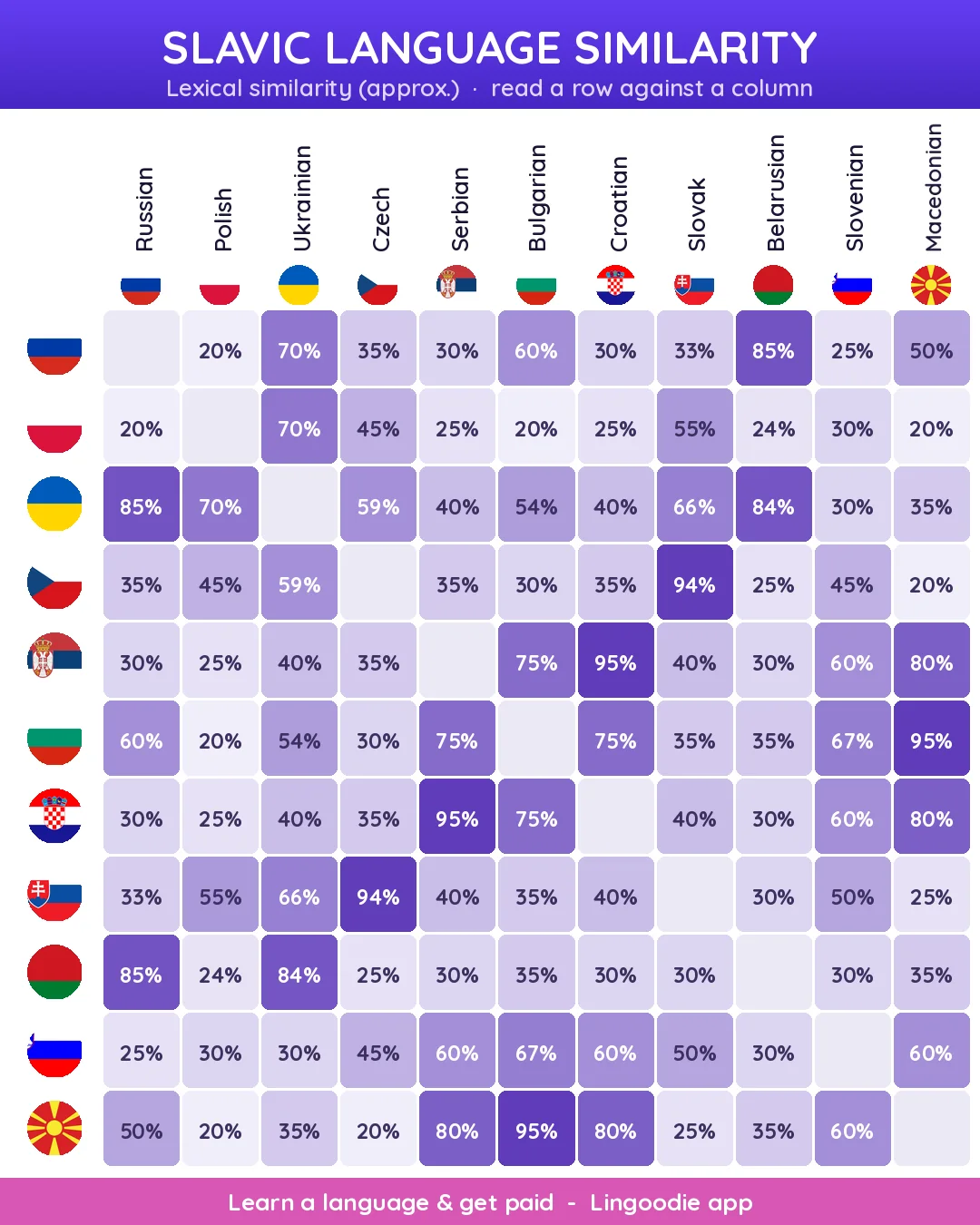 Approximate lexical similarity between Slavic languages. Treat these as directional estimates, not exact figures. Lexical overlap is only one ingredient of whether speakers actually understand each other.
Two important warnings before you read too much into any single number.
First, lexical similarity is not the same as mutual intelligibility. Sharing vocabulary helps, but grammar, pronunciation, false friends, and simple exposure all change whether two people can actually follow each other. Researchers who have measured this properly, most notably Charlotte Gooskens and colleagues at the University of Groningen, do it with listening and reading comprehension tests rather than by counting shared words. Their results line up with the general shape below, but the exact percentages are fuzzier than a tidy grid suggests.
Second, family averages are misleading, and there is a great cautionary tale next door. People often assume Germanic languages are more mutually understandable than Slavic ones. But English and German, both Germanic, understand each other very poorly. English is the odd one out of its family: it dropped most of its grammatical endings and borrowed roughly half its vocabulary from French and Latin. The reason "Germanic" looks intelligible on average is the Scandinavian languages (Danish, Swedish, Norwegian), which are unusually close, not English. The lesson for Slavic: do not trust an average. Look at the specific pair.
With that said, the pattern in the data is real and useful. Same-branch pairs cluster high. Cross-branch pairs drop off. And a few pairs are so close they are barely separate languages at all.
The Superclose Pairs: Almost One Language
A handful of Slavic pairs sit near the top of any similarity measure.
Czech and Slovak are the classic example. They are so mutually intelligible that Czechs and Slovaks generally just speak their own language to each other and understand it fine. In cross-language comprehension studies, Czech and Slovak come out as one of the most mutually intelligible pairs anywhere in Europe. Decades of a shared country (Czechoslovakia) and constant media contact reinforced an already tiny gap.
Serbian, Croatian, Bosnian, and Montenegrin are the other headline case, and here the honest answer is uncomfortable for the map. Linguistically, these are national standard varieties of what used to be called Serbo-Croatian. They share the same grammar, the same core vocabulary, and the same dialect base, and speakers understand one another with no trouble at all. The differences are real but small, roughly like the gap between British and American English, plus the fact that Serbian also uses Cyrillic while Croatian uses Latin. So "is Serbian the same as Croatian" is really a political and cultural question wearing a linguistic costume. If you learn one, you can talk to speakers of all four.
Russian, Ukrainian, and Belarusian are close in the sense that all three are East Slavic and share a lot of roots. Belarusian and Ukrainian are especially close to each other. But this is exactly where the "all Slavs understand each other" myth breaks down, so it deserves its own section.
Russian and Ukrainian: Similar, But Not the Same
Russian and Ukrainian are often assumed to be nearly identical. They are not. They are separate languages with a large shared vocabulary but real differences in sound, grammar, and a surprising number of everyday words. Estimates of shared vocabulary sit somewhere around 60 percent, which is roughly the distance between Spanish and Italian. Two Spanish and Italian speakers can get the gist of each other on paper and struggle in fast conversation, and Russian and Ukrainian are broadly comparable.
There is also an asymmetry that shows up again and again in Slavic: exposure changes everything. Because Russian was long dominant across the region, many Ukrainian speakers have heard a great deal of Russian and understand it well, while a Russian speaker with no exposure to Ukrainian understands noticeably less. That is not a statement about the languages being "better" or "worse", it is about who has been exposed to what. Mutual intelligibility often runs in one direction more than the other.
The same one-way effect appears elsewhere. Slovenian speakers, for instance, tend to understand Croatian better than Croatian speakers understand Slovenian, partly because of exposure and partly because of the specific ways the two languages differ.
Which Slavic Language Is Easiest to Learn?
If your goal is the gentlest entry point as an English speaker, two names come up more than any others: Bulgarian and Macedonian.
The reason is grammar. Most Slavic languages have a case system, where nouns, adjectives, and pronouns change their endings depending on their role in the sentence. Russian, Polish, and Czech have six or seven cases. Slovenian keeps not just cases but also the dual, a special grammatical form for exactly two of something, which almost every other Slavic language has dropped. That case machinery is the single biggest hurdle for English speakers, because English barely inflects at all.
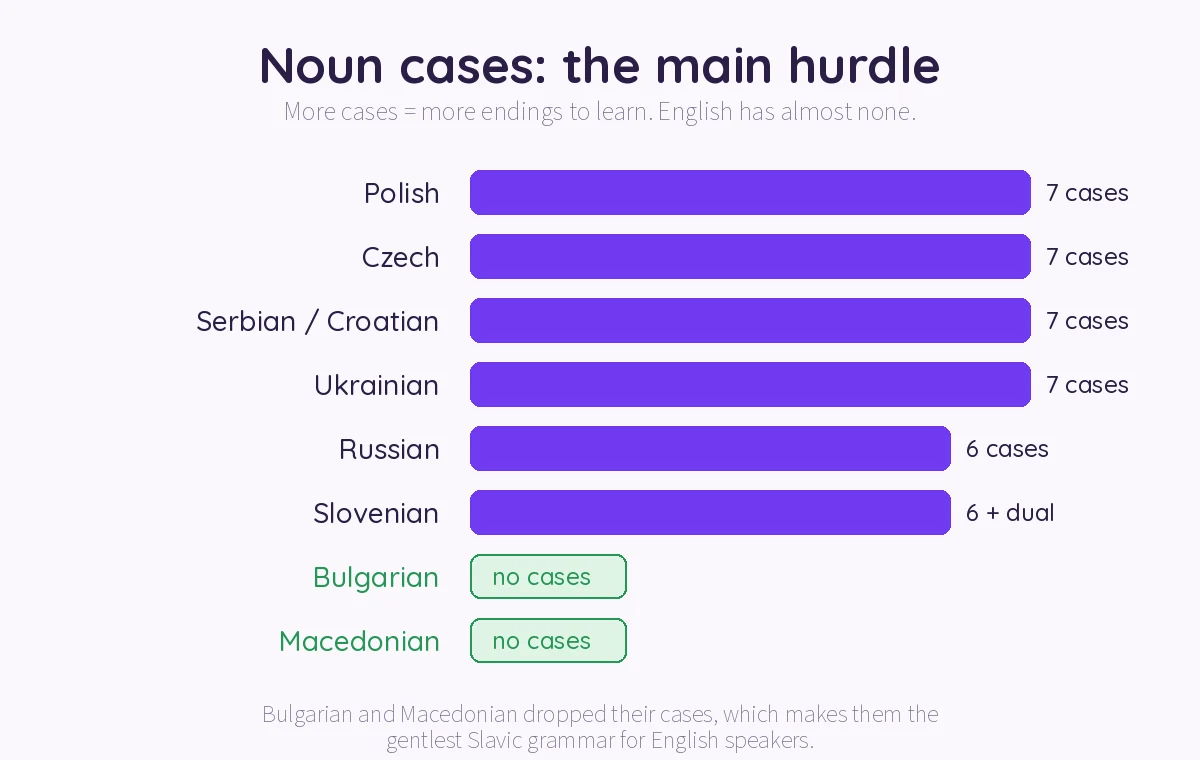
Bulgarian and Macedonian are the outliers: over the centuries they largely lost their noun cases, which makes their grammar feel closer to what an English speaker expects. The trade-off is that they are written in Cyrillic, so you take on a new alphabet in exchange for simpler grammar. Learning the Cyrillic script, though, is genuinely fast. Most learners are reading slowly within a week or two.
A few honest notes for the other big options:
- Russian has the largest number of speakers and the most learning resources by far, but a full six-case system and a Cyrillic alphabet.
- Polish has a reputation for difficult pronunciation and spelling, plus seven cases, though English speakers get a head start from the Latin alphabet.
- Croatian and Serbian open the door to all of the former Serbo-Croatian region at once, which is a lot of reach for one language.
- Slovenian is spoken by only about two million people, but it is a beautiful, distinctive language, and its dual number is one of the most charming features in Europe. We wrote a whole piece on the Slovenian dual if you want to see it in action, and on Slovenia's astonishing 48 dialects.
If you are weighing Slavic against other language families for difficulty, our guides to the easiest languages to learn and the hardest languages to learn put all of this in context.
The Best Part: One Slavic Language Unlocks the Others
Here is the encouraging flip side of everything above. Because the Slavic languages share so much deep structure, the same cases, similar word-building, thousands of common roots, learning one gives you a real head start on the rest of its branch, and a running start on the others.
Learn Croatian and Serbian, Bosnian, and Montenegrin come almost for free, with Slovenian and Bulgarian within reach. Learn Russian and you will find Ukrainian and Belarusian far less foreign than they looked. Learn Czech and Slovak is nearly a bonus language. Slavic learners often describe a moment, usually a few months in, when a second Slavic language suddenly stops looking like a wall and starts looking like a dialect of something they already know.
That compounding is exactly why picking one and actually sticking with it matters more than agonising over which one is theoretically easiest. The best Slavic language to learn is the one connected to your reasons: your heritage, the people you want to talk to, the country you are drawn to, or simply the one whose sound you like most.
Learn a Slavic Language, and Get Paid to Do It
Lingoodie teaches four Slavic languages, Russian, Ukrainian, Slovenian, and Croatian, and it is built around the one thing that actually determines whether you get anywhere: showing up every day. You complete short lessons, earn points, and cash out real money via Revolut or PayPal, available in 200+ countries. The rewards are small on purpose. They are a genuine nudge to keep practising through the case tables and the new alphabet, which is precisely where most Slavic learners quit.
If you have been circling the Slavic languages for a while, pick the one that pulls at you and start this week. A few minutes a day, with a small reward attached, beats a perfect study plan you never open.
Download Lingoodie free on Google Play or the App Store, and learn a Slavic language while earning real cash.