Romance Languages: How Similar Are They, and Which One Should You Learn?

If you have ever read a Portuguese menu using nothing but school Spanish, or wondered why French looks so familiar on paper and sounds like a completely different animal out loud, you have already run into the strange arithmetic of the Romance languages. They are close enough to flatter you and different enough to trip you.
Around a billion people speak one of them. They all descend from the same ancestor, and that shared inheritance is the single best argument for learning one: the second one costs a fraction of the first. This guide walks through the family tree, looks at how similar the languages actually are, sorts out the famous cases, and finishes with the practical question of which one to start with. Lingoodie teaches four of them, so there is skin in the game here, but the honest picture comes first.
The Romance Family Tree, in Plain Terms
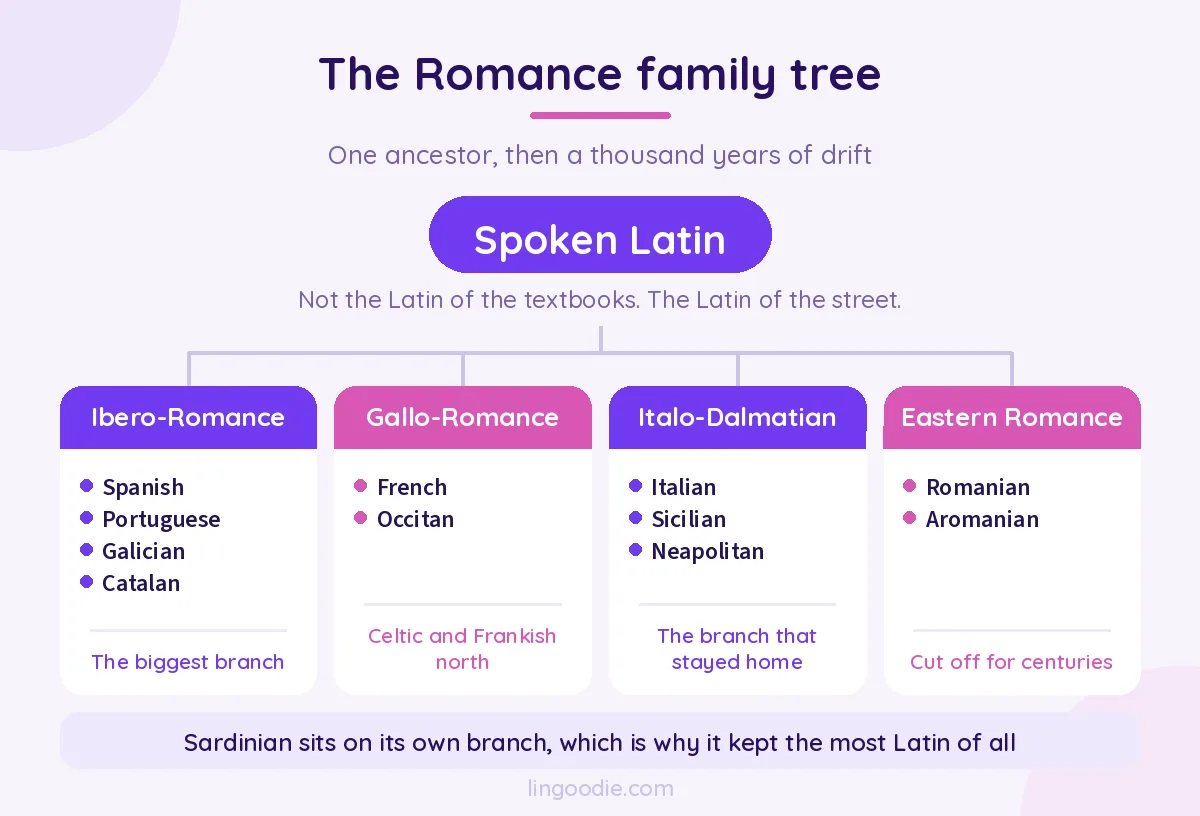
Every Romance language is a descendant of Latin. Not the polished Latin of Cicero and the textbooks, but the ordinary spoken Latin that soldiers, traders and farmers carried across the empire. When central authority faded, those regional versions kept drifting, and after a thousand years or so of drift you get the languages on the map today.
Linguists sort them into branches, and the branch tells you most of what you need to know about how close two of them will feel:
- Ibero-Romance: Spanish, Portuguese, Galician and Catalan. The biggest branch by speaker count, by a wide margin.
- Gallo-Romance: French and Occitan. Latin filtered through a Celtic substrate and then a heavy Frankish influence from the north.
- Italo-Dalmatian: Italian, Sicilian, Neapolitan and their neighbours. The branch that stayed closest to home.
- Eastern Romance: Romanian, plus smaller relatives like Aromanian, cut off from the rest of the family for centuries.
One name is missing from that list on purpose. Sardinian sits on its own branch. It broke away from the rest earliest, and that isolation is exactly why it is usually described as the most conservative Romance language, the one that kept the most Latin. There is also a smaller Rhaeto-Romance group, including Romansh in Switzerland and Friulian in northern Italy, which rarely makes it into the popular version of the family tree.
How Similar Are They, Really?
The usual way to answer this is lexical similarity: the share of core vocabulary two languages have in common. It is a blunt instrument, but it is the closest thing to a shared yardstick, and Ethnologue publishes figures for most of the major pairs.
Spanish and Portuguese come in around 89 percent. French and Italian, which feel like an odd couple to most learners, sit at roughly the same 89 percent. Italian and Catalan land near 87, Spanish and Catalan near 85, and Spanish and Italian around 82. Romanian, the branch that spent centuries surrounded by Slavic and Hungarian speakers rather than Romance ones, sits lowest against everything else, in the low seventies.
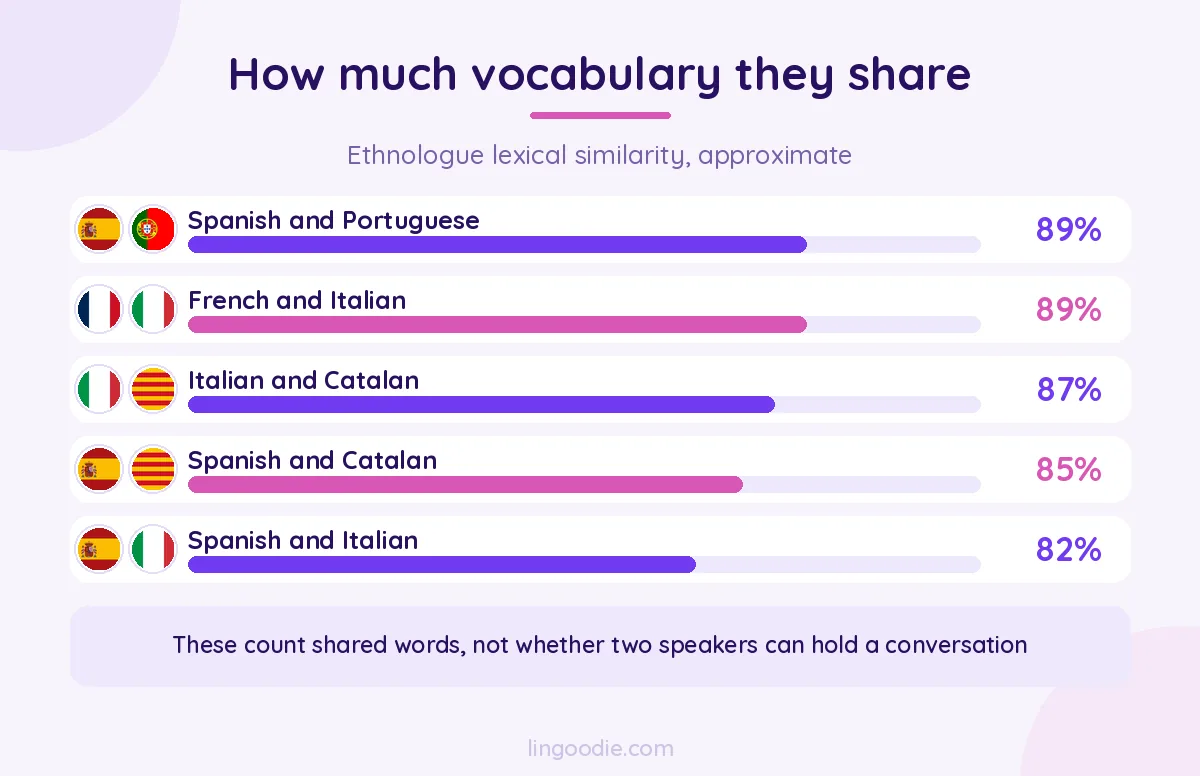
Read those numbers with one caveat firmly in mind: they count words, not conversations. Two languages can share most of their vocabulary and still leave their speakers staring at each other, because the shared words arrive wrapped in different sounds, different rhythm and different grammar. Lexical similarity tells you how much of the raw material overlaps. It does not tell you whether you will follow a fast-talking stranger in a market.
Spanish and Portuguese: The Pair Everyone Asks About
This is the pair that generates the most arguments, and the honest answer is that the relationship is not symmetrical.
On paper, the two are remarkably close. A Spanish speaker can usually get the gist of a Portuguese newspaper on a first read, and the reverse is even easier. Out loud, the traffic runs mostly one way: Portuguese speakers tend to follow spoken Spanish noticeably better than Spanish speakers follow spoken Portuguese.
The reason is phonology. Portuguese carries a much larger vowel inventory, including nasal vowels and heavily reduced unstressed vowels, while Spanish runs on a tidy five-vowel system. For a Portuguese speaker, Spanish sounds are effectively a subset of familiar territory. For a Spanish speaker, Portuguese is full of sounds with no home in their own system, and words compress in ways that make them hard to catch at speed. Exposure matters too, and Brazilian media travels widely, so this is a tendency rather than an iron rule.
The same asymmetry logic explains Galician, which sits between Spanish and Portuguese geographically and linguistically and is close enough to Portuguese that the two are sometimes described as varieties of a single historical language.
Reading Is Easy. Listening Is the Hard Part.
If there is one thing to take away before you start, it is this: the Romance family is generous on paper and merciless out loud.
The generosity comes from a shared alphabet and a shared word stock. Look at the word for night across four of them: noche, notte, nuit, noite. Anyone who reads one can make a decent guess at the rest. Whole categories of vocabulary line up like this, especially the formal and academic register, which is also why English speakers get a free ride on Romance vocabulary through centuries of borrowing.
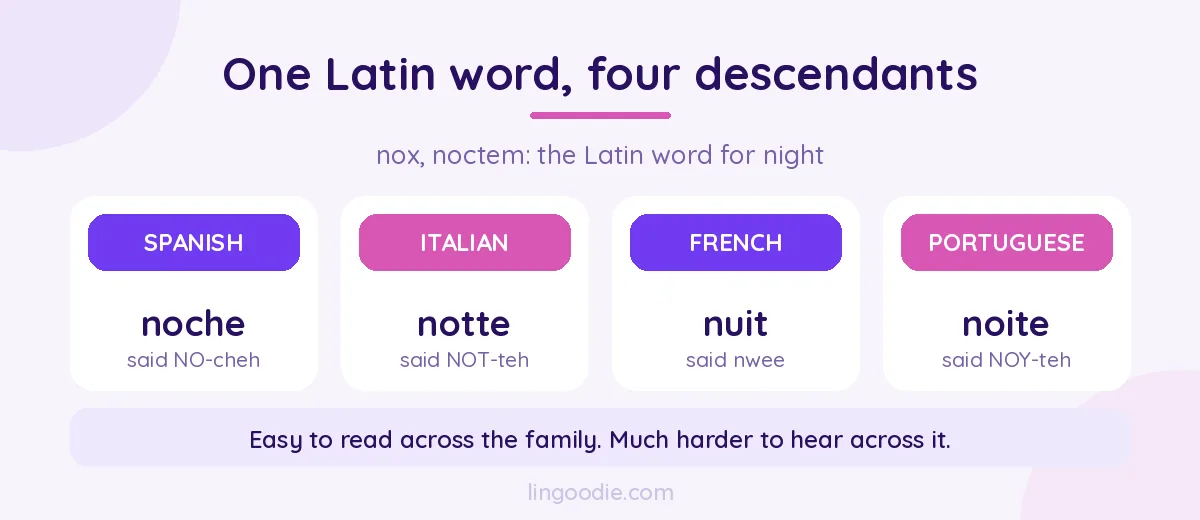
The mercilessness comes from what each language did to those words afterwards. French buried most of its final consonants and a good share of its vowels, so the gap between the written and the spoken word is enormous. Portuguese swallows unstressed vowels and runs words together. Italian, by contrast, is almost boringly faithful to its spelling, which is a large part of why learners find it comfortable.
This is why the most common learner experience in this family is a strange split: reading progress that feels almost too fast, and listening progress that feels stuck for months. Both are normal. The fix is simply more ears-on time than you think you need, early.
The False Friends That Catch Everyone
Shared roots also share traps. Because the languages look so similar, learners import words wholesale, and a handful of them mean something else entirely on the other side of the border.
- burro is a donkey in Spanish and butter in Italian.
- largo means long in Spanish and wide in Italian.
- salir means to go out in Spanish and to make dirty in French.
- embarazada in Spanish means pregnant, not embarrassed, which is the single most reliably reported learner disaster in the language.
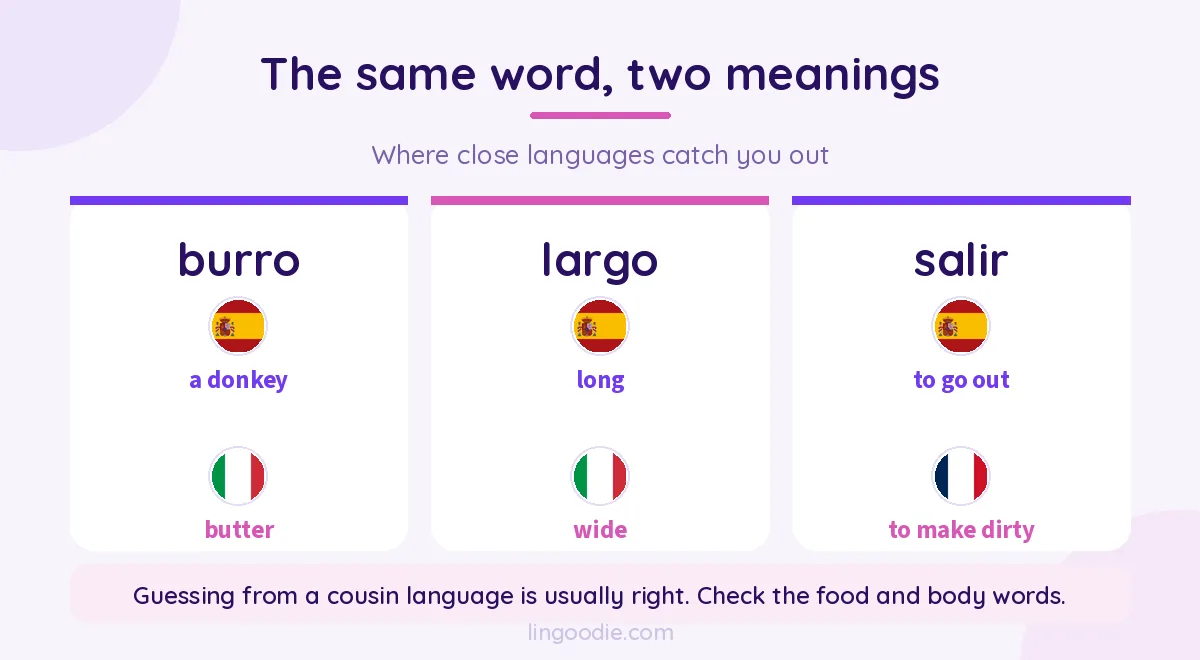
None of this is an argument against leaning on cognates. Guessing from a related language is one of the most efficient things a learner can do, and it is right far more often than it is wrong. It just means the guesses need checking, especially the ones about food, bodies and emotions, which is where the family's traps cluster. If you want a longer list for one language, we went deep on the Spanish ones in Spanish false friends.
Which Romance Language Is Easiest to Learn?
For English speakers, the whole family is on the easy end of the scale. The US State Department's Foreign Service Institute, which has been training diplomats since 1947 and tracking how long each language takes, puts every major Romance language in its easiest category.
Within that category there are still differences. Spanish, Italian, Portuguese and Romanian are listed at 24 weeks of intensive training, commonly quoted as roughly 600 class hours. French is listed at 30 weeks, closer to 750 hours, and the extra time is not about grammar. It is about the distance between how French is written and how it is said.
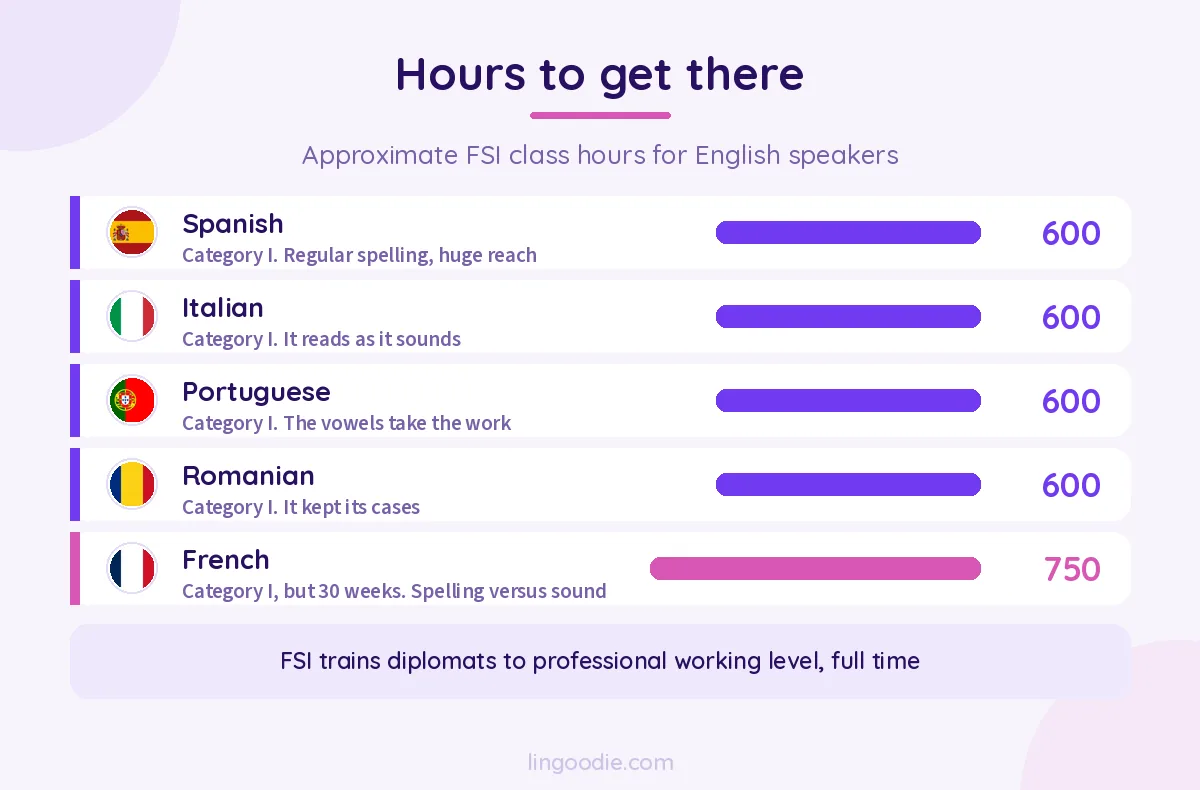
A practical read of that table:
- Spanish is the default for a reason. Predictable spelling, enormous speaker base, and more free material than any other language on earth.
- Italian is the friendliest to your ear. Words are pronounced as written, which makes early listening far less punishing.
- Portuguese costs the same on paper and a little more in practice, because of the vowel reduction discussed above. Brazilian Portuguese is usually the gentler starting point.
- French takes longer to hear, and rewards patience with an enormous body of literature, film and academic writing.
- Romanian looks like the outlier and is worth a word of warning: it kept a case system the others dropped, so the grammar asks more of you even though the vocabulary is familiar.
If you are weighing this against other families entirely, we compared the full field in the easiest language to learn.
One Romance Language Unlocks the Rest
Here is the part that makes this family worth committing to. The 600 hours is only the price of the first one.
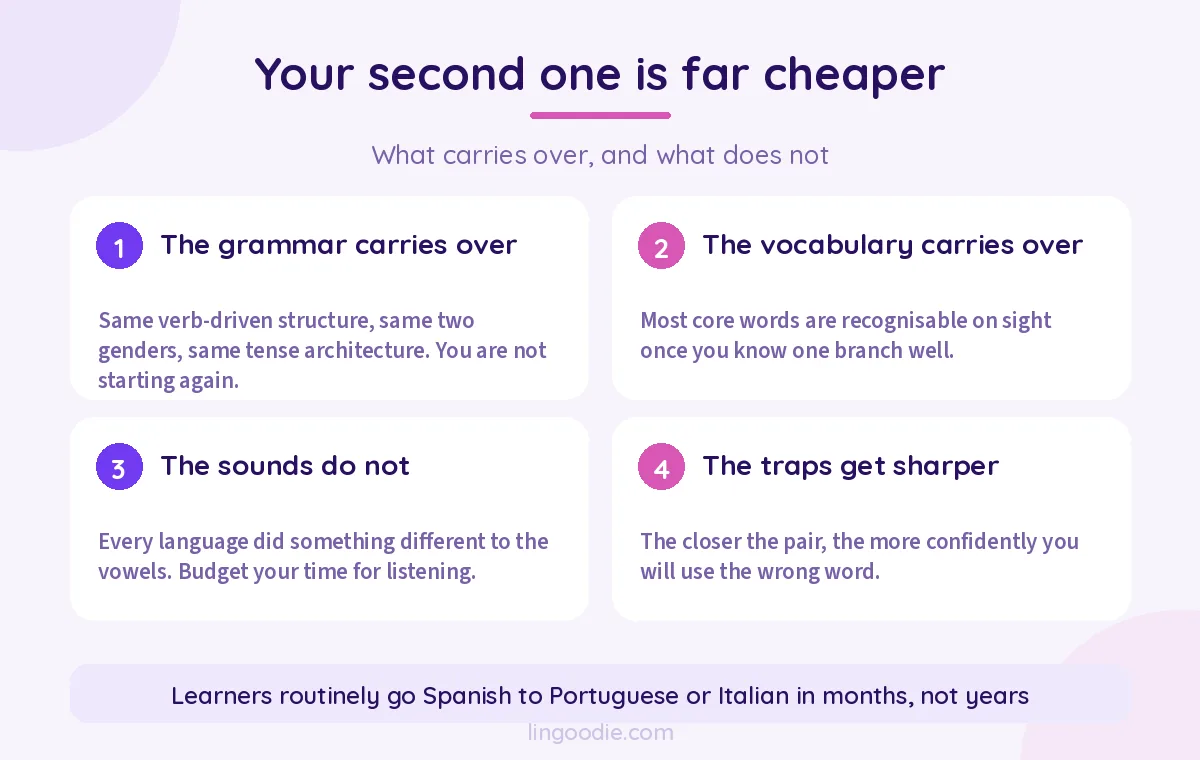
Once you have a Romance language at a solid intermediate level, you have internalised most of the machinery the others run on: the same verb-heavy sentence structure, the same two-gender noun system, the same tense architecture, the same enormous shared vocabulary. Learning a second one is far less about starting over and far more about mapping what you already know onto slightly different sounds and endings. Learners routinely describe going from Spanish to Portuguese or Italian in months rather than years.
That is the same pattern we found when we looked at the Slavic languages, where one language quietly unlocks a whole branch. The Romance family is simply the version of that deal with the biggest possible payoff, because the languages involved are spoken across Europe, most of Latin America, and large parts of Africa.
So the honest advice is: stop agonising over which one to pick. Pick the one whose films you want to watch, whose family you married into, or whose country you keep going back to. The family's structure means the choice matters far less than the commitment.
Learn a Romance Language, and Get Paid to Do It
Most of the difficulty in this family is not conceptual. It is showing up on the days when it is boring. That is the specific problem Lingoodie was built for.
Lingoodie teaches Spanish, French, Italian and Portuguese, along with several other languages, and it pays you for the time you put in. Every lesson you complete earns Lingoodie Points, and those points convert into real money that you can cash out through PayPal or Revolut. It is not a fortune, and we are careful never to pretend otherwise. What it is, reliably, is a reason to open the app on the days you would have skipped, which is exactly where most language learning quietly dies.
If earning while you study is the part that interests you, we broke down how that works across the whole category in apps that pay real money.
Ready to pick one and start? Download Lingoodie free on Google Play or the App Store, choose your Romance language, and put the first hour in today. The second language in this family will thank you.