Germanic Languages: How Similar Are They, and Where Does German Fit?
Most English speakers learn at some point that English is a Germanic language, file it away as a piece of trivia, and never look at what it actually means. It means quite a lot. It means the language you already speak is a cousin of German, Dutch, Swedish and Icelandic, and that a large part of the work of learning any of them is already done.
It also means something less obvious: English is not sitting where most people assume on that family tree. This guide walks through the branches, looks at how close the languages really are, sorts out the famous Scandinavian question, and ends with the practical case for German, which is the one Lingoodie teaches and the one with the most leverage behind it.
The Germanic Family Tree, in Plain Terms
Every Germanic language descends from Proto-Germanic, spoken somewhere around the Baltic and the North Sea a couple of thousand years ago. It split into three branches, and one of them is gone entirely.
- West Germanic: English, German, Dutch, Afrikaans, Frisian, Yiddish and Luxembourgish. Easily the most crowded branch, and the most spoken.
- North Germanic: Swedish, Danish, Norwegian, Icelandic and Faroese. The Old Norse side of the family, carried out of Scandinavia by the Viking expansion.
- East Germanic: Gothic and its relatives. Every language on this branch is extinct, though Gothic survives in written form thanks to a fourth-century Bible translation.
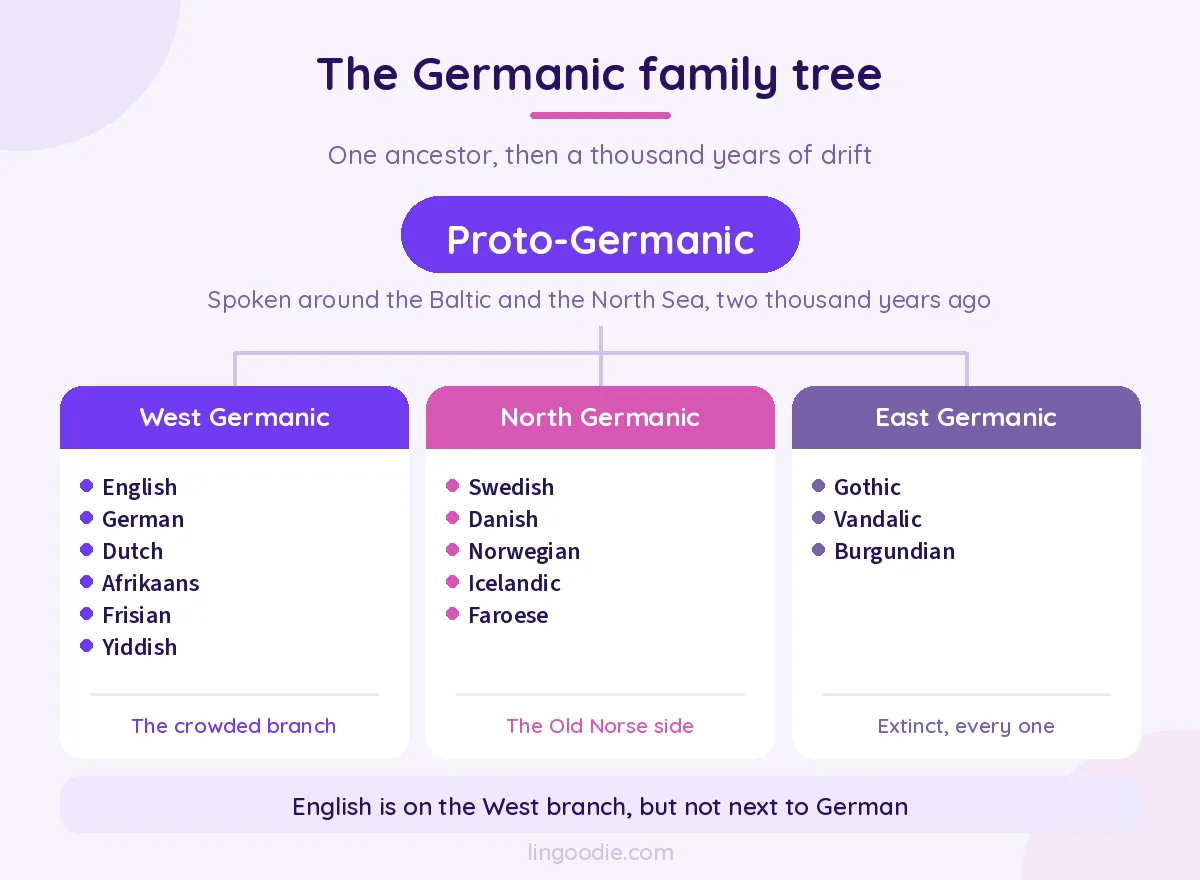
The split matters for learners. Within a branch, languages tend to be close enough that one gives you real traction on the next. Across branches, you keep the deep grammatical instincts but lose a lot of the vocabulary shortcuts.
It is worth noticing how small the family looks and how large it is in practice. There are only about fifteen living Germanic languages, far fewer than the Romance or Slavic counts, but they include the most widely spoken second language on earth and the native languages of most of northern Europe. The branch punched well above its weight, largely by travelling.
Where English Actually Sits
Here is the part that surprises people. English's closest living relative is neither German nor Dutch. Setting aside Scots, which is closer still and whose status as a separate language is its own long argument, the nearest branch is Frisian, spoken by a few hundred thousand people along the North Sea coast of the Netherlands and Germany.
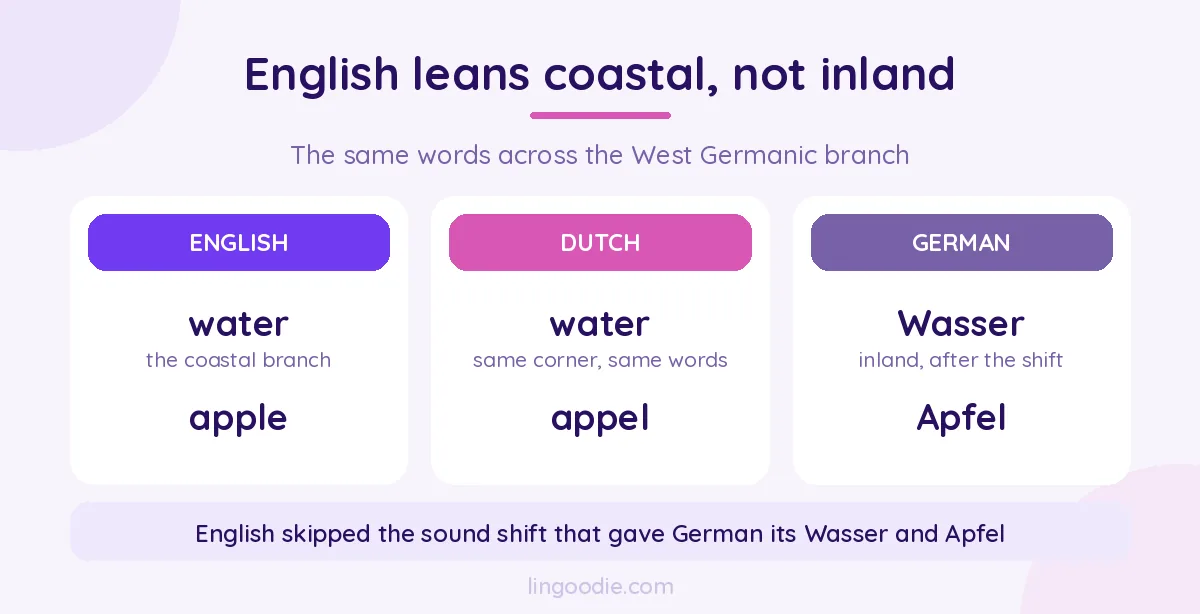
English, Frisian and Dutch all come out of the same coastal corner of the West Germanic world. High German developed inland and went through a sound shift that English never experienced, which is why so many pairs line up neatly between English and Dutch and then go sideways once you reach German. Compare English water, Dutch water, German Wasser. Or English apple, Dutch appel, German Apfel.
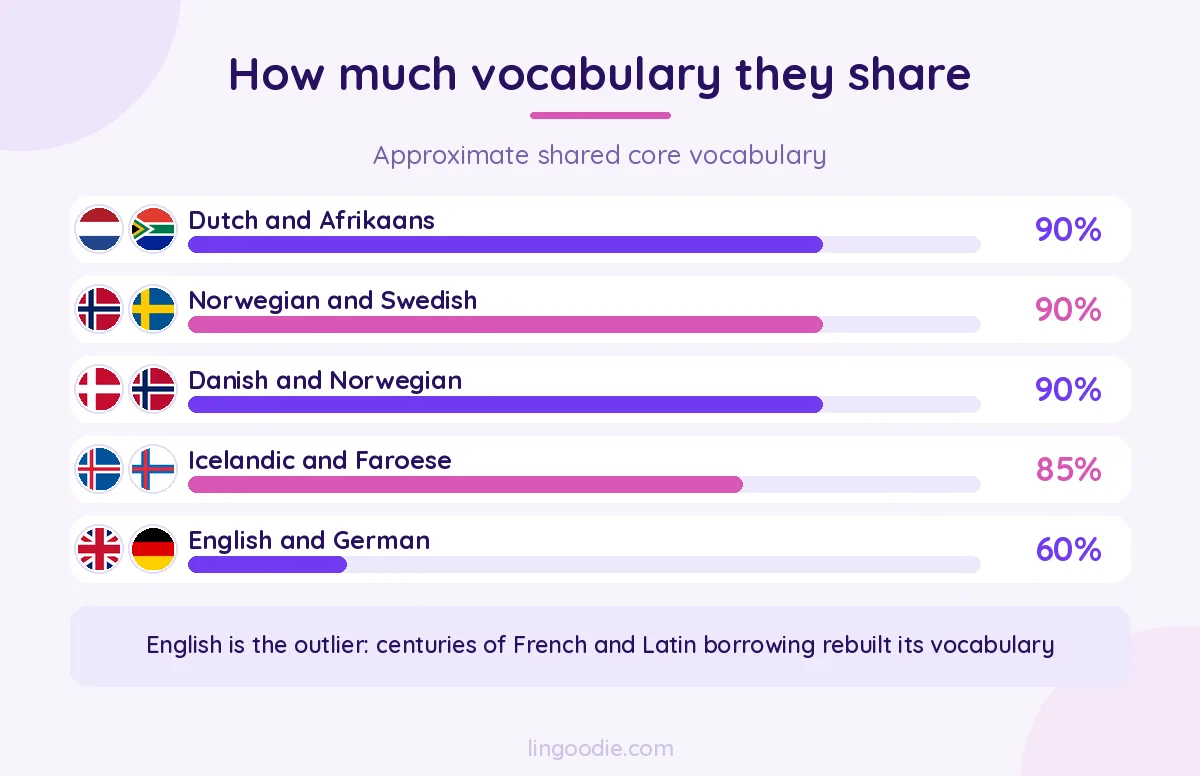
The numbers back up the intuition, with a caveat. Ethnologue puts English and German at around 60 percent shared core vocabulary, which is low for two languages in the same branch. English is genuinely the odd one out here: a thousand years of French and Latin borrowing rebuilt a huge share of its vocabulary, so it looks less Germanic than its grammar says it is. Estimates for English and Dutch run a little higher, but they come from different sources and should be treated as a direction rather than a precise gap.
How Close Are the Rest of Them?
Away from English, the family gets much tighter. Dutch and Afrikaans sit around 90 percent, which is unsurprising given that Afrikaans is a daughter language of seventeenth-century Dutch that simplified its grammar along the way. Dutch speakers can read Afrikaans almost cold.
The Scandinavian three, Norwegian, Swedish and Danish, cluster at roughly 85 to 90 percent. Icelandic and Faroese stay close to each other, around 85 percent, and hold the rest of the family at arm's length. Both stayed on islands and kept grammar the mainland dropped, which is why Icelandic speakers can still read the medieval sagas with far less help than an English speaker needs for Chaucer.
The Scandinavian Middle Ground
Scandinavia runs on something linguists call semi-communication, a term coined by Einar Haugen back in 1966: speakers of Norwegian, Swedish and Danish frequently just use their own language with each other and manage.
Norwegian sits in the middle of that arrangement, and it is the best-positioned of the three. Written Norwegian is close to Danish, a legacy of centuries of Danish rule, while spoken Norwegian is much closer to Swedish. The result is that Norwegian speakers tend to understand both neighbours better than those neighbours understand each other.
Danish is the hard one to hear. It looks familiar on the page to a Norwegian or a Swede and then sounds almost nothing like it reads, thanks to heavy consonant weakening and a compressed, swallowed delivery. Research on this is fairly consistent: spoken Danish is measurably harder for its neighbours to decode than the other direction.
For a learner, this has a practical consequence that rarely makes it into the brochures. If your goal is to be understood across all three countries, Norwegian is the efficient bet. If your goal is a specific job, city or family, pick that country's language and accept that the other two will come cheap afterwards.
The Traps Sit Where the Languages Overlap
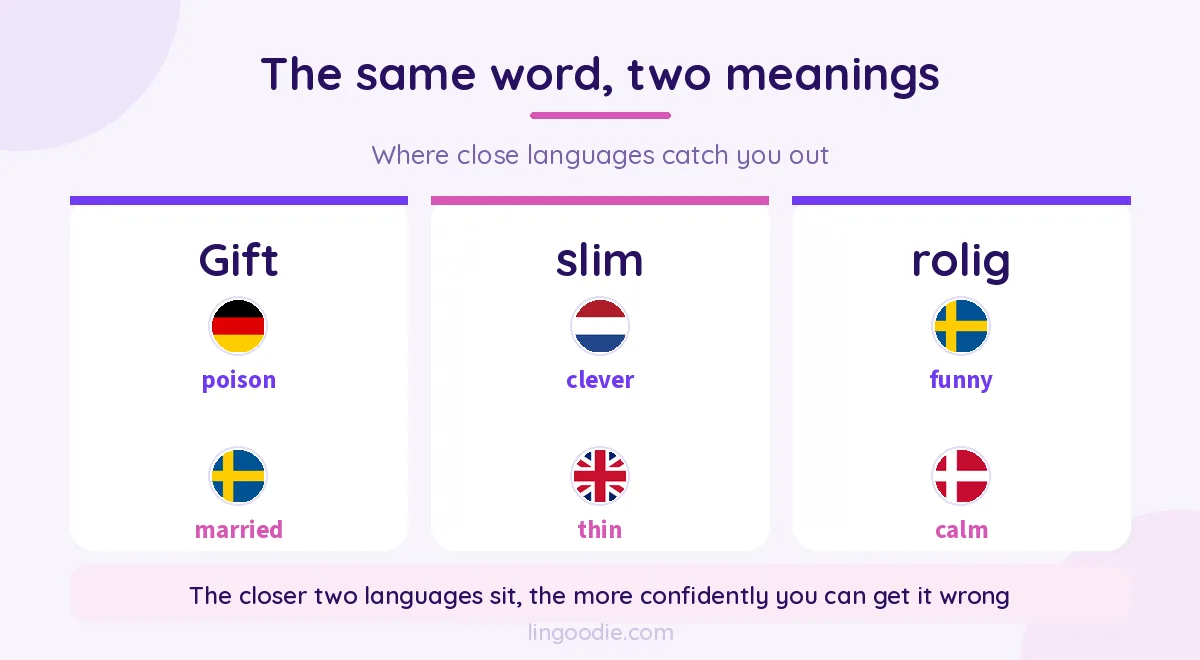
The closer two languages sit, the more confidently you can get things wrong. Germanic false friends are a genre in their own right.
- Gift means poison in German. In Swedish, gift means married, and also poison, which says something about someone's sense of humour.
- slim means clever in Dutch, not thin.
- rolig means funny in Swedish and calm in Danish, so a Swede describing a party and a Dane describing a party may not be describing the same evening.
- bekommen in German means to receive, not to become, which catches nearly every English speaker at least once.
Is German the Hard One?
Sort of, and less than its reputation suggests.
The Foreign Service Institute puts Dutch, Norwegian, Swedish and Danish in its easiest category, roughly 600 class hours for an English speaker. German sits one tier up at around 900 hours. Icelandic, which kept four cases and a thicket of irregular forms, is usually quoted around 1,100.
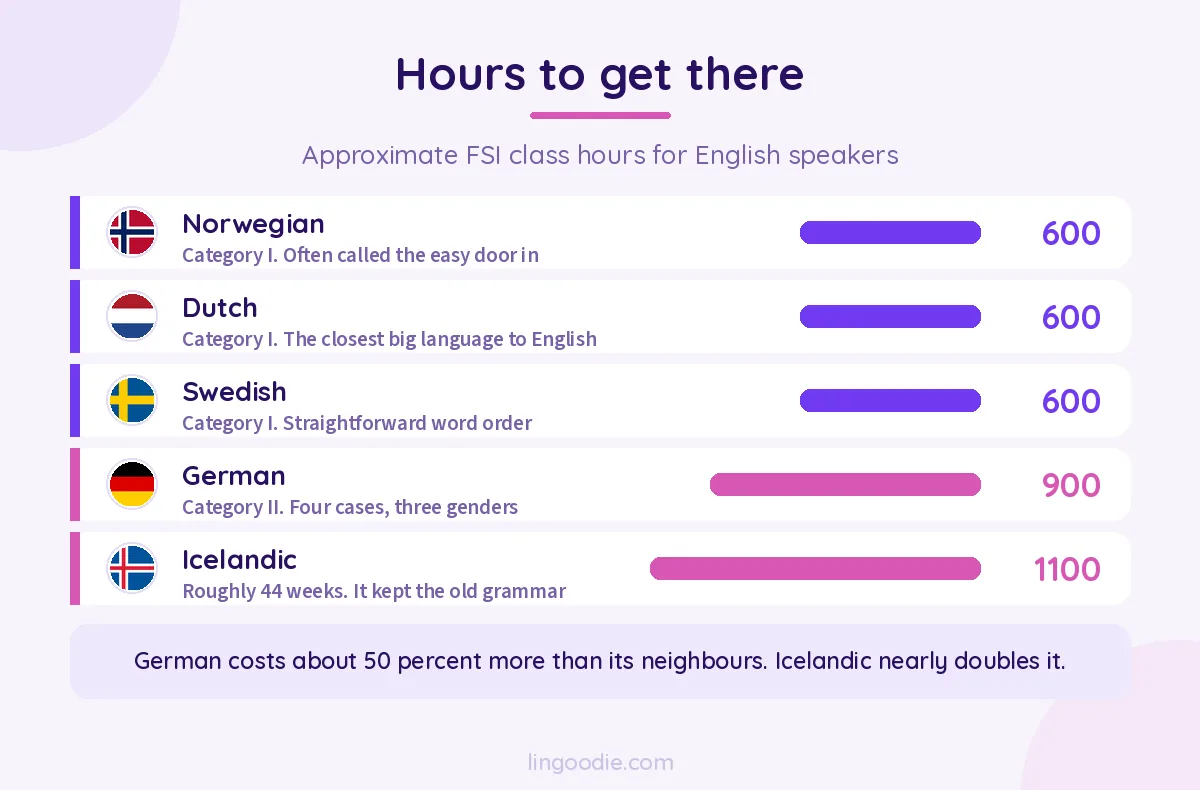
The extra 300 hours for German buy you three specific obstacles: four cases, three genders that are not reliably predictable from meaning, and word order rules that push verbs to the end of subordinate clauses. None of them are conceptually difficult. All of them require drilling, because they are decisions you have to make correctly in real time while also trying to remember a noun.
What the number does not capture is how much English gives you for free. Core German vocabulary is deeply familiar once you know where to look, sentence rhythm is intuitive to an English ear, and the sound system holds very few surprises. Most learners who quit German quit at the case tables, not at the pronunciation.
Why German Is the Highest-Leverage One to Learn
If you are going to spend the hours, German is the pick with the most behind it, for four reasons.
It has the most speakers in Europe. German is the most widely spoken native language in the European Union, and it is an official language in Germany, Austria, Switzerland, Luxembourg, Liechtenstein and parts of Belgium and Italy.
It is the economic centre of the family. Germany is the largest economy in Europe, which makes German the Germanic language with the clearest professional return.
It sits in the middle of the branch. German gives you a substantial head start on Dutch, and a real one on Yiddish and Luxembourgish. Starting with Dutch is easier, but starting with German covers more ground.
The grammar it demands is transferable. Learning to handle cases and flexible word order in German makes the Nordic languages feel almost frictionless afterwards, and it makes Slavic grammar considerably less alien if you ever go that way. We wrote about that family in Slavic languages.
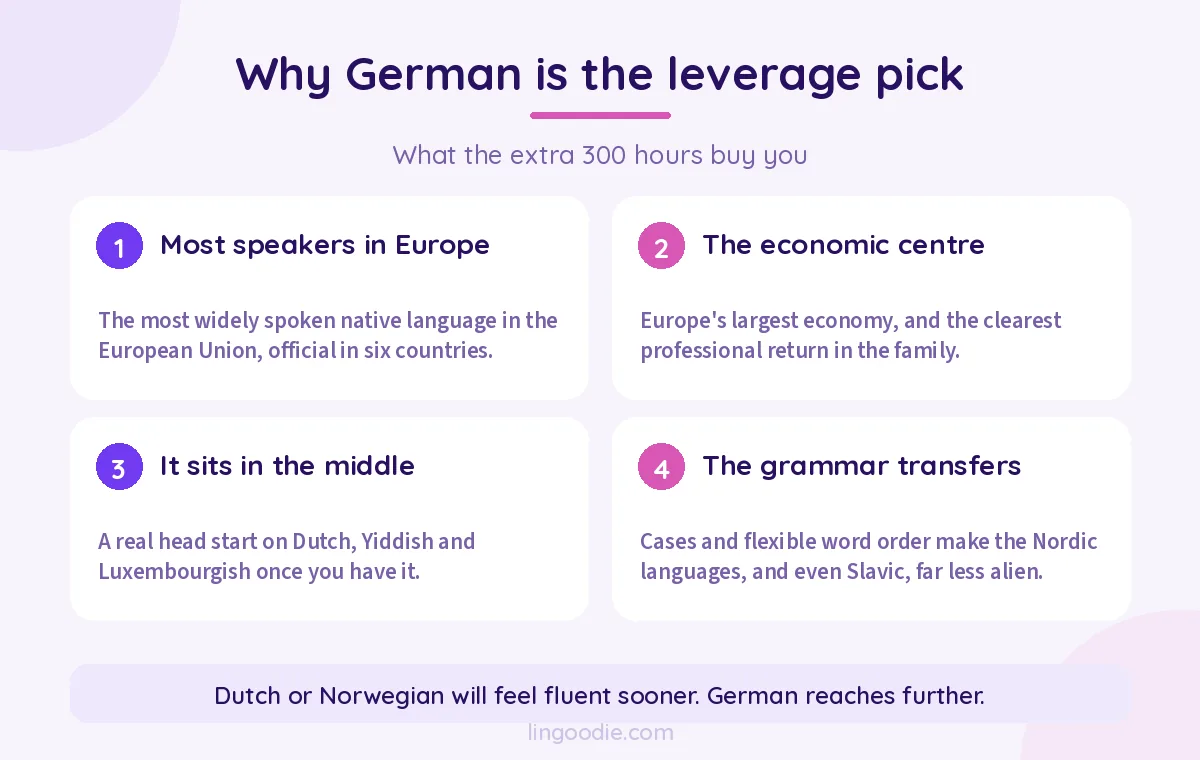
There is a reasonable counter-argument, and it is worth stating fairly. If your goal is to feel fluent quickly, Dutch or Norwegian will get you there faster, and both are genuinely pleasant first Germanic languages for an English speaker. The case for German is not that it is the easy one. It is that the hours convert into the most usable reach, and that the difficulty is front-loaded: the case system is brutal for a few months and then quietly stops being the thing you think about.
If you want the practical version rather than the linguistic one, we covered study methods and resources in the best way to learn German and compared the tools in the best app to learn German.
Learn German, and Get Paid to Do It
The honest obstacle with German is not the cases. It is the eighteen months of ordinary weekday sessions between deciding to learn it and being able to use it. That is the specific problem Lingoodie was built for.
Lingoodie teaches German alongside Spanish, French, Italian and Portuguese, and it pays you for the time you put in. Every lesson earns Lingoodie Points, and those points convert into real money you can cash out through PayPal or Revolut. Nobody is retiring on it, and we will not pretend otherwise. What it does is give you a concrete reason to open the app on the evenings you would have skipped, and consistency is the entire game with a Category II language.
Download Lingoodie free on Google Play or the App Store, start with German, and see how much of it you already recognise. Your English is doing more work than you think.